

A Glorious Legacy Fading into History
Master Mohammad Afzal
The world-famous saffron fields of Pampore, once the pride of Jammu and Kashmir and a vital part of its cultural and economic heritage, are witnessing a tragic and steady decline. This centuries-old industry, deeply rooted in the soil and soul of Kashmir, is now shrinking rapidly in both scale and relevance — a situation that demands immediate and serious attention from policymakers and stakeholders alike.
A Steep Decline in Cultivation
The once-vibrant saffron fields stretching across Pampore and its surrounding villages have been dwindling year after year. The area under cultivation has decreased drastically, driven by poor yields, climate challenges, lack of irrigation, and declining interest among younger generations.
Once considered the backbone of the rural economy — especially in Pulwama district’s villages such as Konibal, Samboora, Chandhara, Wooyan, Khrew Shar, Bathen, Lethpora, Patal, Ladhoo, and in parts of Srinagar district including Khanmoh, Zawoora, Zewan, and Chrar-e-Sharief — saffron cultivation is now reduced to a struggling, often overlooked occupation.
Thousands of educated youth who once depended on saffron farming for livelihood are now abandoning the tradition due to unsustainable returns.
Low Yield and Low Prices: A Vicious Cycle
Several interconnected factors have led to the sector’s downfall:
Low productivity and erratic yields due to climate variability and lack of soil health management.
Falling market prices, with no protective pricing system or MSP (Minimum Support Price).
Inadequate irrigation infrastructure, making crops dependent on increasingly erratic rainfall.
Lack of government incentives and scientific support for growers.
As a result, many farmers are now either abandoning saffron fields or considering switching to alternative crops or even selling their land for non-agricultural use — a move further hastened by the growing pressure of urbanization.
—
The National Saffron Mission: A Missed Opportunity
In response to the industry’s decline, the National Saffron Mission was launched during the tenure of the Mufti-led coalition government. Its goal was to rejuvenate saffron cultivation through scientific interventions, irrigation projects, and infrastructure support.
Despite sincere efforts by former MLA Pampore Mir Zahoor, then Agriculture Minister Jinab Ghulam Hassan Mir, and committed officers from SKUAST-K and the Agriculture Department, the mission largely failed to deliver lasting results.
Mismanagement, poor implementation, lack of follow-up, and the government’s deaf ear to the ground realities rendered the mission ineffective. What could have been a turning point became another example of a well-intentioned policy lost in execution.
—
Saffron: Kashmir’s Identity and the World’s Treasure
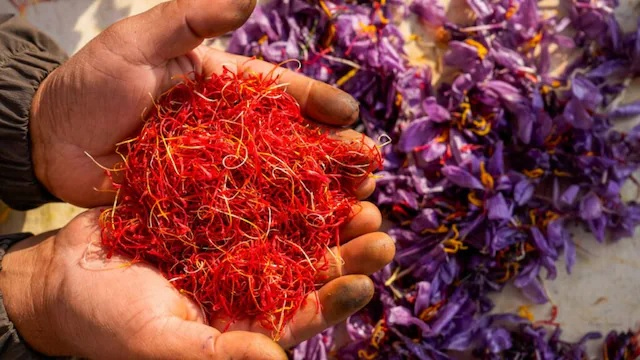
Saffron is not just a crop — it is Kashmir’s pride, a symbol of its heritage, and a vital economic commodity. Known as the costliest spice in the world, it is used in expensive medicines, food, perfumes, and traditional remedies.
Kashmiri saffron, known for its deep color and strong aroma, has no match globally. Its fields, blooming with vibrant purple flowers during autumn, add to the scenic and cultural beauty of the Valley, attracting tourists, artists, and photographers alike.
The decline of saffron is not merely an agricultural concern; it represents a cultural erosion and economic loss with long-term consequences.
—
A Call for Revival: What Needs to Be Done
If serious steps are not taken now, saffron cultivation may soon become a part of Kashmir’s past — remembered only in books and photos. However, revival is still possible, provided the government and community act together.
Key steps that must be taken include:
Free distribution of high-quality saffron seeds to cultivators.
Direct financial assistance and crop insurance to protect farmers from losses as was done in 2002 by the coalition government.
Modern irrigation systems (sprinklers and drip) to ensure water availability by making borewells functional market regulation and price support mechanisms to ensure fair compensation
Training and awareness programs to real farmers to help them adopt better practices .
Moreover considering population growth and the housing crisis the blanket ban on residential construction in saffron zones should be reviewed and slightly relaxed with strict regulations and zoning to strike a balance between agricultural and development.
The decline of saffron industry is not just the loss of the crop it is the fading of legacy that defined generations if ignored further this golden tradition may soon exist only in museum displays and nostalgic memories.
The government must act urgently, sincerely strategically so that this golden legacy can be protected and the saffron fields of Pampore can be seen shining again.
 Follow our WhatsApp channel
