

Jang S Verman
Harjitsingh12041955@gmail.com
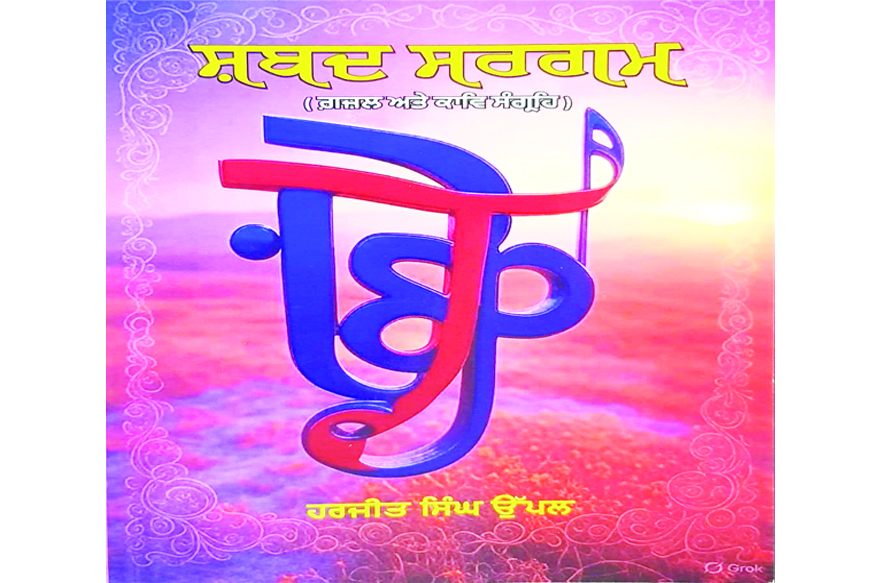
Name of Book : ‘Shabad Sargam’
Author : Harjit Singh Uppal
The Persian poetical expressions in the form of Ghazal, was born during 7th century in Arabia. It came into Indian sub-continent during 12th century due to the influence of Sufi mystics and the spread of Islamic Sultanate. A typical style of amatory poetry is generally composed with five to fifteen Sheyar (couplets in particular order of syllables), with the lines ending with the same word or group of words (Radif), preceded by a specific rhyming pattern (Qaafiya). In spite of each couplet being composed with different thought from that of the other one, it remains an integral part of the main idea/theme or emotion of the Ghazal. Ghazals are composed generally with the themes of spiritual and romantic love and separation. The first couplet called ‘Matlaa’ gives the clues of the thought, content and spirit of the following couplets included in the Ghazal. Many times, the last couplet includes ‘Takhallus’ (the adopted nickname name of the poet), then, that couplet, is called ‘Maqta’. After centuries of its birth, the Ghazal, used to be written in other languages in the world, particularly in Urdu. These days, Ghazal is one of the popular mediums of expression in different languages in India e.g. Kashmiri, Hindi, Dogri and Punjabi etc.
The new collection of Ghazals and poems, titled ‘Shabad Sargam’ composed by Harjit Singh Uppal, a well established Punjabi Ghazal writer of Jammu includes forty five Ghazals and thirty three poems on various themes including number of trivial issues, the Nature around, floura-n-fauna, elements of Nature, word of advice, issues related to religion and spirituality, and so on. The book was recently released at the Auditorium of P G Department of Punjabi, University of Jammu.
Whereas Uppal’s Ghazals reflect his sensibility in expressions with spontaneity, ease and simple Punjabi diction, his Ghazals and poems are related to day-to-day experiences; anecdotes; human behavior; love; partition; desire to re-unite; the life and contribution of Gurus; communal harmony; issue of migration of youth; travelogue; the village life; traditions; the world around; divorce; feticide and other such other issues. According to Dr. Arvinder Singh Amn, former Additional Secretary, J&K Academy of Art, Culture and Languages, “Uppal is concerned with the ‘Present’, and through introspection and auto-interaction, he reacts with many concerns through some of his Ghazals. His flight of ideas starts from finite and travels through the infinite… His Ghazals point toward the intentions of Uppal to understand and make others understand the metaphysical issues like- Finite to Infinite; Spiritualism; the deviation of living beings from the Supreme Light, causing the humans to hang out; his trials to make the humans realize the existence of the Supreme Power in their physical existence… and his trials seem to affect the readers, in a way.” According to Dr. Monojit, a prominent satire writer and poet of Jammu, “Harjit Singh Uppal has the qualities of a thinker, reviewer and a critic.”
A retired administrator of a bank and President Punjabi Sahitak Sabha, R S Pura, Harjit Singh Uppal, though has been writing for a long time but has come to the fore in the recent years. In his poetry, he has written Ghazals and poems with equal proficiency. He is well versed with Vazan, Behar and Arooz, the basics of Ghazal writing. The role of Nature in all the activities of human beings is the main feature of his poetry. The vegetation, its greenery, flora-n-fauna, the musical harmony of flowing water of rivers and springs with other elements of Nature are found in abundance in his poetry.
According to Pritpal Singh Betab, a prominent Urdu and Punjabi Ghazal writer, in his foreword, wrote. “The couplet of a Ghazal (Sheyar) has great expansion in itself which can accommodate any feeling or perception… There is great scope of symbols and imagery in Ghazal writing… Even a single couplet of a Ghazal is sufficient to convey a big message… At times, a very trivial content can be a part to create a great couplet of a Ghazal…” On the other hand, Pal Gurdaspuri, a renowned Ghazal writer of Punjab, wrote, “There is spontaneity, simplicity, clarity, compatibility, sensitivity, typical ordinary Punjabi diction, pronunciation etc. in the Ghazalof Harjit Singh Uppal.”
On the other hand, renowned Punjabi Ghazal writer of Jammu & Kashmir, S. Ajit Singh Mastana, writes, “Due to Harjit Singh Uppal’s association with music, his expressions in Ghazals and poems are quite musical.” The comprehension of the elements like ‘Behar’, ‘Vazan’ and ‘Aarooz’, and the proficiency in expression, by the use of these elements, as well as, the use of symbols and metaphors, enable a poet, to write a genuine and fine Ghazal.
A typical note observed in his poetry is inclusion of i.e. a few of poems included in the book are long to very long ones. These poems are- ‘Meri Bhaderwah Pheri’; ‘Neeley Diyaan Taapaan Te’; ‘Pind Di Satth’; and ”Rukh Te Manukkh’. Inspite of being long poems, the scripts keep the reader involved to proceed further in reading the poems.
In his Ghazals, Uppal has explained his purpose of writing Ghazals. In Ghazal (S. No. 1), he writes: Ghazal hai zindagi meri Ghazal jee jaan hai meri/ Ghazal hi bandage meri Ghazal pehchaan hai meri//… In Ghazal at S. No.18, he writes: Ghazlaan da hai pajj ki kaapee yaadaan di/ Kaav khiyaaalaan vich rahe sanvaadaan di//… In the Ghazal at S. No. 4, Uppal has described the elements of Nature, and floura-n-fauna around.
He has raised the issue of migration of the youth to the foreign countries. In the poem ‘Pind Di Satth’, he writes: Babey kar gaye kooch jahaanon/ Bacchey tur gaye Hindustaanon/ Aunaa jaana beetiyaan gallaan/ Khushiyion da naa naam nishhaanon/…
There is a satire, at times, in his poems, wit, and a light-hearted satire on hypocrisy. In his poem ‘Gal Vich Dholak’, he writes: Kya Hindu Sikh Muslim Bhai/ Amlaan baajhon dhoyee naahi// Hattheen kirat taan karda nayio/ Khud noon practical akkhvayuney… In his Ghazal (S. No. 15), satirically expresses on disguised people and system: IChunjh gyaani ban baithey ne/ chaar kitaaban parh ke lok/ Jeevan jaanch sikhavan khaatar/ Sufi baanha pa kea a/… In his poen ‘Main Naheen Nahauna’, he writes: Bhaaven kah lyo Bhand Maraasi/ Saddo Chaachi Taayee Maasi/ Mainu mushkil rijhaana/ Main naheen nahauna…/… Andron mailey bhari hai daldal/ Baaharon nahavo pindey malmal/ Andron aapey nahaa ke pahilaan/ Pher mainu nahaaun aayuna/ Main naheen nahauna…
Commenting on the prevailing situation in the world, in the Ghazal (S. No. 11), he writes ‘Kisey chakkarview vich, aa gaya, mehsoos kardaan/ Zamaaney di, badal chukkee, laggey taseer mainoon’/…
Harjit Singh Uppal has earlier contributed a Punjabi poetry book, titled ‘Shabdaan De Sur Panchhee’; and ‘Bann Uthhayee Potli’- a Punjabi translation book of an autobiography ‘Mere Hissey Ki Duniya’ authored in Urdu by prominent Urdu Ghazal writer, Pritpal Singh Betab.
 Follow our WhatsApp channel
