

Prof J N. Baliya, Parinka Sharma
 Education is undergoing a major transformation in India today. With technology reshaping classrooms and new teaching methods being introduced, there is also a growing recognition of the need to reconnect with the indigenous traditions of learning.Among the great contributions in this direction is the Panchpadi Vidhi, revived and popularized by the educationist Shri Lajja Ram Tomar.
About Shri Lajja Ram Tomar
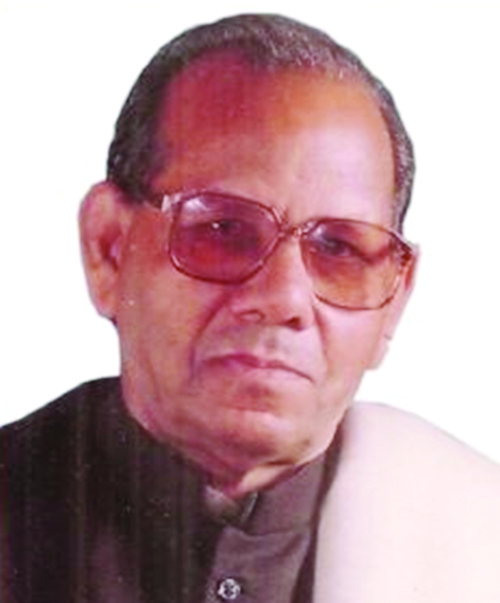
In the modern education scenario, whenever we visualize learner-centric experiential and value-based teaching learning process we will always think about Indian rooted educational practices reflected in the thoughts of Shri Lajja Ram Tomar ji, who as a schoolteacher and educationist, always promoted indigenous pedagogical models for drawing out the best values in every child. Shri Lajjja Ram Tomar ji was born in Murraina district of Madhya Pradesh on 21st July 1930. During his childhood, he was greatly influenced by the ideology of Rashtriya Swayamsevak Sangh (RSS), which shaped his life as a devoted and committed teacher in various schools. He was the head of Vidya Bharati, the education wing of Rashtriya Swayamsevak Sangh (RSS), from 1979 until he died in 2004. His work brought back into focus a teaching-learning framework that is simple, structured, and deeply rooted in the Indian way of education. Tomarji often summarized his philosophy of Panchpadi Vidhi through Sanskrit expressions. One such verse states:
(True education is knowledge and application, insight and discipline within the self.)
This reflects his belief that education must nurture both intellect and character.At a time when the world is talking about active learning, critical thinking, and holistic development, Tomarji’s Panchpadi Vidhi stands out as a timeless method that connects the wisdom of the past with the demands of the present.His ideas continue to inspire institutions across India that seek to blend tradition with modernity.
The Five-Steps of Panchpadi Vidhi
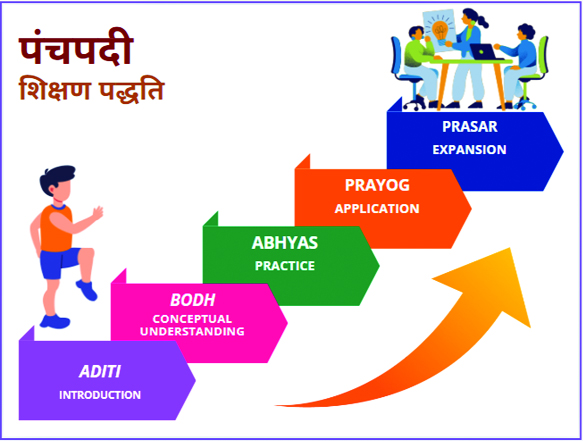
The Panchpadi Vidhi literally means the five-step method of learning. As conceptualized by Shri Lajja Ram Tomar, it provides a complete process for teaching that begins with curiosity and ends with sharing knowledge. The first step is Adheeti, which means introduction or preparation. In this stage, the teacher captures the attention of the learner and builds a connection with what they already know. The second step, Bodh, focuses on understanding. The teacher explains the new concept clearly, often using examples and illustrations to make it meaningful. The third step, Abhyas, emphasizes practice and reinforcement. Here, the learner gets repeated opportunities to strengthen understanding. The fourth step, Prayog, is the stage of application. This is where students are encouraged to use their knowledge in real situations, experiments, or problem-solving tasks. The final step is Prasar, which means extension or dissemination. Learners are motivated to share their knowledge with peers or apply it in wider contexts, ensuring that learning is not restricted to the classroom but flows into real life.This five-step journey described in Panchpadi Vidhi is more than just a teaching technique.It represents a philosophy of learning that is deeply aligned with the needs of modern education.
A Classroom Example
A simple classroom example helps to illustrate its power in terms of its applicability and impact on learners’ outcomes. The teacher may begin by asking students what would happen if all honeybees disappeared tomorrow-this is Adheeti. The discussion then moves to food chains and ecological balance, explained with diagrams and case studies-this is Bodh. Students practice their understanding by solving quizzes, worksheets, and group discussions-this is Abhyas. They then undertake a small project to observe biodiversity in their surroundings-this is Prayog. Finally, they share their findings in class presentations or community exhibitions-this is Prasar. Through this process, what could have been a dry theoretical lesson becomes an exciting and memorable learning journey.
Alignment with National Education Policy-2020
NEP-2020 stresses the importance of experiential and competency-based learning. It calls for moving away from rote memorization towards application, critical thinking, and creativity. Panchpadi Vidhi naturally aligns with these goals. By taking learners from introduction to application and dissemination, it ensures that learning is both meaningful and applicable in real life. In fact, many of the challenges seen in today’s classrooms, such as disengaged learners, over-dependence on textbooks, and lack of practical application, can be addressed by adopting this model.Tomar’s vision aligns with the Upanishadic call:
Speak the truth. Follow righteousness. Never neglect self-study and practice.
This verse reflects the spirit of Abhyas (practice), Prayog (application), and Prasar (sharing of knowledge). Tomarji’sPanchpadi Vidhi transforms classroom learning into a lifelong discipline of truth, practice, and self-study.
Panchpadi Vidhi in Digital Classrooms
The relevance of Panchpadi Vidhi becomes even more visible when we think of today’s digital and technology-rich classrooms. For instance, Adheeti can be enriched through multimedia tools such as videos or interactive quizzes that immediately spark curiosity. Bodh can be supported by virtual simulations or digital storytelling, making abstract concepts easy to grasp. Abhyas can be implemented through online practice platforms, e-assessment tools, or interactive worksheets with gamification. Prayog can be facilitated through virtual labs, project-based learning, or real-world community activities that encourage the application of knowledge. Finally, Prasar can find expression through online presentations, group discussions, blogs, or podcasts, where students share what they have learned with a larger audience. In this way, Panchpadi Vidhi can seamlessly blend with modern technology, making classrooms vibrant and dynamic while retaining the essence of Indian educational philosophy.
Challenges & Opportunities
Despite its relevance, adopting Panchpadi Vidhi across schools faces some challenges. Many teachers are not familiar with this approach and continue to depend on lecture-based methods due to a lack of training. The pressure of a crowded curriculum often limits the time available for practice, application, and dissemination. Moreover, the present examination system, with its heavy focus on memory-based testing, discourages innovative practices in the classroom. Yet, these challenges are not insurmountable. With proper teacher training, curriculum adjustments, and reforms in assessment practices, Panchpadi Vidhi can be effectively integrated into modern education.
The opportunities are significant. Teacher education institutions can include Panchpadi Vidhi as part of their training modules, enabling future educators to use it naturally in their classrooms. Schools can create activity-based assessments that align with the method, making learning outcomes more authentic. Educational technology can make the model scalable even in large classrooms by offering tools for practice, application, and sharing. By incorporating both traditional and contemporary concepts, Panchpadi Vidhi has the potential to become a model for education in India in the 21st century.
Carrying Forward Tomar’s Legacy
So, the Panchpadi Vidhi, developed by Shri Lajja Ram Tomar Ji, serves as a blueprint as India seeks to build an education system that is both rooted in culture and ready for the future. It is not only a method of instruction but a vision for holistic learning. It emphasizes more the value-based and skill-based learning that boosts curiosity, clarity, practice, application, and sharing among modern learners. It proves that the answers to our present challenges often lie in our own traditions. Far from being outdated, Panchpadi Vidhi is a timeless pedagogy that continues to inspire educators and learners alike. Tomarji’s emphasis on integrating knowledge, practice, and values continues to inspire educational reforms even today. Vidya Bharti schools across the community have been applying Panchpadi Vidhi to ensure the meaningful and optimum attainment of educational goals. Vidya Bharati Uchcha Shiksha Sansthan (VBUSS) stands as a living example of this legacy. As an institution committed to higher education with Indian values at its core, VBUSS has taken forward Tomarji’s dream by integrating indigenous pedagogical models like Panchpadi Vidhi with contemporary educational practices. In doing so, it offers a framework for building not only competent professionals but also responsible citizens who embody truth, discipline, and creativity, principles that remain timeless in the journey of learning. However, we need to look into the wider adaptability and applicability in all the schools across India.
(The authors are Professor, Central University of Jammu & President, VBUSS, J&K and Ladakh Prant; and Ph.D. Research Scholar, Central University of Jammu)
 Follow our WhatsApp channel
