

Maj Gen Ranjan Mahajan (Retd)
It has been nearly two and a half decades since insurgency first gave way to full-fledged terrorism in Kashmir, born out of Pakistan’s infamous “policy of a thousand cuts” and ever since then Pakistan deliberately fuelling unrest and turning a peaceful valley into one stained with blood and creating hurdles for prosperity and growth of people of Kashmir to a large extent. I consider myself both a witness and participant, having seen the Kashmir of harmony gradually descend into turmoil and re stabilised.
From the very beginning, the Pakistan Army perfected a system of manufacturing terrorists – arming them, providing training and radicalising vulnerable youth as well as hardened elements of society. In truth, very little has changed since militancy erupted in 1989. Pakistan’s “terror factory” has never stopped producing misguided and radicalised terrorists.
A closer examination of the profiles of Pakistani nationals infiltrating into Kashmir reveals a stark reality: many are not driven by ideology or freedom, but are instead petty criminals and convicts serving sentences in Pakistan. These men are radicalised, armed and dispatched across the border on temporary assignments lasting two to three years, enticed by promises of hefty rewards. Disturbingly, there are well-established instances of such terrorists exploiting and preying upon innocent Kashmiri girls.
Initially, Kashmiri youth too were taken across the border, trained in camps, and sent back to join various Tanzeems. Over time, the model shifted. Instead of exfiltrating locals, active terrorists within Kashmir began identifying susceptible young men, indoctrinating them and arming them locally – thus sustaining the cycle of terrorism from within.
Let’s have a crisp, field-oriented overview of how militant/terrorist modus operandi in JandK has evolved over roughly the last 27 years – and why. This will automatically get connected with the changing strategy and tactics of Security Forces to beat back their nefarious designs.
In the early years of militancy, around 1989-90, I personally witnessed Kashmir’s tragic transformation from a serene paradise into a land of turmoil. At that time, infiltrating groups often consisted of hundreds of Kashmiri youth, taken across to Pakistan either voluntarily or under coercion. There, they were given training in weapons and explosives before being pushed back through the thinly held Line of Control (LC). Local guides, well-versed with the terrain and routes, facilitated their movement. Large caravans of mules laden with arms, ammunition, and other war-like stores would often accompany them. Owing to the wide gaps and sparse deployment along the LC, many of these groups managed to slip through undetected and reach the hinterland with relative ease. However, the Security Forces soon adapted, establishing effective counter-militancy grids and operations, which helped bring the situation firmly under control.
And then in early-mid 2000s, there were infiltration of fidayeen cross-border with much heavier weapons to include AKs Rifles /Universal Machine Guns, Remote Controlled Improvised Explosive Devices (IEDs) etc. It worked out due to larger safe areas, weaker border fence/surveillance on the LC and deeper Pakistan-side facilitation. They adopted newer tactics of fidayeen (suicide-style) raids on camps and enjoyed well entrenched hideouts in the Valley. The Security Forces adopted a stronger Counter Terrorism (CT) grid and strengthened the fence with physical occupation and surveillance devices. The leadership decapitation to compel smaller signatures and small team operations.
The terrorists encashed on the tools of Social Media during the Burhan Wani’s era (2015-16) with rapid narrative projection and online outreach often seen having selfies with weapons. This definitely had catalysed the recruitment of local youth with short life-cycles for cadres. This phase also experienced increased hit-and-run shootings, grenades lobbying in crowded areas. Another new tactic of crowd mobilisation around encounter sites to hinder the operation of Security Forces and enabling terrorists and Over Ground Workers (OGWs) to escape. The Security Forces undertook Counter-adaptation with specific targeted operations and enhanced technical surveillance thereby bringing in precision resulting in shortened militant survival time and pushing groups toward deniability and dispersion.
Post-2019 there came a phase of proxy fronts, “Hybrid” shooters, and selective terror. And then it witnessed the emergence of faceless labels The Resistance Front (TRF) to mask LeT/JuD fingerprints and evade FATF scrutiny. Of course there were increased telegram/online claims and non-religious iconography to project “indigenous resistance”. Part time “Hybrid terrorists” generally having clean records otherwise started getting quickly tasked with pistol-borne shootings of off-duty policemen, Political/Panchayat workers, minority civilians and migrant labourers. They started melting back into daily life making the task of Security Forces and JKP more tougher and challenging. The aims were towards disrupting grassroots governance, increased low-signature targeted killings with an intention to spread fear.
There is a dilemma with the enemy on the attempted infiltration along the LC. The two dreaded organs of Pakistan i.e., ISI and Military have likely diverse views post the adoption of CFU in 2021 in which Pak military had suffered tremendously due to the poor morale, infrastructure, and capabilities. ISI in the meantime found other easier routes along the International Borders (IB) to infiltrate terrorists in small numbers.
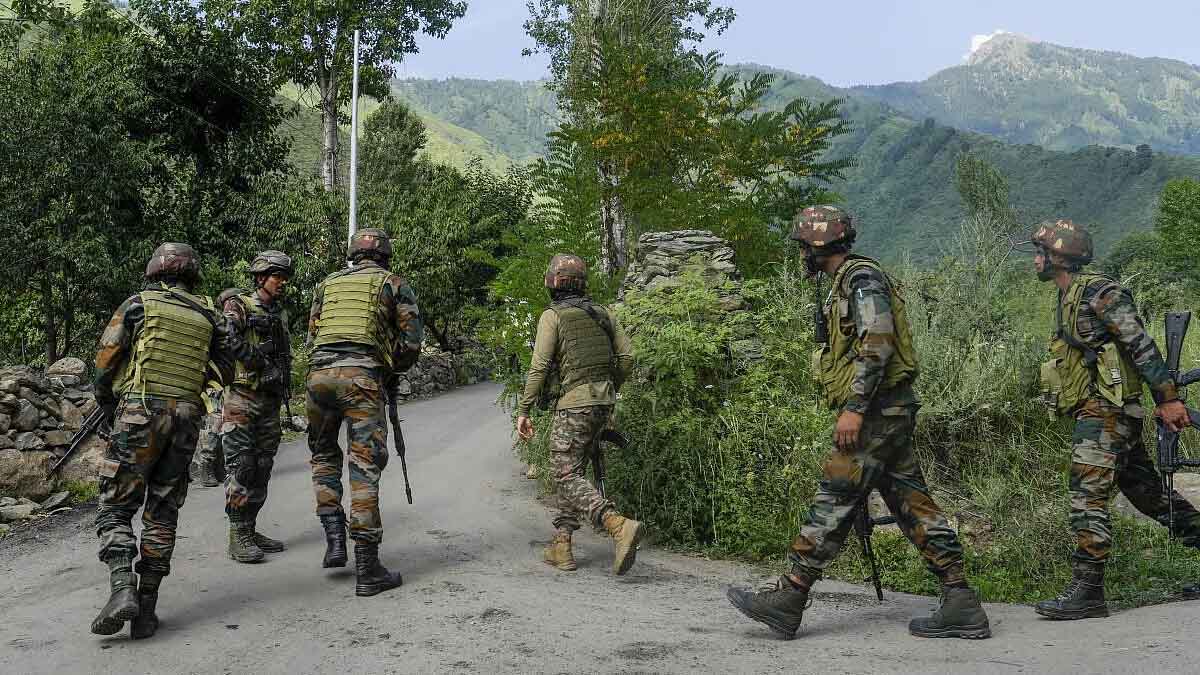
These terrorists were moved to the hinterland with assistance from OGWs. Indian Army reviewed focus on hinterland after initial setbacks made the operational situation difficult for the terrorists’ and their sympathizer forcing them to go the higher reaches of Pir Panjal. Civil Administration along with police also played a crucial role in breaking the financial network of narco and hawala with booking of OGWs / terrorists’ sympathizers. Pre and post Op Sindoor, ISI have been trying to make certain attempts along the LC which has not achieved success due to stronger technological strengthened counter infiltration grid of India’s Northern Army. This forced them to change the modus operandi by use of smaller terrorists’ groups of two – three including the guide. While terrorist organisations have tried to remain ahead of the technological curve in communications and weaponry, it is becoming seemingly difficult to breach the LC facing maximum attrition.
Consequently, their overall focus remains on the IB sector with new avenues like tunnels, drones and narco sympathizers in areas where police and border guarding forces are involved in routine policing duties and presence is minimal.
Security Forces on the other hand are buoyant by the reenergized coordination at the top level which is fructifying with results on the ground. The multiprong approach of targeting narco and hawala operators, engaging youth, confiscating assets of terrorists/ OGWs and a technologically stronger grid at the LC has paid off.
There has been an immersive push towards the absorption of technology by the Indian Army. Each soldier is being skilled in one or the other force multiplier skills from Al, autonomous detections systems, microwave radar coverage for bad weather, all weather drones from surveillance to strike options, new weapons (AK 203), combined with improved Anti Infiltration Obstacle System (AIOS) which has been smartised with day and night cameras for 24×7 surveillance autonomous detection and engagement options.
The combined effect of all these individual vectors has resulted in a net vector that has given disproportionate results to Security Forces. Technology has enabled Security Forces to deploy more troops in a dynamic grid thus generating and radiating their presence in more numbers for covering large swathe of ground along the LC making AIOS impregnable.
While ISI and terrorist organizations are likely to innovate and change their modus operandi for infiltration, technology combined with “Men behind the Gun/Equipment” is proving to be their nemesis on the LC. They are likely to explore the areas where it is easier to infiltrate men and weapons separately and safely like combinations of tunnels and drones. Dominance of Security Forces at LC and hinterland restricted their space and safe opportunities even in their traditional areas. This has been the winning factor for the Security Forces. In addition, with the ever progressing Atma nirbharta in the defence sector, we are likely to remain ahead in the counter terrorism curve, with a stable and secure LC.
In order to bring in the newer technology and improve logistics, the handlers from Pakistan started increasingly use drones to drop weapons, hand/sticky grenades, IEDs and even cash and drugs – mainly into Jammu/Kathua/Punjab belts – thereby reducing infiltration risk and resupply time and boost up narco-finance. TRF’s birth announcement somehow was made via encrypted platforms through wider adoption of encrypted apps/closed channels for tasking/propaganda. Narco-terror pipelines (primarily heroin) and Hawala were addressed and increased punitive actions rolled out linking cross-border handlers, OGWs and local distributors.
There was a spatial shift : with the Kashmir Valley’s CT grid hardened, terrorists exploited Rajouri – Poonch forests and folds, staging woodline ambushes and IED attacks against patrols and convoys and then exfiltrating through complex and challenging terrain. 2023-24 saw more attacks in Jammu division than earlier years; degraded roads/works in some corridors created tactical windows for stand-off fire and quick strikes. Please refer to my article “Changing Games in JandK : A n analysis and the Recommended Approach” https://www.dailyexcelsior.com/changing-games-in-jk-an-analysis-and-the-recommended-approach/ published in Daily Excelsior o n 0 3 /0 9 /2 4
The implications for counter-terrororism have been well anticipated by the Security Forces at every stage and proactive operations and domination in JandK have been achieved under the clear cut directives issued by the Central Government and Indian Army. Sustained financial/NIA-led pressure on narco-hawala flows and OGW ecosystems; treat drone drops and heroin seizures as counter-terrorism indicators, not just crime. The dynamically changing Counter Terrorism Strategy, SOPs have been evolving from Corden and Search Operations to Specific Intelligence based Operations through Small Teams and prioritising terrain-dominated CT operations in jungles/higher ridges. Expanding counter-drone nets along IB /LC and rear areas has also been evolving.
Over the last few years, the terrorists have shifted their bases from urban areas of J&K and have taken refuge in the thick jungles. The dependency seems to have shifted more to foreign terrorists a s compared to local terrorists, who used to b e in larger numbers before sometime. The sustenance is being taken from Gujjars and Bakarwals, who per force have to go to these areas in search of food for their livestock. Off late it has come to notice that they are dependent on hides and caches which are stocked b y the terrorists themselves during routine activities. These locations are only known to themselves and any supporting local is not allowed to venture nearby. These places are well camouflaged and almost impossible to be noticed. Recent operations of Security Forces stand testimony to this fact as well as display humungous efforts being made by them.
As far as execution of operations by Security Forces are concerned in these risky jungles, these areas have adequate hiding places from observation of eyes and surveillance of troops deployed there. The operations demand employment of a large body of troops to address a particular area which in turn makes it difficult to maintain surprise. Also, the survivability of troops has limitations in such rugged terrain. These factors aid the activity of terrorists in these mountains.
For communication, reportedly they have been known to possess specially designed handsets which utilise the frequency bands which are not being used by mobile communication or by the Security Forces. The transmissions are made mostly from remote places which makes it difficult to be intercepted or even if intercepted, cannot be acted upon in real time. As far as support base from locals is concerned, latest policies b y the government indicate that the larger base has died down, however, hardliners still are believed to be existing. They may be working out of compulsion or due to a radical mindset which is deeply embedded in some of the minds.
Latest successful operations by Security Forces indicate their persistent efforts over vast forested and mountainous areas. At times the forces do not get the requisite success or suffer setbacks too, but it is indicative of shift on terrorists’ strongholds. This may take time to be addressed in totality, however, by then some other contours can be expected to have been explored by terrorists and their think tanks sitting across the b orders.
While highlighting dynamically and professionally conducted Operation Mahadev eliminating three terrorists involved in the Pahalgam bloodshed, Lt Gen Pratik Sharma, The Northern Army Commander, said at the recent 2025 NDTV Defence Summit, “We hunted them in the forest of Hapatnar, We chased them into the areas of Tral and finally surrounded them in this forest of Dachigam. It was 97 days of day and night intense operations. You will be surprised to understand the way the entire dynamics of the operations of terrorists in the hinterland has changed. They no longer operate from the built-up areas. They are operating in the hill areas, jungles, caves, and that creates a huge challenge. So the intensity with which we were chasing them and hats off to our Security Forces in the joint operations which we did with intelligence agencies, JKP, CRPF and the Security Forces & also the Special Forces who eliminated them”.
 Follow our WhatsApp channel
