

Kiran Badoni
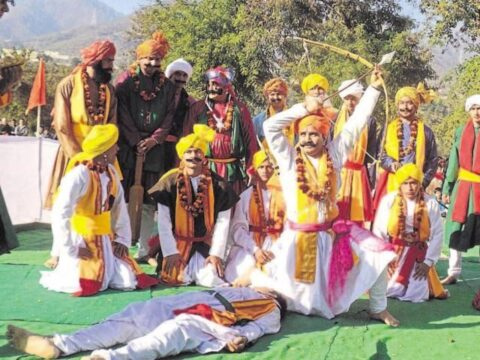
Uttarakhand’s culture is incomplete without its vibrant traditions of folk music, dance, and theatre, which vividly reflect the region’s deep-rooted values, mythology, and communal memory. Among these rich expressions, Pāṇḍav Nritya (also known as Pāṇḍav Līlā) stands out as one of the most spiritually and culturally significant folk performances, particularly in the Garhwal Himalayas. This ritualistic dance-drama enacts episodes from the Mahābhārata not merely as a form of entertainment, but as a sacred communal event, interweaving devotion, identity, and ancestral remembrance.
Performed during the winter season—between November and February—Pāṇḍav Nritya usually coincides with religious festivals such as Diwali and Dussehra in Garhwali villages. The event begins with the invocation of Someshwar Devta, the local deity believed to be the divine protector of the village. The god’s symbolic presence is carried in a ritual procession on a palanquin, accompanied by villagers and performers. As the performances begin, the participating artists—often local farmers or non-professional villagers—are believed to be spiritually possessed by the spirits of the Pāṇḍava brothers. The performance space, thus, transforms into a consecrated site for communicating with divine ancestors.
Unlike classical theatrical performances that follow a fixed storyline, Pāṇḍav Nritya follows an episodic and flexible structure. The performers do not aim to retell the Mahābhārata linearly; rather, they select episodes based on their recognisability, emotional appeal, and communal relevance. This structure allows each village to highlight aspects they find most significant, be it through drama, music, or devotional elements. Performances typically begin after dark and extend into the early hours of morning. As the days progress and the dramatic intensity builds, they may commence earlier in the afternoon and continue till dawn.
Among the most commonly enacted episodes are the infamous game of dice, Draupadi’s disrobing, the exile of the Pāṇḍavas, their incognito year in King Virata’s court, and the dialogue between Krishna and Arjuna on the battlefield of Kurukshetra, which forms the essence of the Bhagavad Gītā. One of the most anticipated and emotionally charged scenes is the battle between Arjuna and his son Nagarjuna, popularly known as Gainda (meaning rhinoceros), named after the symbolic rhinoceros involved in the conflict. This episode embodies themes of duty, identity, and generational confrontation—core elements of the Mahābhārata.
The weapons used during the performance hold deep ritual value. They are never allowed to touch the ground and are carefully preserved from one year to the next, as they are believed to retain spiritual power. The performance itself is viewed as a form of śrāddha—a ritual of ancestor worship—especially by Rajput families, many of whom trace their lineage to the Pāṇḍavas. For them, participation in Pāṇḍav Līlā is not just an act of devotion but a sacred duty, believed to invoke divine blessings and spiritual protection for the entire community.
The entire performance is conducted in the local Garhwali dialect, accompanied by traditional instruments such as the dhol, damau, and bhankore, which together create an immersive sonic atmosphere. The intensity of the facial expressions, trance-like states of performers, and spontaneous dialogue add an emotional dimension to the performance. The audience does not merely watch; they feel, interpret, and relive the moral dilemmas, sacrifices, and spiritual messages of the epic.
Unlike classical Indian theatre, which prioritises choreographic precision, Pāṇḍav Nritya thrives on embodied memory, spiritual surrender, and community participation. Among the many folk traditions of Garhwal, it holds a special place because of its emotional accessibility and mythological depth. In regions such as Chamoli and Pauri Garhwal, where religious sensibilities are deeply embedded in everyday life, Pāṇḍav Nritya serves as a vital spiritual and cultural anchor. The widespread familiarity with the Mahābhārata enhances the audience’s engagement—even improvised or abbreviated renditions carry deep meaning, prompting people to travel across villages to witness the performances.
The origins of Pāṇḍav Nritya are believed to date back to the mythic past when, according to local legend, the Pāṇḍavas themselves ruled or traversed these Himalayan regions. Initially developed as a didactic tool to educate tribal communities about the moral and heroic tales of the Pāṇḍavas, it gradually evolved into a sacred tradition that fused religious worship with storytelling. Over generations, it has served not only to preserve oral narratives but also to solidify community identity, strengthen social cohesion, and transmit ethical values from one generation to the next.
Though Mahābhārata-inspired traditions also exist in Himachal Pradesh—in districts like Kullu, Mandi, and Shimla—their nature and purpose diverge significantly. Himachali customs often centre around oracular practices and devta worship, where ritual specialists communicate with gods in temple settings. In contrast, the Garhwali Pāṇḍav Nritya is rooted in trance, dramatic enactment, and community-based performance. This distinction reveals a uniquely Garhwali approach to mythology: one where myth is not only remembered but physically and spiritually re-enacted. The boundary between performer and deity, between past and present, often dissolves in this immersive theatre of devotion.
Pāṇḍav Nritya continues to attract both locals and tourists—Indian and international alike—drawn by its aesthetic beauty and spiritual gravity. The relative geographical isolation of the Garhwal region has helped preserve this tradition, shielding it from rapid modernisation and cultural erosion. Oral transmission has played a crucial role in its continuity. However, challenges remain, ranging from poor documentation and dwindling interest among younger generations to the broader impacts of urban migration and cultural homogenisation.
Pāṇḍav Nritya is far more than a folk dance; it is a sacred form of ritual theatre, a living embodiment of the Mahābhārata’s moral universe within the social and domestic sphere of Garhwali life. By conveying the timeless principles of dharma (duty), karma (action), and bhakti (devotion) through dance, music, and communal storytelling, it stands as a resilient symbol of Uttarakhand’s spiritual heritage and cultural vitality amid the Himalayan heights.
(The author is an IPE-ICSSR Doctoral Fellow in the Department of Economic Studies and Planning at the Central University of Karnataka.)
 Follow our WhatsApp channel
