

Alaknanda Mahajan, Manvika Bamba
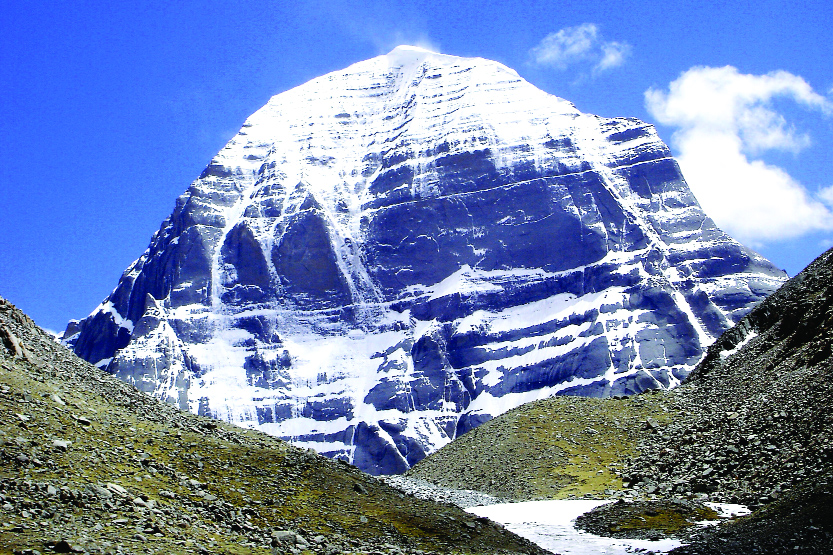
As the Kailash-Mansarovar pilgrimage resumes for its annual season between June and September, many Indian pilgrims set their sights on the sacred peaks of Mount Kailash and the pristine waters of Lake Mansarovar. For centuries, this spiritual journey has effortlessly interwoven spiritual traditions, religious belief and historical continuity. But few pilgrims today would be aware of the fact that the traditional route to this pilgrimage once passed through a village named Minsar.
Most Indians would be oblivious to the existence of Minsar, a small hamlet located in Western Tibet, 32 miles west of Mount Kailash which has been connected to India through cultural, historical and religious ties for over three centuries and paid revenue to the Kashmir government. Minsar’s history has been deeply intertwined with that of the Kingdom of Ladakh and later the Princely state of Jammu and Kashmir. From early 17th century this village was under the administration of Kingdom of Ladakh and then under the jurisdiction of Dogra rulers of Jammu and Kashmir. The revenue generated from Minsar was directed towards maintenance of the Kailash-Mansarovar pilgrimage. Today, this Indian enclave in Tibet is under the occupation of China. However, no formal agreement exists which indicates Indian relinquishment of their rights over Minsar. India’s lost claim over this small yet geopolitically significant principality needs to be brought into focus.
Geographical Extent
Minsar lies in the Ngari-Khor-sum region (Western Tibet). Traditionally reached from Demchok (Ladakh) through a ten-day journey, it was a part of the old Kailash-Mansarovar pilgrimage route.This serene village housed about 60 families, nearly 280 people, mostly Buddhists who sustained themselves through rearing of livestock and wool trade.Surrounded by Tibetan territory on all sides and 70 miles from the nearest Indian border, Minsar was located on the main trading route from Leh to Lhasa and acted as halting place for Hindu and Buddhist pilgrims on their journey to Mount Kailash. As a result of its distant location, the means of communication with Kashmir Durbar and India proved to be difficult.
Historical Origins: From Ladakh to Dogras
Indian ties to Minsar trace back to the 16th century with the rise of Bhagan of Bhasgo and the Namgyal Dynasty in Ladakh. King Singge Namgyal (1616-1642), the most powerful ruler of this dynasty extended his control over Western Tibet including Minsar. His achievements however triggered the hostility of Tibetans resulting in the Tibet-Ladakh War of 1679. In 1684, following its defeat in war, Ladakh was compelled to sign the Treaty of Tingmosgangwhich recognized Tibetan control over much of the region except Minsar. Article 8 of this treaty distinctly allowed the Ladakhi king to retain Minsar to support the pilgrimage to Kailash and Mansarovar.
“But the king of Ladak reserves to himself the village (or district?) of Monthser (i.e., Minsar) in Ngarees-khorsum, that he may be independent there; and he sets aside its revenue for the purpose of meeting the expense involved in keeping up the sacrificial lights at Kang-ree (i.e., Kailas), and the Holy Lakes of Manasarowar and Rakas Tal”.
Dogra Conquest and Treaties
By the first quarter of the 19th century, the state of affairs in Ladakh were in disarray. In 1834, Raja Gulab Singh set his sights on the conquest of Ladakh. Beyond the exposed political weakness of Ladakh, another reason which motivated the Dogra Raja to invade was the lure of the region’s lucrative shawl and wool trade. With this aim in mind Raja Gulab Singh thus dispatched an expedition to Ladakh commanded by his ablest general, Zorawar Singh Khaluria. After successful campaigns, Ladakh became a tributary of the Sikh Empire, but Gulab Singh exercised actual authority over the region. The Dogra army later marched into Tibet, but General Zorawar Singh’s tragic and untimely death in the Battle of To-Yo(1841) put an end to any further advance into Western Tibet. The resulting Treaty of Chushul (1842) only reaffirmed earlier the provisions of 1684 treaty. Eventually, with the signing of theTreaty of Amritsar(1846), Ladakh including Minsar was incorporated into the Princely state of Jammu and Kashmir under British suzerainty.
In the years that followed, the Kashmir government continued to send its officials for the purpose of collecting revenue. From 1853 to 1905, revenue records confirmed regular collections by Dogra officials.In the year 1853, during the governorship of Mehta Basti Ram, the revenue of Minsar amounted to Rs 56which gradually increased up toRs 297 by the year 1905 as mentioned in the settlement report of Faqir Chand, the Wazir Wazarat of Ladakh. Minsar also found mention in the census reports of 1911 and 1921. The latter document clearly mentioned that Minsar has 44 houses, 87 men and 73 women. Although the revenue collected was quite meagre but the symbolic and strategic importance of the area was far greater.In 1940s other officials of the Kashmir government TsetanPhuntsog and Abudul Waid Radhu, a Muslim merchant also visited Minsar and through their writings offered glimpses into the political situation prevailing in the region.However, in the coming decades, with the independence of India and deteriorating relationship between India and China, the geopolitical situation in the Himalayas was about to witness a dramatic shift.
Post-Independence Shift
Following independence, the Instrument of Accession (signed on 26th October 1947) brought Jammu and Kashmir, including Minsar, into the Indian Union. A cursory glance at the instrument of accession reveals that when Maharaja Hari Singh signed it,he referred to himself as “Shriman Inder Mahinder Rajrajeswar Maharaja Dhiraj Shri HariSinghji, Jammu & Kashmir Naresh Tatha Tibbet adi Deshadhipati.” The adoption of this title validated Maharaja’s sovereignty over the princely state of Jammu and Kashmir as well as over the adjacent area of eastern Ladakh, including Aksai Chin, and some areas reaching into Western Tibet (Enclave of Minsar). Even after independence officials of the Jammu Kashmir government continued to visit the area and collect revenue from there. In the year 1950, the Kashmir government deputed a civil officer, N. Rigzen Ghagil Kalon to visit Minsar. This was the last documented visit to the area by an Indian official.
The Panchsheel Agreement and Diplomatic Oversight
By 1954, India and China signed the Panchsheel Agreement- which included the five guiding principles of peaceful coexistence between both the nations. It is important to note that prior to the signing of the Panchsheel Agreement at the scheduled Beijing Conference of1954, the issue of Minsar was brought to the attention of Prime Minister Jawaharlal Nehru. He instructed Indian negotiators not to raise the issue of Minsar, but to concede if the matter was taken up by the Chinese. Although the Government of India was well aware of the strategic importance of Minsar for providing foothold in Tibet there appears to be no clear reason for India’s silence on the issue. India’s renunciation of claims over Minsar is viewed by a considerable body of academic opinion as a strategic miscalculation, often labeled as a ‘Nehruvian Blunder’. Critics believe that Nehru’s unwavering faith on China, ultimately undermined India’s strategic interests.
In 1960, as India-China tensions escalated after the India’s grant of refuge to 14th Dalai Lama from Tibet. India’s intervention and extension of asylum to the Dalai Lama was seen as a breach of Panchsheel agreement by the People’s Republic of China. Amidst prevalent contentions, Chinese Premier-Zhou Enlai visited India in 1960. In the light of this visit, on 22nd April 1960 Prime Minister Nehru revived the issue concerning Minsar with Zhou Enlai. He highlighted Kashmir Government’s administrative presence in Western Tibet and presented tax records as proof of sovereignty. Nehru maintained that he is making no new claims but defending established boundaries,proposing evidence-based resolution of disputes, especially on India’s traditional claims overMinsar. Even after such a vocal stance made over India’s position regarding Minsar, thediplomatic talk over the matter reached no substantial end. Ultimately, India’s claim over Minsarwas gradually lost and as historianJohn Bray has very eloquently put it ‘reduced to a minor foot note in history’. Minsar was forgotten from our collective memory except for a few academic discussions. China continues to exercise control over the principality of Minsar as over other Tibetan territories.
Conclusion
The legacy of Dogra rule over Minsar reflects a long-standing yet overlooked chapter in India’s territorial history.Minsar is linked to India through cultural, spiritual, and historical ties, especially due to its proximity to the Mount Kailash. Along with this,its key position on China’s G219 highway further increases its strategic relevance in present times. Recently, China celebrated its 70th anniversary of the founding of the People’s Republic China in Minsar. This move by China is reflective of its ever-expanding territorial ambitions in theHimalayas and acts as a direct threat to India’s frontier security. Hence, there is an urgent need to revisit the issue of Minsar not just in academic discourse but for Indians in general.
(The authors are Ph.D. Scholars, Department of History, University of Jammu)
 Follow our WhatsApp channel
