

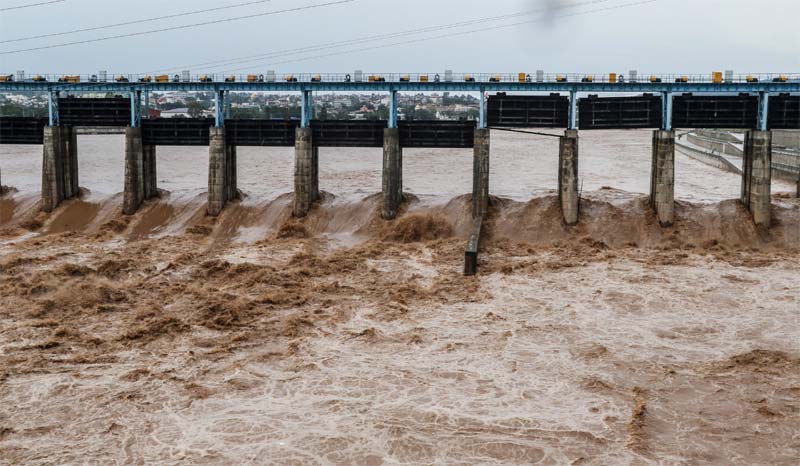
Non-adherence of law leaves many areas susceptible to disasters
Mohinder Verma
JAMMU, Aug 28: Even 15 years after the enactment of the law mandating identification and notification of flood basins, the authorities in Jammu and Kashmir have failed to formally declare the flood basins of the Tawi and Chenab Rivers thereby increasing the risk of large-scale devastation during heavy rainfall as was witnessed during the floods on August 25 and 26.
Follow the Daily Excelsior channel on WhatsApp
The Water Resources (Regulation and Management) Act, which was enacted in 2010, through Sections 75 and 76 provides a clear framework for declaring as “flood basins” those areas comprising river-beds, adjoining lands and low-lying zones vulnerable to inundation.
The Section 75 read: “Where the Authority considers it necessary or expedient so to do, it may recommend to the Government for declaration of any area through which a water source flows and the area comprising of the bed, both sides and nearby low land susceptible to floods by inundation of such water source, as flood basin”.
Similarly, the Section 76 states: “For determination of the limits of a flood basin, the prescribed authority shall cause a survey to be made of a water source and for the said purpose proper charts and registers shall be prepared specifying all the boundaries and landmarks and any other necessary matter for the purposes of ascertaining such limits”.
A flood basin is the natural area along a river or stream that acts as a buffer zone during heavy rains, snowmelt or sudden water discharge and it usually comprises the river-bed, adjoining banks and nearby low-lying lands that are prone to submergence whenever water-level rise.
The identification and notification of flood basins is of utmost importance because they play a vital role in the flood risk management. Once notified, flood basins become officially recognized zones where construction, encroachments and unregulated activities can be strictly controlled.
Without such measures, rivers lose their carrying capacity, drainage channels shrink and settlements come up in highly vulnerable zones leading to devastating floods that cause widespread loss of life and property. Moreover, formally declaring flood basins allows Government to prepare accurate floodplain maps, design early warning systems and frame disaster preparedness strategies.
However, even 15 years after the enactment of the law, the flood basins of the Tawi and Chenab Rivers have not been formally notified by the concerned authorities although J&K Water Resources Regulatory Authority has repeatedly taken up this matter with the Government, official sources told EXCELSIOR.
“The identification of flood basins of river Tawi is under finalization on the basis of the work done under the Jhelum Tawi Flood Recovery Project. The draft report of JTFRP has been reviewed by the prescribed authority and observations sent to the consultant for inclusion in the report. However, in respect of Chenab basin the work is in progress”, read an official document, the copy of which is available with EXCELSIOR.
“The successive Governments allowed the provision of the law to remain on paper leaving flood-prone areas particularly the catchment areas of the river Tawi exposed to unchecked urbanization and encroachments”, they said, adding “this inaction has directly contributed to the magnitude of recent floods”.
The torrential rains of August 25 and 26 battered parts of Jammu caused massive damage to infrastructure, washed away bridges and roads, and left several habitations marooned. Similar devastation was witnessed during the 2014 deluge in the Valley. “Both disasters underline what could have been mitigated had flood basins been scientifically identified and notified”, sources further said.
“In the Himalayan region, where climate change is intensifying rainfall events, such negligence is unforgivable. The authorities are ignoring the most basic precaution. Flood basins are our natural shield. By treating them as real estate, we are inviting repeated tragedies,” said some environmentalists, adding “each flood is followed by high-level meetings and assurances, but when the water recedes, everything is forgotten. Unless the flood basins are identified and encroachments removed, people will continue to suffer”.
 Follow our WhatsApp channel
