

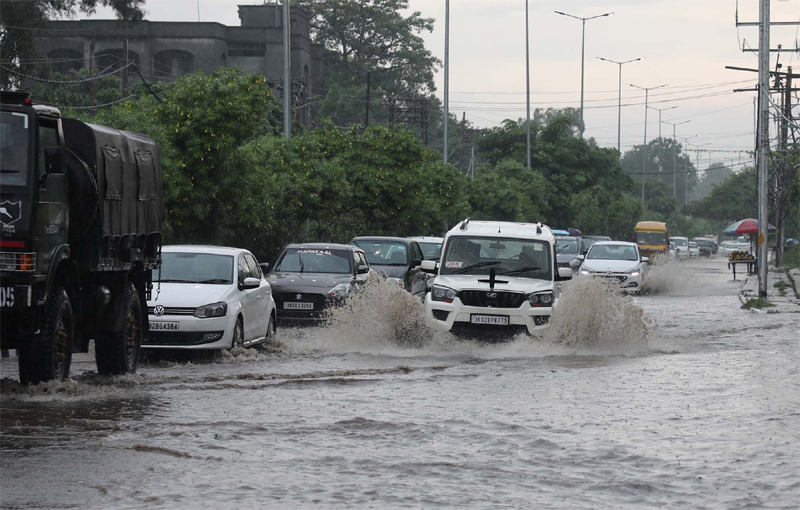
Timely adherence to LBSAP would have minimized damages
Mohinder Verma
JAMMU, Aug 24: The havoc caused by last night’s massive rainfall in different parts of Jammu city is the outcome of complete inaction on the blueprint prepared in 2023 to mitigate the very impact of intense downpour in the vulnerable low-lying areas.
A comprehensive Local Biodiversity Strategy and Action Plan (LBSAP) painstakingly prepared by the Forest Department in April 2023 had clearly defined the goals and fixed timelines for different Government agencies to mitigate the impact of heavy rains in the vulnerable areas.
Yet, even more than two years later, the plan has remained buried in official files and no meaningful step was initiated by the concerned agencies, allowing the situation to spiral into chaos. Had even half-hearted action been taken on the goals outlined in the LBSAP, the scenes of devastation witnessed across the city’s low-lying belts last night could have been avoided and losses to the public would have been significantly curtailed, experts told EXCELSIOR.
Follow the Daily Excelsior channel on WhatsApp
While the Forest Department did its part by framing a well-researched and implementable strategy, the onus was on multiple other departments-Jammu Municipal Corporation (JMC), Urban Environment and Engineering Department (UEED), Irrigation & Flood Control Department, Jammu Development Authority etc to act in a coordinated manner. Shockingly, not a single goal has been translated into action on the ground till date, they pointed out.
“Due to this, the overnight rains turned several localities of Jammu into virtual water-logged islands, paralyzing life, damaging property and pushing residents into trauma”, they said, adding “Jammu’s urban expansion, unregulated construction and blatant encroachments on natural drains are key risk factors for years”.
In the LBSAP, stress was laid on identifying and mapping the catchment areas, threats within the catchment areas, understanding the changes in the extent of water resources over time and developing an integrated action plan for the low-lying areas. For all these activities, one year time-frame had been fixed in the LBSAP. However, the situation created by heavy downpour has exposed that no action was taken by any of the concerned Government agency.
Further, one to three years timeframe was fixed for development of a detailed plan for the protection and conservation of the river, restoring the degraded areas of the river, implementing scientifically informed riverbank restoration actions and reducing mining impacts on water body health. But, this goal of LBSAP has also failed to receive due attention of the concerned authorities.
As far as canal system is concerned, in the LBSAP thrust was laid on developing a comprehensive canal management plan that guides the protection and maintenance of the same and documentation of ponds within the city and their protection and conservation. “However, there is complete inaction on this aspect also”, experts said.
“The tragedy is not the rain-it is the concerned authorities’ silence and failure to act despite having a plan in hand,” remarked environmentalists, blaming the administration for treating the exercise as a mere formality, adding “the LBSAP was not prepared to gather dust in the official files, it was a blue print for all the concerned authorities with defined timelines for action with utmost seriousness”.
They stressed that all out efforts should be made by the administration to restore national drainage channels choked by encroachments and water absorption zones to hold excess rainfall to mitigate urban flooding besides initiating prompt action on all the goals set under LBSAP.
Officers in concerned departments, when approached to ascertain reasons behind inaction on LBSAP, said, “no doubt the blueprint has assigned different tasks to us. However, our hands are tied for want of sufficient funds. We are not getting adequate funds even for routine developmental works”.
“In such a situation, the Government should also keep sufficient funds at the disposal of all those agencies which are required to implement LBSAP so that in future the situation which was witnessed due to overnight heavy rains is not repeated in future”, sources stressed.
 Follow our WhatsApp channel
