

Rakesh Magotra
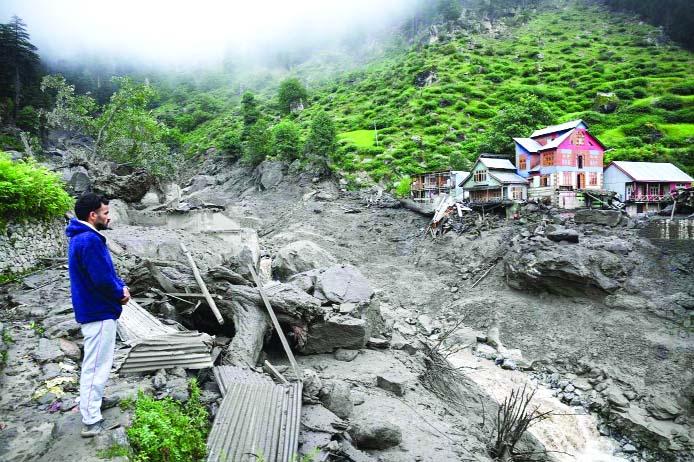
On the noon of August 14, 2025, the picturesque Chishoti village in Kishtwar district was ripped apart by nature’s fury. A massive cloudburst triggered flash floods that swept away scores of residential houses, government buildings, temples and watermills. A 30-meter-long bridge collapsed. Vehicles were crushed and uprooted trees floated like matchsticks in a violent torrent. Families have reported more than hundred missing; locals fear the toll runs much higher. Videos circulating online capture pilgrims of the Machail Mata Yatra running for their lives, their cries drowned by the roar of rushing waters.
Among the deceased are personnel of the CISF and J&K Police-grim reminders that no one is beyond the reach of climate extremes. Rescue teams have pulled out over 160 survivors, many in critical condition. But the larger story is that these disasters are not aberrations-they are part of a disturbing pattern across Jammu & Kashmir.
Only a few months earlier, Ramban had seen cloudbursts and flash floods that blocked highways and damaged villages. South and Central Kashmir were battered by storms that destroyed apple orchards. Across the Kandi region of Jammu, erratic monsoons have left fields parched one month and inundated the next. These repeated blows expose a sobering truth: J&K has entered an era of accelerated climate vulnerability.
This fragility is not accidental. The Himalayas are a global climate hotspot where warming is occurring faster than the global average. Orographic lifting-where moisture-laden winds release sudden, intense rainfall-makes cloudbursts common. What was once a rare event is now increasingly frequent and devastating. A recent IMD analysis revealed that J&K received 575% excess rainfall in a single day earlier this year, destabilizing slopes and displacing communities.
The consequences are profound. Agriculture and horticulture-the backbone of the region’s economy-are directly in the crosshairs. Apple cultivation worth nearly Rs 10,000 crore annually supports lakhs of households. The shift to high-density plantations is promising higher yields but also exposing farmers to greater risk from hail and unseasonal rain. In Jammu’s Kandi belt, staple crops like maize and pulses face yield decline as rainfall patterns collapse into unpredictability.
The economic costs are only one side of the coin; the human toll is deeper. Each washed-away bridge is not just infrastructure-it is a lifeline to schools, hospitals, and markets. Each orchard lost is a family’s future destroyed. For communities perched on fragile slopes, “climate change” is not jargon; it is the daily question of survival.
Yet, resilience remains weakly institutionalized. Less than 10% of horticulture in J&K is insured. Weather-based parametric insurance-where payouts are triggered automatically by rainfall or hail intensity-could cushion growers, but schemes remain piecemeal. Disaster preparedness plans are still largely reactive. Relief arrives after the deluge, not before.
In this context, the role of financial institutions becomes critical. Banks like J&K Bank, with their deep reach into every village, must expand from being credit providers to resilience partners. Credit for climate-adaptive agriculture, loans tied with weather insurance and financing for slope stabilization or water conservation projects can shift the paradigm. Just as Business Correspondents drove financial inclusion, agriculture-linked institutions and grassroots organizations can be mobilized for credit inclusion-ensuring that vulnerable farmers are not excluded from resilience financing.
Infrastructure development must also recalibrate. Agencies like NHAI, which collect crores in tolls while cutting roads through fragile hills, cannot externalize climate costs. A portion of these revenues should be ring-fenced for slope reinforcement, watershed management and compensatory afforestation. Otherwise, “development” will become self-defeating, eroding the very ecological base it depends on.
Technology, too, can be an equalizer. A dense network of automatic weather stations across J&K, linked with mobile alerts, can give farmers precious hours of warning. AI-driven risk models, IoT-based monitoring of water flows and remote sensing of slope stability are no longer futuristic-they are necessities. Local universities like SKUAST, alongside IIT Jammu and IIIM Jammu, can be tasked with developing region-specific adaptation models. The knowledge exists; what is lacking is integration into governance.
But resilience is not only technical; it is political and social. District-level climate vulnerability indices must be prepared and mainstreamed into development planning. Funds for disaster relief must be linked to proactive investments in mitigation. Panchayats should be trained not only in relief distribution but also in preparedness drills, slope vegetation, and water channel maintenance.
The Kishtwar tragedy is a reminder that the costs of inaction are measured not only in rupees but in lives. Each delay in institutional reform, each reluctance to integrate insurance, each negligence in slope management multiplies human suffering. Climate disasters may not respect borders, but their impacts are deeply local-and so must be the solutions.
At a time when global climate negotiations often falter, regions like J&K cannot afford paralysis. The Himalayan states must come together as a coalition for climate resilience, demanding greater financial and technological support. The Government of India, which has rightly prioritized infrastructure, must equally emphasize climate infrastructure-early warning systems, resilient roads, climate-proof housing. Symbolism must not overshadow substance.
The world is warming, and the Himalayas are its frontline. The question is not whether cloudbursts will occur again, but when-and how prepared we will be.If J&K is to avoid becoming a case study of climate tragedy, it must pivot from piecemeal relief to systemic resilience. Farmers need insurance, villages need early warning, infrastructure needs ecological accountability, and governance needs urgency. Banks, governments, and communities must act in tandem.
(The author is a General Manager in JK Bank)
 Follow our WhatsApp channel
