

Nikhil Khajuria
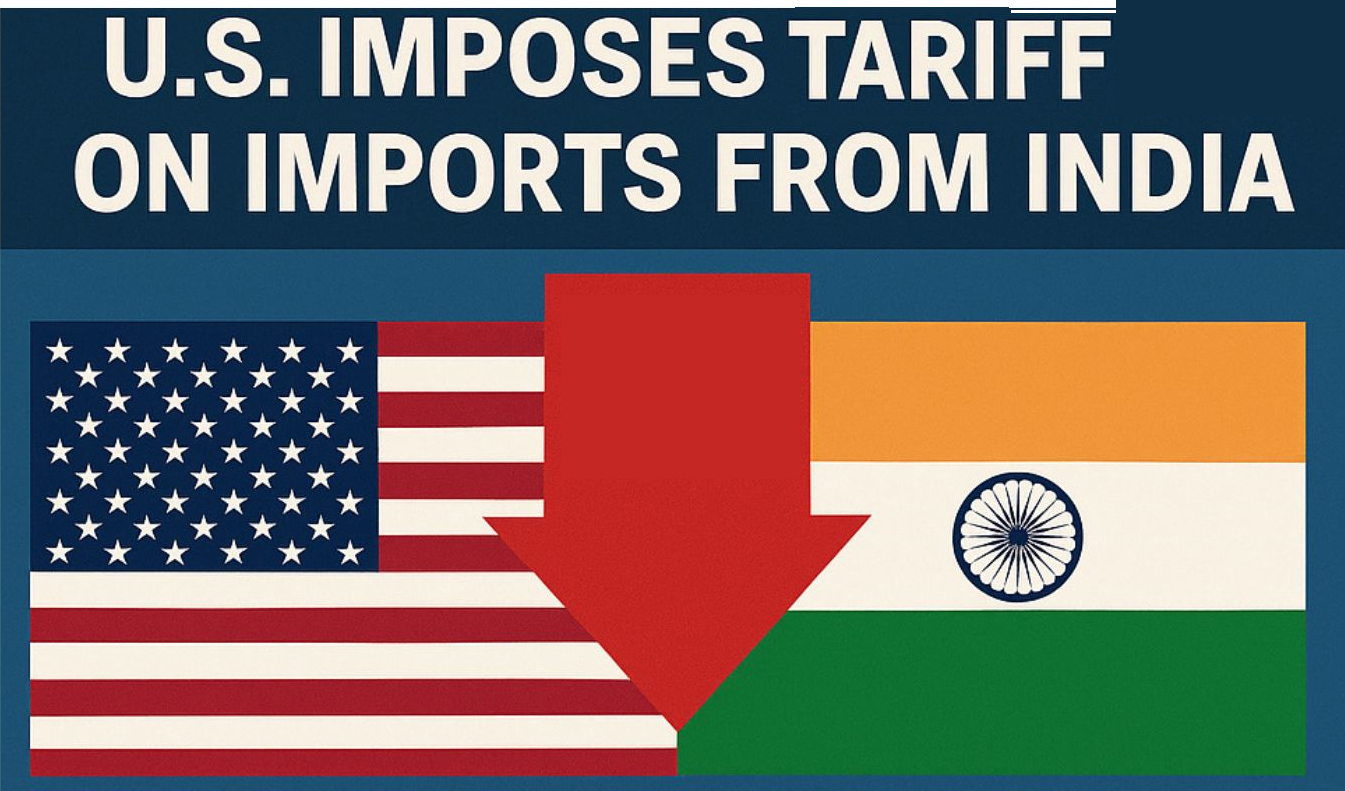
The United States has implemented a comprehensive 25% tariff on all imports from India, effective August 1, 2025, in a dramatic shift in Indo-US trade relations. This move has caused a significant shock to the world’s fastest-growing main economy and has raised serious concerns about the future of the partnership between the two democracies. Washington has justified the action as necessary to address two critical concerns: a ballooning bilateral trade deficitwhich reached a staggering $45 billion in 2024and discontent over India’s unwavering purchases of Russian oil and military hardware in the context of the ongoing Ukraine conflict. This action follows months of deadlocked trade talks. In contrast to tariff actions taken against other countries, the United States did not grant product-level exemptions to India. Consequently, critical sectors such as electronics, pharmaceuticals, petroleum, textiles, jewels, and auto components were placed under regulatory scrutiny.
The immediate and acute consequences for India’s export-driven industries are significant. Export volumes from India to the United States, which are presently valued at $86.5 billion, are expected to decrease by nearly 30% in the forthcoming fiscal year if tariffs are maintained, according to trade analysts. MSMEs that are heavily reliant on US demand, particularly in sectors such as textiles and auto parts, are currently at a significant risk of revenue loss and potential employment cuts. The smartphone industry, where India had emerged as a global production hub, stands to lose competitiveness just as industry leaders like Apple had ramped up Indian sourcing. A broad cross-section of generic and bulk drug exports will now be at a disadvantage, undermining India’s long-held status as the “pharmacy of the world.” Pharmaceuticals, which have traditionally been a bright spot in Indian exports, are also facing uncertainty. While some key medicines may still find market pathways due to regulatory necessity, the situation is uncertain. The high-tariff list includes gems, jewelry, petroleum, apparel, auto components, and solar modules, which pose a threat to both export earnings and supply chains.
Indian financial markets have been rattled by these developments on a domestic level, with equities in export-oriented sectors experiencing losses and foreign investors reevaluating India’s appeal as a global manufacturing hub. India’s exports are subject to lower tariffs and less geopolitical scrutiny from Washington, which has led to increased concern that it may lose territory to countries such as Vietnam and Bangladesh.
Nevertheless, this crisis has also prompted a discussion regarding potential positive outcomes. Experts argue that this adversity could serve as a motivator for India to expedite domestic reforms, diversify its export markets, and reduce its reliance on the United States by pursuing new trade agreements in Asia, Africa, and Europe. Some government officials and industry leaders are optimistic that India and the US will soon resume negotiations. Their objective is to obtain sectoral exemptions or progressive rollbacks in exchange for market concessions or closer alignment on global issues.
In a geopolitical context, the tariffs emphasize the increasing tension between the United States and India, even though their comprehensive strategic partnership is essential for maintaining regional equilibrium. The episode exposes the vulnerability of global trade norms in a world where economic pressures and foreign policy are increasingly intertwined.
Industry leaders and policymakers are urgently recalibrating strategies as Indian exporters prepare for the months ahead. They are investigating new trade corridors in Asia and Africa and advocating for policy reforms at home to enhance India’s competitiveness in a changing global landscape. Even though diplomatic channels are actively seeking new opportunities with their American counterparts, boardrooms in Mumbai, Surat, and Bengaluru are actively considering both risks and resilience. The current standoff is not merely a measure of export strength or trade negotiation prowess; it reflects the changing realities of a multipolar world, in which economic decisions are inextricably linked to strategic ambitions and cross-border alliances. Investment, expansion, and long-term planning decisions are significantly influenced by every development emanating from Washington for Indian businesses and workers who are directly impacted by these tariffs. In this crucible of competition, diplomacy, and the relentless pursuit of new opportunities beyond old paradigms, the ultimate shape of Indo-US commerce will be forged, despite the uncertainty that currently exists.
 Follow our WhatsApp channel
