

Hot on Heels of Americans
By Ewa Fronczak
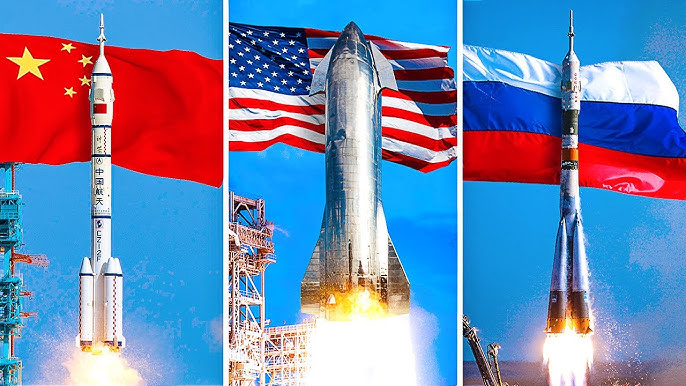
“In a decade, the US has gone from the undisputed leader in space to just one of two equals in competition”—this recent statement by US Senator Jim Inholfe at Senate Armed Services Committee hearing adds another voice to the debate on one of the most important races of our time: the race for space supremacy. The two major powers, US and China, seem to understand that dominance in space means dominance in every other domain. But one of these countries is particularly striking in the pace and quality of its development of space exploration capabilities, and that’s China. Senator Inholfe’s words are not fiction, but an opinion supported by abundant evidence and tangible achievements in Chinese science.
According to a recent report by Washington-based think tank, Progressive Policy Institute, an erosion of US leadership in space could occur within the next five years. For example, in some areas, such as positioning, navigation, and time synchronization, China already possesses superior capabilities. In others, such as broadband satellite services in low Earth orbit, the US still leads the way. The report’s authors emphasise that the primary goal of China’s space policy is to usurp the US’ leadership in space by 2045—and it increasingly appears that this goal will be achieved.
Even Xi himself leaves no doubt, speaking of “exploring the vast universe” and “becoming a space power.” Such a development would undoubtedly have disastrous consequences for America’s national security, global standing, and economic growth, as the parties themselves acknowledge. The Office of the Director of National Intelligence (ODN) is sounding the alarm, emphasising:“China’s space activities will increasingly undermine benefits in national security, trade, and global influence that the US has gained from its leadership in space.”
Alarms about China’s growing dominance in space are also being heard in military circles. General Stephen Whiting, commander-in-chief, USSpace Force, is warning of Chinese military technology based on space technology being developed “at a breathtaking pace.”Says he, China’s use of space to complete the “chain of death”, the process of identifying, tracking, and attacking a target, has become “very concerning.” The importance of space warfare capabilities in national defence strategies is demonstrated by the recent decision by current White House team to create a “Golden Dome”– $17.5 billion proposal for creation of a network of satellites by 2029 that will detect, track, and destroy missiles fired at the US.
General Whiting highlights three areas in which China has made impressive progress. One, space-based targeting system designed to search, target, and track foreign forces, for example in sensitive Indo-Pacific region. It can also be used to support precision “over-the-horizon” attacks on US military targets. End last year, China had over 500 satellites capable of conducting intelligence, surveillance, and reconnaissance (ISR), and over past decade, Beijing has placed nearly 900 satellites into orbit. China also developed the world’s most powerful satellite tracking camera, capable of capturing images with mm–precision accuracy from a distance of over 100 km.
Two, China’s strategic achievement is space-based anti-missile weapons –capable of destroying or disrupting foreign satellites launched from both Earth and space. These include reversible cyberattacks, SATCOM (satellite communications), and GPS jamming, as well as high-energy lasers, direct-launch anti-satellite (DA-SAT) missiles, missiles, and co-orbital Asat satellites placed in orbit to threaten other satellites.
The final area of concern is integration of Chinese space capabilities with the conventional Army, Air Force, and Navy. By utilising space services, Beijing has made its armed forces “more lethal, more precise, and with greater range.” During a major strategic realignment in 2016, the PLA added an air force unit to its Strategic Support Force, tasked with overseeing information conflicts. In April 2024, this force was divided into three independent units: a specialised aerospace force, a cyber army, and an information support force.
The history of independent manned missions began in China in 2003, when the Shenzhou 5 spacecraft, carried the taikonaut Yang Liwei into space to conduct first solo orbital mission. Since then, China has become the third country in the world, after the US and Russia, to have independent manned spaceflight capabilities. The mission’s main tasks are scientific research and ongoing expansion of China’s Tiangong space station. More than a dozen flights have already taken place, and Shenzhou 20 mission, which launched in April of this year, is currently underway.
It’s worth noting the Chinese, excluded by Americans from International Space Station, are generally open to international cooperation. The next batch of astronauts being prepared for Shenzhou 21, planned for 2026, is currently undergoing selection and training. For the first time, the group will include astronauts from special administrative regions of Hong Kong and Macau, but also from Pakistan, with which an agreement on cooperation in space has already been signed.
China is only the third country in history to send astronauts into space and build an autonomous space station, after the Soviet Union and US. China’s Tiangong (Heavenly Palace) space station is undoubtedly a symbol of its growing ambitions in space exploration –from humble beginnings in 2011 to a fully-fledged, manned orbital station, it’s a tale of technology, determination, and geopolitical aspirations.
American decision only accelerated China’s autonomy and the creation of the Tiangong station as since 2011, the US banned China from using the International Space Station (ISS) due to national security concerns. A law known as the “Wolf Amendment” prohibited NASA from engaging in bilateral cooperation with China.
Interestingly, US military’s global reach has been and remains largely dependent on Earth-based satellites, which, on the other hand, may constitute its potential Achilles’ heel. Satellites enable US armed forces to communicate effectively, navigate, gather intelligence, and precisely attack targets worldwide. According to US Department of Defence experts, China is testing and developing a range of weapons and tools that, firstly, counter American satellite dominance in space and, secondly, can destroy, disable, or intercept foreign satellites. It’s no coincidence that between 2019 and 2021, Beijing doubled the number of its intelligence, surveillance, and reconnaissance satellites in orbit—from 250 to 499.
Much can be said about Chinese civilization, but one of the most pertinent observations is that the Chinese like and are able to learn – from the best. This is also why the Chinese do not hide that the rapid development of Starlink over the last decade (currently around 8,000 satellites, with 42,000 planned) is both an example worth emulating and a challenge they have decided to take on and intend to accomplish – equally quickly and effectively.
So far, there have been four launches of Thousand Sails, which have launched 72 satellites into orbit; China is currently building a new category of orbital satellite constellations, numbers of which could reach thousands. The constellation, dubbed China’s Starlink, will join other space projects offering broadband satellite internet services. By maintaining its current pace, Beijing could not only replicate the American satellite giant’s successbut even surpass it—Thousand Sails is expected to have over a thousand satellites by 2027 and 14,000 by the end of the next decade.
In terms of exploration of the Silver Planet, China has transformed itself over the past two decades from an aspiring player to a leader. Its lunar program, named Chang’e – after the mythological goddess of the Moon – is a series of missions that not only pushed the boundaries of space technology but also delivered breakthroughs in other scientific fields. The Chang’e program began in 2007 with China’s first lunar probe, Chang’e 1 and on June 6, 2024, it became first country to land on the far side of the Moon with its Chang’e 6 mission. Once again, US and rest of world are left in amazement.
Undoubtedly, both the US and China view lunar missions as a milestone in programs aimed at exploring, settling, and potentially exploiting resources and other economic and strategic opportunities offered not only by the Moon but also by space in general. Therefore, it’s not surprising that China’s ambitions are raising concerns among key global players. NASA chief Bill Nelson warned that the US cannot afford to be left behind in the race for lunar exploration. During testimony on Capitol Hill, he expressed concerns that China could declare the lunar south pole its exclusive exploration territory if the Americans delay their efforts to return to the Moon.
The US-China space rivalry is unfolding, but Mars and its exploration are undoubtedly among the most important.In early September 2024, China announced its plan to launch a mission to collect and return samples from the Red Planet’s surface by 2028. If this plan is successful, and China’s achievements to date suggest so, China will be the first country to return material to Earth from another planet.
However, it is only when compared to NASA’s decision in April 2024 that the Chinese decision takes on another significant resonance. The Americans announced that their own Mars sample return mission is over budget and will be significantly delayed. It’s worth noting China has now become the second country after US to successfully soft-land an operational spacecraft on Mars.
The US-China space competition is not just a technological race—it’s also, and perhaps above all, part of a larger systemic clash between the world’s two largest economies. Space dominance, and opportunities it brings, seem crucial to every major nation today. Space exploration means more information, and information is an advantage—an advantage in every field. Chinese space activities will likely increasingly undermine the security, trade, and global influence advantages the US has gained from its previous leadership!—INFA
 Follow our WhatsApp channel
