

Upender Ambardar
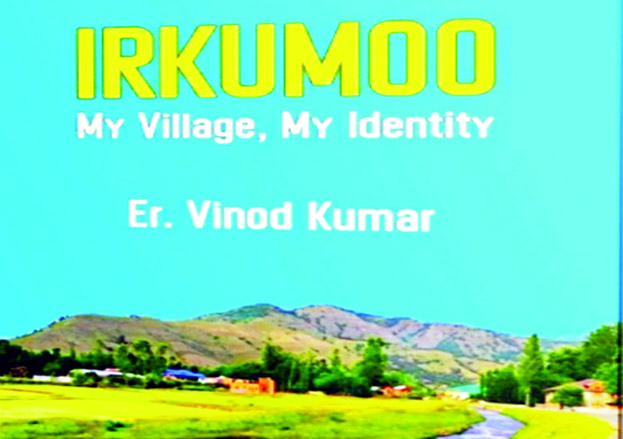
Name of Book: Irkumoo – My Village My Identity
Name of Author: Vinod Kumar
Kashmir, as we know is home to ancient culture, rich heritage, mysticism and unique holiness. The dynamic and purposeful traditions, ancient socio-cultural knowledge and wisdom are an inseparable part of our spiritual ambience. Additionally, the unsullied serenity is an integral part of it’s landscape. It bestows the exalted status of ” Dev Bhoomi ” to it. Our ethos and our moorings are both rooted and centered in it’s sacred geography as it is dotted with antiquated holy shrines and sanctimonious faith centers. It’s glorious civilization having an unknown continuity since ages has also nourished a wide mosaic of various art forms ranging from literature, poetry, music, drama, painting and architecture. All these artistic fruitions, socio-religious and historical linkages enjoyed a sort of divinized status in the times of yore.
The amazingly built age old stone temples, having exquisite intricacies are regarded as architectural masterpiece wonders. They also are a telling testimony to the architectural skill and contributed of ancient Kashmir.
The various spiritual cum religious shrines of Kashmir ranging from Hari Parbat, Tulla Mulla, Amreshwar Cave Shrine, Chakrishvari Peetham and Sarvijna Sharda Peetham (now in P.O.K.) showcase the Vedic origin of Kashmir and the grandeur of it’s prehistoric past. The tantric philosophy of Kashmir Shaivism in it’s different aspects like Pratibhijna, Kula, Krama and Spanda had a nourishing growth in Kashmir itself. Kashmir also boasts of a rich tradition and exalted concept of Shaktism ; wherein the Shakti alternatively known as Prakrati or Devi is the Supreme Divine energy expression. It finds it’s first mention in the Rigveda, wherein the ‘ Maya ‘ and Shiva are regarded as the two inseparable facets of the macrocosm.
Even Adi Shankrachrya, initially a steadfast Shavite had a thought change over in Kashmir and realized Shakti as a supreme entity and creative force of Lord Shiva, during his visit to Kashmir. Shaktiwad, comprising of ten mahavidhyas and 64 Yoginis, even now occupies a foremost place in Kashmir in the realm of spiritual philosophy.
The divine play of Prakrati having it’s root in Shakti has a powerful expression base as the entire Kashmir region is regarded as the ‘ Devi Angan ‘ ; the divine play-field of the supreme Goddess Parvati. It is metaphorically represented by the holy site of the ‘ Devi Angan’ at the holiest of the holy shrine of Hari Prabat, Srinagar.
The famous shrine of Martand of Mattan, representing the 13th manifestation of the Sun God, even owes its origination in Kashmir as per an established lore.
The Saundriya Lahari, the famous Tantric literary work in Sanskrit, hailing the glittering glory of the Shakti was composed by the renowned sage Adi Shankara atop the Gopadari hill of Srinagar.
The rivers, lakes, springs and other water bodies, especially the Vitasta are regarded as sacred and in most cases enjoy the same status as accorded to the Ganga or Godhawari rivers of the mainland. Legends, fables and oral narrative are deeply rooted in the age-old historical and socio-cultural expressions of Kashmir. They have been passed on to posterity mostly orally. They form a connecting link between the exalted past and the present times. They are usually laced with various elements of divinity, supernaturalism and mystery. They exercise a profound influence and impact in shaping our thoughts and indigenous narratives.
The book ” Irkumoo – My Village, My Identity ” authored by young writer Er. Vinod Kumar is a result of laborious documentation done by him. It is mostly based on the oral narratives and the information collected by him over the years through his extensive hard work. The oral history regarding his native village Irkumoo has been meticulously pieced together into a single whole in the form of a book by the author. I pat him for his intense and sustained interest for the documentation of the socio-cultural aspect of his native land. It is bound to inspire the creative urge among others, especially the youngsters.
The said book has been divided into several thoughtfully chosen chapters ranging from Administrative division of Kashmir, Anantnag, Breng Valley and its prominent surrounding places, Irkumoo hamlet, prominent persons of Irkumoo, and other related information about the author’s native village.
One feels both nostalgic and emotional while going through the narrative penned down by the writer. It is like a silent sojourn back to one’s own home and village. The experience seems to be both emotive and cathartic. The author, having a degree in Mechanical Engineering and a Master of Business Administration, is holding a superior post in his office. He seems to me as a sort of a pen man, who has passion and interest for language, literature, heritage and culture. This contrasting cross over seems to have helped the author to have an observant eye for details in unrelated spheres.
For a writer the language is as important as the apparels for a bride. Er. Vinod has taken it into his consideration while writing this book. This is possible when he has taken more study and research of Kashmiri literature. These are the two faces of the literary coin. If any writer ignores any of these two things, then his writing will not be effective. In this direction our young writer Er. Vinod is fortunate that he taken care of both study and research. This will make him an effective writer in times to come.
The getup of the book is very attractive. The front cover page beautifully justifies the title of the book. The paper and printing is very good.
The said book rounds off with the inclusion of genealogical tree charts of the families of Irkumoo village. It helps one to get acquainted with distant family members, relationships and shared ancestry.
In a plain speak, the book on Irkumoo is a delightful readable book packed with valuable information. It will cheer all those, who have an appetite for the related topic and the subject.
 Follow our WhatsApp channel
