

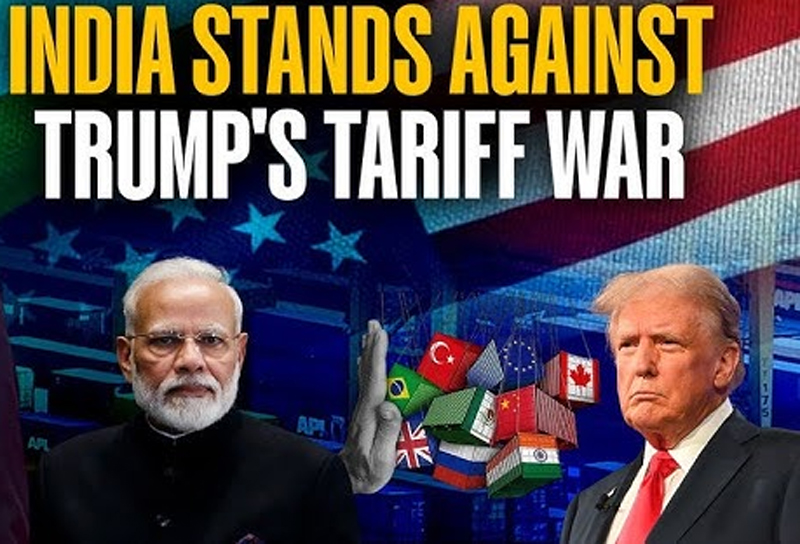
The recent remarks by Prime Minister Narendra Modi are, in essence, a calculated diplomatic signal aimed at Washington. Modi’s statement that India will “never compromise” on the interests of its farmers, fishermen, and dairy sector was a direct response to US President Donald Trump’s decision to hike tariffs on Indian goods to 50 percent. Washington wants lower tariffs on products such as corn, soybeans, apples, almonds, and ethanol, as well as increased access to US dairy products. India, however, resists-and rightly so. The bulk of Indian farming is still rooted in traditional, smallholder-based agriculture, with the majority of farmers cultivating for household needs or local markets. These farmers lack advanced machinery, genetically modified seeds, or high-tech farming systems; they operate in a world where survival, not surplus, is the driving force. Allowing cheap imported farm and dairy products to flood the market would devastate these livelihoods. It would erode the already fragile rural economy, reduce the bargaining power of Indian producers, and potentially create food dependency on foreign supply chains. This is why Modi’s stand is not just political posturing-it is a fundamental defence of economic sovereignty and social stability.
The US’s tariff escalation is not an isolated incident. In recent years, Washington’s trade policy has increasingly relied on unilateral pressure tactics, targeting India, China, the EU, Canada, Brazil, and others. Brazil’s President Lula da Silva’s supportive phone call to Modi and China’s open criticism of the US’s tariff on India are clear signs that other nations recognise the stakes. Many of these countries have been on the receiving end of similar punitive measures and understand that unchecked unilateralism could set a dangerous precedent. India’s position is further fortified by its strategic autonomy in global geopolitics. Since independence, India has followed a non-aligned policy, maintaining trade and diplomatic ties across the spectrum-from the US to Russia, from the EU to the Global South. The US pressure to reduce crude oil imports from Russia, especially at a time when Russian oil offers significant cost savings, is another example of overreach. By importing cheaper oil, India saves billions of dollars that can be redirected toward development projects. It is both economically prudent and politically legitimate for New Delhi to resist external diktats on where it sources its energy.
With Modi slated to visit China for the SCO summit and Russian President Vladimir Putin expected in India later this month, the stage is set for potential geopolitical recalibrations. The global order is in flux, and the aggressive tariff strategy of US may accelerate alignments among countries seeking a fairer, multipolar trade system. India’s strengths-its vast labour pool, cost-effective manufacturing, skilled technical workforce, and status as the world’s pharmacy for affordable generic medicines-make it a formidable player in the global economy. These are sectors where the US, with its high labour costs, cannot easily compete. In areas such as garments, footwear, pharmaceuticals, and IT services, the US is more dependent on imports than it cares to admit.
The PM’s long-term vision for Indian agriculture-nutritional security, climate-resilient crops, AI-based farming support systems, solar-powered micro-irrigation, and soil health management-suggests that India is preparing to make its farming sector more competitive globally, without sacrificing the smallholder model. The push for crop diversification and technological integration is aimed not just at meeting domestic needs but also at carving out a larger share of the international agricultural market.
Practically, the US tariff hike is not just ill-timed-it is strategically shortsighted. By targeting a country with both economic potential and geopolitical clout, the US risks uniting a broad coalition of nations against its trade policies. As the world shifts toward multipolarity, such confrontations could hasten the decline of unilateral dominance. The message is clear: India will not bow to arm-twisting, whether in agriculture, energy, or trade. And if Washington’s actions end up galvanising a global pushback, the tariff war it has initiated might well become the catalyst for a new, more balanced international trade order.
 Follow our WhatsApp channel
