

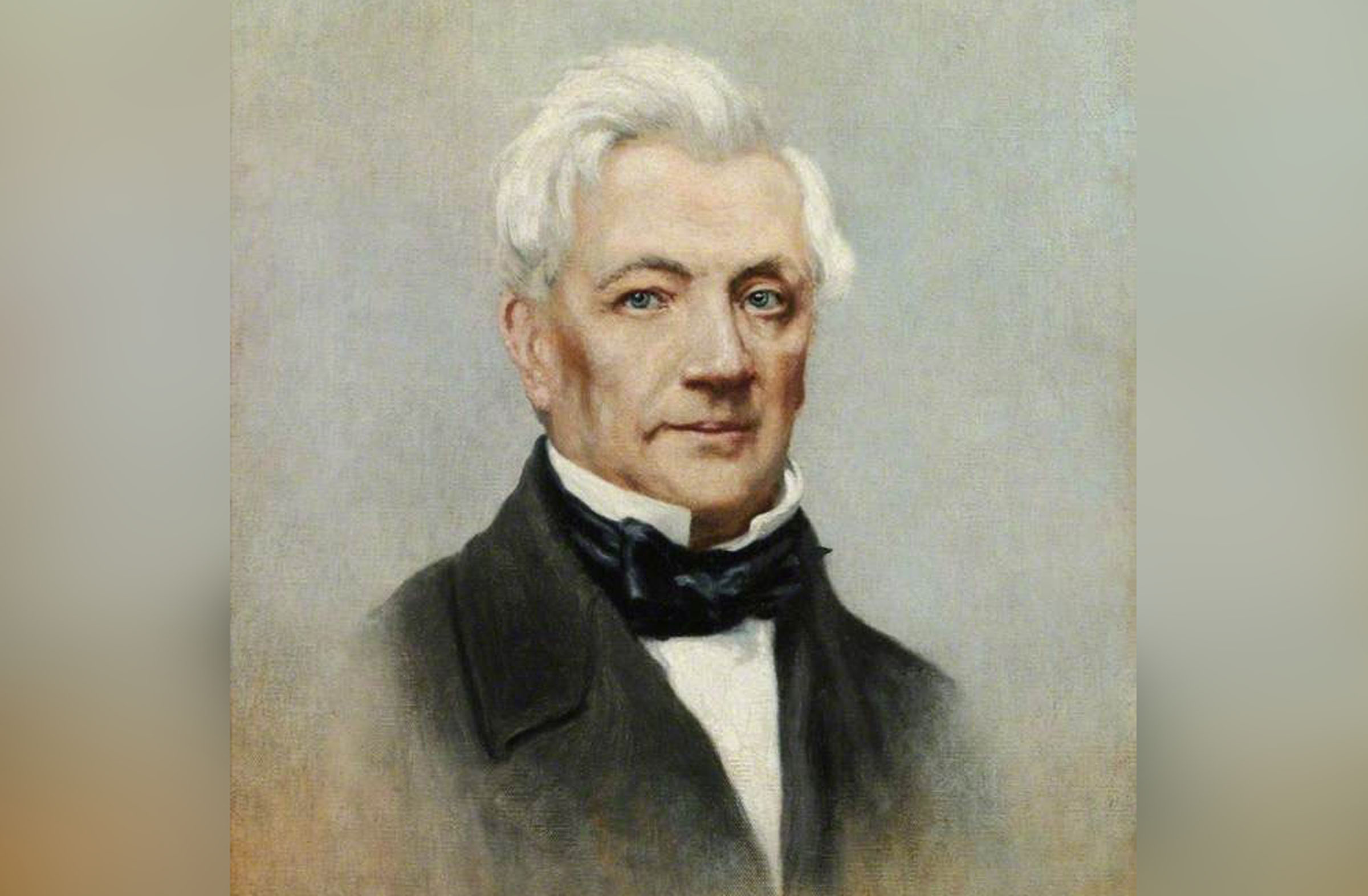
Iqbal Ahmad
It would certainly look unbelievable, born in 1799, perished in 1840 (total age 40 years) and in his few matured years of this little age, he became the father of twin disciplines of Indian numismatics and Indian palaeography. I am talking about a 19th-century English scholar James Prinsep, a rare genius scholar who, in this little age, became the first expert to decode Indian ancient scripts and coins.
Usually, the colonial period of Indian modern history is referred to as the darkened period of Indian history because of its several misdeeds, particularly in terms of its monarchical rule of slavery and exploitation of the country’s resources. But if we think cool-mindedly and analyse it on facts, in several terms it will look to us a golden era. During this period, a number of development works were, for the first time, undertaken and several miracles also happened in this period of modern Indian history. I very much know that people would hardly agree with my view, as most of my friends have been reckoning this period as the darkened age in terms of its aggression and exploitation of India’s resources, but personally, I have got a bit different view. While speaking above all political lines and beliefs, during this era several British administrators, academicians, and professionals played an important role in the establishment of educational institutions, missionary hospitals, cultural institutions, promotion of literacy, social equality, and in the rights of marginalised communities. Their advocacy for reforms such as the abolition of Sati and widow remarriages contributed to India’s broader social justice and enhancement of cultural fabric.
In terms of culture, British experts not only explored the Indian cultural past but also identified, deciphered, and conserved it for the Indian generations to come. They introduced the scientific investigation of its archaeological sites and uncovered the hidden history of this country by introducing archaeological, numismatic, and epigraphic research studies. In historiography, they evolved a scientific process of separating myth from Indian history. For them, it was a challenging and most difficult task, but they did it in a pleasant manner. In fact, India has a rich and ancient tradition of storytelling, myths, legends, and folklore heritage which has almost shadowed the genuine historical facts. And in India’s conservative context, it was not such an easy task to clear its mythological contents with its real historical facts; it often blended seamlessly and local historians would hardly like it.
James Prinsep was the first English scholar who undertook this grand process. He was a rare genius, and skilled in various cultural fields, particularly in identifying and deciphering of ancient alphabets and ancient words. He is best known for deciphering the Indian ancient scripts, Brahmi and Kharosthi, of ancient India, and he was the first to unlock the meaning of Emperor Ashoka’s inscriptions.
Prinsep’s work on deciphering the scripts was crucial for understanding early Indian history, particularly the reign of Ashoka, as his inscriptions were the earliest tangible evidence of Buddhism. He meticulously studied and documented various aspects of numismatics, metallurgy, and meteorology, in addition to his work in deciphering scripts.
Prinsep’s most significant achievement was deciphering the Brahmi and Kharosthi scripts, which were used in ancient Indian inscriptions and coins. This breakthrough allowed scholars to read and interpret texts from a period previously shrouded in mystery. The Indian scholars to whom these ancient scripts belonged were unable to identify them.
Besides epigraphy, Prinsep made contributions to Indian numismatics, metallurgy, and meteorology fields as well. He was the first scholar to identify Indian coins and decoded the legends and motifs displayed on these ancient coins.
The ancient Indian coins and scripts, for decades, had been a mystery for local historians and there was nobody from Indian origin to decipher this treasure trove. Surprisingly, James Prinsep, from a very far-off land and culture, covering several months of distance, arrived here and undertook this difficult job. He, for the first time, decoded Indian ancient words. He became the father of Indian numismatics and Indian palaeography, that too at a very young age. He also became the founding editor of the Journal of the Asiatic Society of Bengal which, for the first time, highlighted his dedication to Indian scholarly pursuits and the dissemination of Indian knowledge.
Although he was extraordinarily genius and hardworking, he was ill-fated as well, as he got very little age to study Indian culture and history and suddenly fell victim to a deadly disease which he could not fight and lost his struggle for life at the age of forty.
But what he did in this little span of age for Indian culture and history, no one could have done in centuries together. His researches enabled his contemporaries to uncover the Indian history, remove myth from it, and reconstruct it on modern scientific lines.
Such genius people are hardly honoured anywhere, but it is their work which keeps them alive.
(The writer is a Senior Archaeologist)
 Follow our WhatsApp channel
