

K D Maini
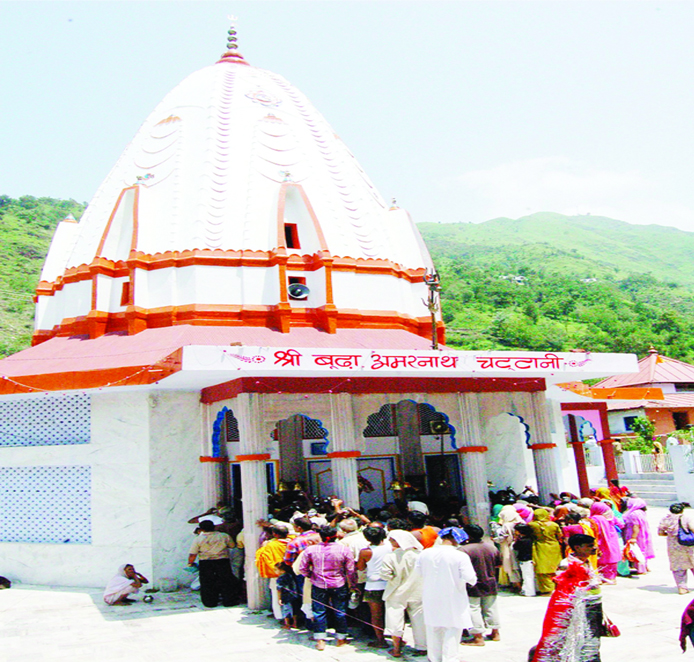
Budha Amarnath Temple is situated in between the main belt of the Pir Panchal range at Rajpura Mandi, 25 km in the north-east of Poonch city and 244 km from Jammu. This glen is surrounded by snow-bounded peaks, thick fir forest on the mountains, green pastures, crystal clear streams with a cool climate.
The centuries-old temple has been constructed with one stone; there are four doors in the temple on the northern, southern, eastern, and western sides which indicate that the doors of the shrine are open for all the Varunas. A natural Shivling of white stone (Chakmak) inside the temple is famous as Chattani Baba. There were four traditional holy springs from a religious point of view, however, at present the water of these springs has been tapped in one pipe. The devotees are taking bath in this holy water before entering the main temple.
Budha Amarnath Mandi has a great religious importance for the Hindu community. It is said that at this very place Lord Shiva started narrating the Amar Katha to Parvati Ji which ended at Amarnath near Pahalgam, Kashmir. It is believed that one must visit this sacred shrine before performing the Yatra of Baba Barfani Amarnath, Kashmir.
As per one legend, Mahatma Pulasta, the grandfather of King Ravana of Sri Lanka, had meditated at this very place for a pretty long period. He was a devotee of Lord Shiva. As per Neelmat Puran, Pulasta was a religious person, an artist, and a sculptor, who had erected a number of images of Lord Shiv. One reference from Neelmat Purana is as under:
‘By saying the Goddess erected by Pulasta gives one the merit of gift of cows and also release from the diseases.’ Even till date, a number of ancient idols have been recovered from this area which are lying in the premises of Budha Amarnath complex. Since Pulasta was a great Rishi, sculptor, and popular among the natives, therefore after his death, the natives constructed a temple of Lord Shiva at Budha Amarnath. It is believed that Lord Shiva himself comes to this temple on Shrawan Purnima and fulfills the desires of devotees.
As per RajTarangini Kalhana, the original name of Mandi was Atalaka where the ancient temple of Budha Amarnath is located. After 850 AD when Raja Singh Raj (the father of great Rani Deeda) established Loharekote Loran principality, constructed impregnable Loharekote fort and defence posts around his principality. One such post was set up at Atalaka (present Attoli) to defend the area and to provide protection to trader communities of Punjab and Kashmir who were bringing their goods at this place near the ancient temple Budha Amarnath to exchange. The temple was renovated and devotees started visiting the shrine. Thus a market was established which was named as Mandi. However, the rest of the village Atalaka is still known as Attoli.
It is said that after some time the temple area had come under the slides and disappeared. In the 16th century AD, a hermit came from the Kashmir side and stayed at this place. The locals told him that there was an ancient temple which had come under the slide. Then the hermit started excavation and recovered the temple.
During the rule of first Dogra Raja Moti Singh (1852-92), this temple was renovated, the Raja of Poonch converted this area into a summer capital of Poonch, constructed a royal bungalow, named this place as Rajpura Mandi and started living there during summer season. Therefore, hustle and bustle started at Rajpura around Budha Amarnath Temple. To make this place more attractive, Raja Moti Singh started Charri Mubarak Yatra from Akhara Tetrinote (now in POK) to historic temple Budha Amarnath. In the meantime, Dashnami Akhara complex Poonch was renovated and it became the seat of Raj Guru. Then the Charri Mubarak Yatra started leaving from this place towards Budha Amarnath Rajpura on the eve of Shrawan Purnima on the pattern of Amarnath Yatra of Kashmir. This ancient temple became the center of devotion for Hindu pilgrims all over the Poonch principality. During the happenings of 1947, since Mandi remained under the occupation of Pakistan for some time, therefore, Yatra could not be performed. However, in 1948 when Mandi was liberated, an Army Colonel Muluk Singh Hakkl of Jammu who was posted in the Mandi area, had renovated the temple, restored its religious sanctity and with his help yatris again started visiting the shrine. Thus Budha Amarnath Mandi again became the center of devotion and Yatra resumed.
Presently the pilgrims from various parts of the country are visiting the shrine throughout the year. However, on the eve of Shrawan Purnima festival, a weeklong Yatra is organized by Vishav Hindu Parishad in collaboration with Bajrang Dal. Nishu Gupta, Yatra Prabhari, told that this year on 27th July the yatris from various parts of the country were received formally at Bagwati Nagar in a function before the departure of the weeklong Yatra towards Budha Amarnath. On 28th July, the Yatra started at 4:00 AM from Jammu, had breakfast at Akhnoor, tea at Sunderbani, lunch at Rajouri, and refreshment at Bhimbar Gali. The yatris were received in Degree College Poonch ground by the citizens of Poonch in a big function in which persons of all communities participated. Proper boarding and lodging arrangements for the Yatris have been done by the management committee. On 29th July early in the morning, Yatra left for Budha Amarnath Mandi and after having the Darshan of the shrine returned the same day. This Yatra shall continue till 6th August. On 7th August, the last Jatha shall leave from the shrine towards their destination.
Master Kheterpal, President Sanatan Dharam Sabha Poonch, told that on 7th August the Yatra shall start from Dashnami Akhara Poonch towards Mandi after Havan, Puja, Kirtan, Pravachans of Swami Maha Mandleshwar Vishav Aatma Anand Saraswati. Then the procession of sacred mace will start towards Budha Amarnath. The persons from all castes and creeds will participate in this procession. A guard of honor is paid to the sacred mace carried in a palanquin by the devotees. Thousands of devotees accompany the holy mace procession. The sadhus and devotees chant the slogans and bhajans throughout the Yatra.
With the installation of the holy mace, the main Mela at Swami Budha Amarnath starts in which thousands of pilgrims from Poonch, Surankote, Mendhar, Rajouri, Nowshera, Sunderbani, and Jammu participate on Shrawan Purnima and have the Darshan of Baba Chattani in the temple. This Mela shall continue till Raksha Bandhan festival on 9th August.
 Follow our WhatsApp channel
