

K B Jandial
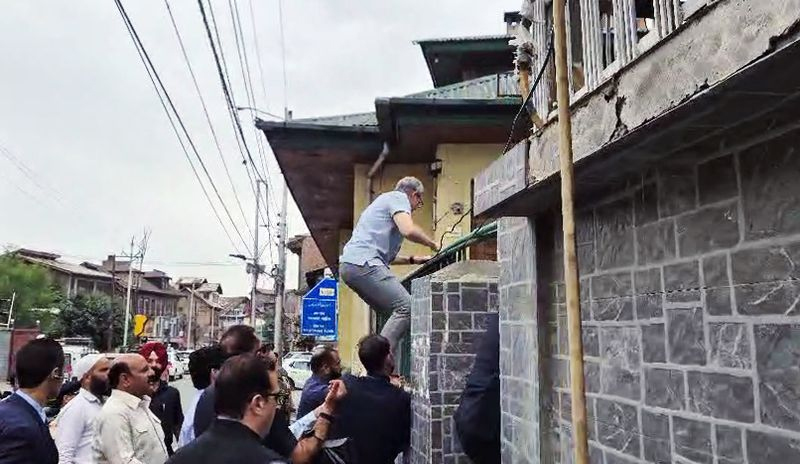
An avoidable controversy erupted in Srinagar on 14th July when Chief Minister Omar Abdullah and other NC leaders, including party patriarch Dr. Farooq Abdullah out manoeuvred the local administration to reach the ‘Mazaar-e-Shuhada’. Despite security barricades and police efforts to stop them, they succeeded in offering fatiha khwani. The Chief Minister had a brief scuffle with the police while scaling the barricaded gate, that was interpreted by some as a show of their political ‘triumph’. It, however, raised legitimate concerns on propriety of the act.
On social media platform X, Omar explained their absence on July 13-the traditional date for observing Martyrs’ Day since 1940, a legacy of Sheikh Abdullah,-“Homes were locked from outside, and police along with central forces were deployed to stop people from paying homage at a graveyard that holds immense historical significance.” Looks embarrassing for a serving Chief minister, even though, in a Union Territory, his authority remains limited under the Constitution.
Straight Talk
Choosing to make a political point, Abdullahs, several ministers, and a handful of party colleagues, arranged a covert visit to the cemetery the next day. Though lacking the formal solemnity typical of official observances, this bold defiance of restrictions served as a political message-one of persistence and soft resistance against administrative control.
A widely circulated video showed Omar Abdullah, flanked by security officers and party legislators, briskly walking towards the shrine while onlookers paused to witness the moment. One clip showed two Jammu and Kashmir policemen trying to restrain him by holding his arms, while one of his security personnel intervened to free him. Omar later shared these visuals, calling the police actions unwarranted and asking under what legal authority he was being stopped from offering prayers. “I am made of sterner stuff,” he wrote, claiming he had done nothing illegal.
Images of the Chief Minister climbing walls to reach the sealed graveyard quickly went viral on social media, portraying him as a defiant leader, casting him in a heroic light. However, the entire episode exposed a serious lapse in political and administrative decorum. It raised an important question: Should the Chief Minister be seen breaking restrictions, and should the police have used force to stop him from offering homage at a site revered by many Kashmiris?
The ‘Mazaar-e-Shuhada’ has long served as a potent political symbol for Kashmir based political parties even though ordinary Kashmiri has no love lost for them as a new class of ‘martyrs'(militants) has come up after 1990. Against this backdrop, the Chief Minister’s stealthy visit seems more politically calculated move than spontaneous reaction. One must ask: Was the symbolism worth the institutional embarrassment?
Historically, July 13, 1931, marks a pivotal chapter in Kashmir’s quest for democratic rights during Maharaja Hari Singh’s rule. It catapulted Sheikh Abdullah to prominence after he left job of teacher and formed the Reading Room Party.
In his autobiography Aatish-e-Chinar, the Sheikh noted how the martyrdom of 22 individuals reignited the spirit of resistance. He wrote, “Who could have imagined that the bloody event involving Abdul Qadeer would revive the dying fire of our freedom struggle…” It was he who bestowed the title of “martyrs” on 22 killed persons in the firing. The Sheikh who was the main beneficiary of 13th July 1931 incident, wrote in ‘Aatish-e-chinar, that at a public meeting at Gao Kadal on 12th July, 1931, he had appealed to the people to desist from marching to the Central Jail next day (13th July) but some leaders like Sayed Maqbool Baihaqi had incited the people to go there.
This historical significance explains why Martyrs Day continues to hold emotional and political value for the NC. Omar and Farooq Abdullah’s decision to gatecrash the graveyard, was their way of reclaiming that legacy.
But who qualifies to be a martyr? Comparing the 1931 killings with the Jallianwala Bagh massacre, as Sheikh Abdullah did inAatish-e-Chinar, is problematic. At Jallianwala Bagh, the people gathering was, a peaceful assembly of people commemorating the Baisakhi festival, while the mob at Central Jail Srinagar was violent, incited by provocative and seditious speech and attacked the jail. Despite being called martyrs by Kashmiri leaders and historians J&K observed a holiday till 2019. The persons killed in 1931 were part of a crowd that turned violent-something many in Kashmir prefer to ignore. Their deaths were the result of violence, not a martyrdom.
While Kashmiri historians and leaders call them martyrs, despite being the rioters and killed while quelling the violence,Kashmiri historians are silent on what happened to Kashmiri Hindus in its aftermath which is a horrifying tale.
More concerning is the historical silence about what followed the 1931 unrest-particularly the atrocities committed against Kashmiri Hindus. Many historians are convinced that the British played a role in stoking the protests, angered by Maharaja Hari Singh’s bold speech at the 1930 Round Table Conference in London. There, the Maharaja passionately advocated for Indian equality within the British Commonwealth and declared himself “Indian first and Indian last”-demanding equality, honour, and freedom for India and its people. This shocked the British, as very few princes had ever dared to use such words in support of India’s independence. He had already curtailed certain privileges enjoyed by the British Resident in Srinagar, further aggravating tensions.
A key source of friction between the Maharaja Hari Singh and the British existed over the control over the strategically vital Gilgit region. Gilgit was divided into two zones-one directly administered by the Maharaja and the other overseen by a British-appointed Political Agent. The Maharaja had long opposed this British interference and wanted full control.Britishers considered the Maharaja haughty and independent minded who had already withdrawn some of the facilities and easements from the British Resident at Srinagar and wanted to clip his wings.
The 1931 upheaval was sparked by Abdul Qadeer Khan, butler of Major Abbott of the Yorkshire Regiment located in Peshawar who was intriguingly present in Srinagar, reportedly on holiday. Qadeer, who had nothing to do with Kashmir, gave an inflammatory speech at Khanqah-e-Mualla on June 21, urged Muslims to “arise and take on your oppressors rise. Pointing towards the royal palace he shouted “pull that edifice down”.He was arrested and charged with sedition.
Sheikh Abdullah later blamed the then Governor, Raizada Trilok Chand, for escalating the situation by ordering arrests of protestors, which led to widespread stone-pelting and arson. Historian P.N. Koul Bamzai documented in his bookCulture and Political History of Kashmir,how an angry mob stormed the jail, prompting police firing. Yet, most accounts stop short of detailing what followed-violence against Kashmiri Hindus.
Bamzai wrote that the aftermath saw Muslim protestors parade the dead through market streets, triggering targeted attacks on Hindu shops and homes. In one Srinagar suburb, three Hindus were killed. Col. (Dr.) Tej K. Tikoo, in his book Kashmir: Its Aborigines and Their Exodus, contended that the riots were orchestrated to destabilize the Maharaja’s rule and pressurise him into leasing Gilgit to the British. According to Tikoo, Kashmiri Pandits bore the brunt of the Muslim mob’s fury, leading to horrific scenes-something The Tribune also reported at the time, referring to it as an “orgy of communal rioting.”Kashmiri pundits call the Martyrs Day as Bhatta loot. The Tribune reported the Kashmir Riot in which it narrated “the orgy of communal rioting” and harrowing scenes including school boys hurled into river.
Couldn’t the embarrassing incident of 14th July have been avoided in the larger interest of political harmony and stability?
Drawing lessons from history, there is a growing sensible view emerging as to how did India lose the gains of a victory? if post conflict management is marred by neglect and complacency of winning the battle, Strategic experts like Lt Gen Syed Ata Hasnain started analyzing why India lost Bangladesh today despite our the most decisive military victory and creation of a new sovereign country. He cited India’s neglectof all aspects of post conflict management. He, in his recent piece, rightly observed that winning a conflict is far easier than managing the peace that follows. According to him, India did little to nurture Bangladesh’s national identity and instead celebrated our victory without endorsing sacrifices of the Mukti Bahini.
This wisdom isequally applicable to Jammu and Kashmir. The abrogation of Article 370 and the successful conduct of Assembly elections mark a turning point. But these gains require sustained trust-building, inclusive narratives, and a focus on healing. Incidents like the 14th July scuffle, no matter how symbolic these may be, have potential to derail progress by reigniting old grievances.
Chief Minister Omar Abdullah has largely avoided confrontation with the Centre. Likewise, the LG, Manoj Sinha-a seasoned politician-recently confirmed that he shares a healthy working relationship with Omar. In this encouraging political climate, all stakeholders must strive to prevent unnecessary flashpoints.
The 14th July episode may have been dramatic, even “heroic” in the eyes of some, but it ultimately distracted from the overarching goals of peace, unity, reconciliation, and integration. Going forward, Kashmir needs mature leadership that chooses dialogue over defiance, unity over division, bridges over barriers and healing over political theatrics. Reaching out to the people of Kashmir, without ignoring Jammu, should also be a part of long-time fruitful investment.
(feedback:kbjandial@gmail.com)
 Follow our WhatsApp channel
