

Dr Sudershan Kumar
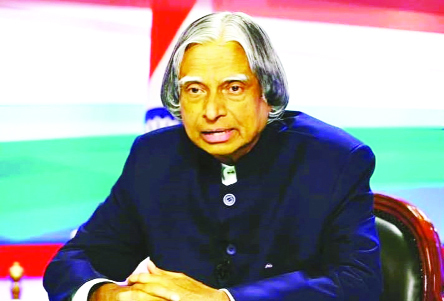
Every year, on 27th July, India bows its head in remembrance of Dr. Avul Pakir Jainulabdeen Abdul Kalam, popularly known as the Missile Man, People’s President, dream of youths and children’s friend who passed away in 2015 while delivering lecture at IIM Shillong in Meghalaya due to sudden Cardiac arrest. Dr. Kalam was not just a scientist, but a visionary, teacher, author, and statesman who left a permanent imprint on India’s journey towards technological self-reliance.
He was the greatest son of India, who dedicated his life for the mother land and its people. It is beyond imagination to understand that how a boy born in a pious Muslim family in Rameswaran located at Southern tip of India in Tamil Nadu state with moderate earning (from boat ferry) rose to become the president of one of the largest democracy of the world and made tremendous contribution in every sphere of life. The young Kalam commenced his journey from Rameswaram, a small town with majority Hindu population and a little sprinkling of Muslim and Christian communities. In this small holy town these three communities were living with peace and harmony since ages from generations together. The mutual trust and harmony was further fostered by the three eminent personalities of the town -AP Jainulabudan (Kalam’s father) an Iman of mosque; Pakshi Lakshmana Sastry, head priest of Ramanathaswamy, the Hindu temple and the father Bodal of Church by forging special bond of friendship between the three of them. These three used to sit every week over a cup of tea to discuss issues related to island. Such an early exposure had convinced Kalam that multitudinous issues lay in dialogue and cooperation among the country’s religious, social and political leaders. Kalam believed that respect for others’ faith was one of the key corner stones of Islam. He even went to the extent of saying that for great men religion is the way of making friends. And for narrowly minded people, religion is a fighting tool. This had a great impact on Kalam’s early life. With this background the young Kalam rose from modest beginnings to become one of the most revered figures in modern Indian history. Dr. Kalam had a tremendous respect for society and was ready to help poor and rural masses. His humility is evident from his saying, as per his words , “I am not hand some guy, but I can give my hand to some one who needs. Beauty is in heart but not in face” As a simple and great man, he changed the life of many Polio patients, gave money from his own pocket to needy and under privileged. He was an inspiration to all of us and the people of the country. Self less service was embodied in him, to the extent that in the year 2012 he launched a programme for youth India “What Can I Do” with the central theme of eradication of corruption from society. His charismatic aura and motivational speeches inspired many. Even the author of this article had the opportunity to interact with him at many occasions during his tenure as a Director General DRDO, President of India and afterward till his death. Each time the author got motivated to take up difficult challenges and evolve strategy for their completion. His life was a story of resilience, brilliance, and selfless service to the nation. He believed in dreaming big and converting those dreams into tangible actions through hard work and indigenous innovation. While the world knew him for his calm demeanor and spiritual depth, the nation admired him for his path-breaking contributions to India’s defense, space, and nuclear capabilities. It is difficult for any individual to pen down the contributions of such a great personality of the world in nation building but the author still endeavoured to gather courage to list down few for acquainting the younger generation. These were instrumental in making India self-reliant in critical technologies.
Architect of Indigenous Missile Development: Dr. Kalam’s most iconic legacy is undoubtedly his work in developing indigenous missile systems. He led India’s Integrated Guided Missile Development Programme (IGMDP) during the 1980s and 1990s a bold initiative that envisioned self-sufficiency in strategic missile technology. For accomplishing this arduous task he had roped in nearly 800 industries. His vision helped India to attain self sufficiency in missile technologies. Thus he was commonly known as a “Missile Man of India”. Under his leadership, India successfully developed and tested a series of missiles, each symbolizing technological sovereignty notably among them were Agni (India’s first intermediate-range ballistic missile.), Prithvi (Tactical Surface to Air missile) Trishul, Akash, and Nag (Representing short to medium-range air-defense and anti-tank missile systems). These projects laid the foundation to reduce dependence on foreign defense imports and made the country one of the few in the world with indigenously developed missile systems. His leadership style blended scientific excellence with nationalistic zeal, making indigenous development not just a goal but a movement. It is not out of context to mention here that the Dr.Kalam had vision to lay a path towards development of niche and critical technologies for future war fare. Use of Indigenous technologies/system in Operation Sindoor is the glaring example. The indigenous system used during Opeartion Sindoor are Akash Missile, Electronic warfare system, BrahMos Missile, Drones, Anti Drone systems, Lightening ammunition, Akashteer and many others etc.
Pioneer of Self-Reliance in Aerospace and Defense: Dr. Kalam played a critical role in the development of India’s first Satellite Launch Vehicle (SLV-III), which successfully placed the Rohini satellite in orbit in 1980. This was a giant leap for India, showcasing its ability to participate in the space race through indigenous efforts.
His tenure initially as Director of DRDL and subsequently as a Director General DRDO (Defence Research and Development Organisation) and in ISRO (Indian Space Research Organisation) was marked by his focus on using science and technology for national development. He constantly advocated for converting military technologies for civilian use, such as lightweight calipers for polio-affected children, cardiovascular stents, and cost-effective power solutions for rural areas. He believed that true development comes only when a country builds its own capabilities, and this belief drove his relentless push for indigenous innovation across all fields viz defense, space, agriculture, healthcare, and education.
Visionary Leader and National Motivator:Dr. Kalam’s contributions went far beyond the laboratory. As the 11th President of India (2002-2007), he brought the spirit of science, innovation, and national pride to the office. He redefined the role of the President, using the platform to inspire million especially students and youth to believe in self-reliance, knowledge, and nation-building.
The vision 2020 document prepared by him, during his tenure as the Principal Scientific Advisor to the Government of India, laid down a road map for India’s transformation into a developed nation through indigenous technology development, innovation, rural empowerment, and inclusive growth. Even after leaving office, he continued to write, teach, and mentor, leaving behind a treasure trove of inspirational books such as: Wings of fire, Ignited Minds, India 2020, My journey and Indomitable spirit. Each of these works emphasized the self-belief, scientific progress, and indigenous strength as pillars of national success.
The Legacy Lives On:
Dr. Kalam’s death was as impactfull as his life. He passed away while delivering a lecture at IIM Shillong, speaking to students about creating a better future. Even in his final moments, he remained true to his life’s mission: to empower youth through knowledge, integrity, and self-reliance. One of the unbelievable and important aspect of his life was that he breathed his last the way he had thought off. He said one is blessed if one can die working standing without long drawn ailing. Good by should be short really short” This exactly happened what the destiny had kept for him.
Today, India’s space missions like Chandrayaan, Gaganyaan, and indigenous defense manufacturing programs under “Aatmanirbhar Bharat” echo Dr. Kalam’s vision. His dream of an India that stands tall on the pillars of technology, innovation, and indigenous capability is slowly but steadily becoming a reality.
On his death anniversary, we remember Dr. Kalam not with sorrow, but with pride, gratitude, and renewed commitment to his ideals. His life remains a guiding light for generations to come.As he famously said:
“Dream, dream, dream. Dreams transform into thoughts and thoughts result in action.”
Let us honor his memory by continuing the action he set in motion towards a strong, self-reliant, and technologically Superior INDIA.
 Follow our WhatsApp channel
