

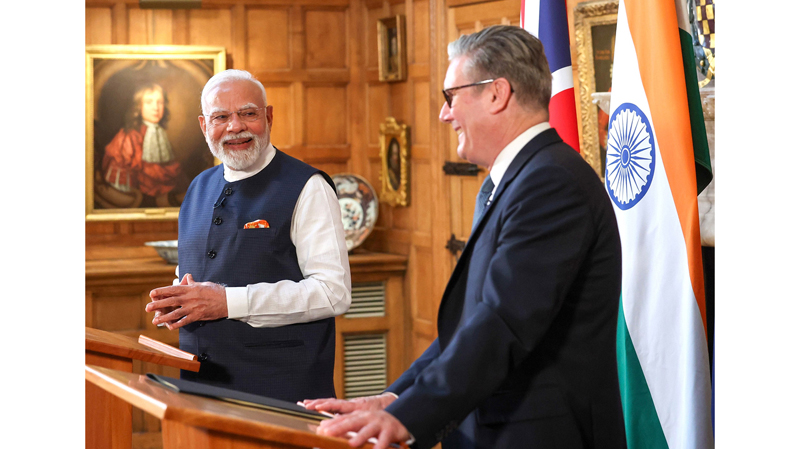
Historic day: Modi on free trade pact
*Most significant deal that UK has signed: Starmer
LONDON, July 24:
India and the UK on Thursday inked a landmark free trade pact that will increase market access, cut tariffs on British whisky and cars among other items and double bilateral trade by 2030 as the two strategic partners vowed to chart a new growth path amid growing global concerns over Washington’s trade policies.
Follow the Daily Excelsior channel on WhatsApp
Today is a historic day in India-UK relations, said Prime Minister Narendra Modi, who witnessed the signing of the trade pact along with his British counterpart Keir Starmer.
After many years of hard work, a comprehensive economic and trade agreement has been inked between India and the UK, he noted, with Starmer by his side at Chequers, the country residence of the British PM.
Click here to watch video
The two leaders held a tete-a-tete before holding serious talks.
The deal is expected to benefit 99 per cent Indian exports from tariff.
In his remarks, Starmer said it is the biggest and economically most significant trade deal that the UK has signed since leaving the European Union.
In his media statement, Modi thanked the UK for its strong condemnation of the Pahalgam terror attack and said both sides are united that “there is no place for double standards in the fight against terrorism.”
We agree that forces with extremist ideologies cannot be allowed to misuse democratic freedoms, he said.
Modi said security agencies of India and the UK will continue to enhance cooperation and coordination on matters such as the extradition of economic offenders.
On the free trade pact, Modi said it will create new opportunities in the British market for India’s agricultural produce and processed food industry, and that it will be particularly beneficial for India’s youth, farmers, fishermen, and MSME sector.
Indian textiles, footwear, gems and jewellery, seafood, and engineering goods will gain better market access in the UK, he added.
Modi said India and the UK are also firming up the “Vision 2035′ roadmap to give new momentum and energy to the comprehensive strategic partnership between the two sides in the next decade.
The Prime Minister also touched upon the overall situation in the Indo-Pacific.
We have continued to share views on peace and stability in the Indo-Pacific, ongoing conflict in Ukraine, and the situation in West Asia, he said.
The Prime Minister asserted that respect for the sovereignty and territorial integrity of all countries is essential.
The demand of today’s era is not “expansionism, but developmentalism”, he said.
Modi also condoled the deaths of several British citizens in the Air India plane crash in Ahmedabad last month.
While India has opened its market to various consumer goods, including chocolates, biscuits, and cosmetics, it will gain greater access to export products such as textiles, footwear, gems and jewellery, sports goods, and toys.
Also, Indian companies, such as TCS and Infosys, operating in the UK won’t have to make social security contributions for up to three years for employees who move from India.
Commerce and Industry Minister Piyush Goyal and his British counterpart Jonathan Reynolds signed the agreement at a ceremony in UK Prime Minister’s country residence Chequers.
For India, the FTA represents its most significant strategic partnership with an advanced economy and could serve as a model for future agreements, including a potential deal with the European Union.
Under the pact, which has been termed Comprehensive Economic and Trade Agreement (CETA), tariffs on Scotch whisky will be reduced from 150 per cent to 75 per cent immediately, and further lowered to 40 per cent by 2035.
On automobiles, India will reduce import duties to 10 per cent over five years, down from the current rate of up to 110 per cent, under a gradually liberalised quota system.
In return, Indian manufacturers will gain access to the UK market for electric and hybrid vehicles, also within a quota framework.
India has provided duty concessions to the UK auto exporters only on large petrol and diesel vehicles and high-priced EVs, while protecting sensitive segments of the domestic automotive industry, especially mid and small cars and low-priced EVs, under the trade pact.
No concessions are given to electric, hybrid, and hydrogen-powered vehicles in the first five years of the agreement.
On the other hand, India will get duty-free access to several agri goods in the UK, such as fruits, vegetables, cereals, turmeric, pepper, cardamom, and processed goods like ready-to-eat food, mango pulp, pickles, and pulses.
Over 95 per cent of agricultural and processed food tariff lines will attract zero duty. Marine products such as shrimp, tuna, fishmeal, and feeds, currently taxed between 4.2 per cent and 8.5 per cent at present, will become completely duty-free once the pact comes into force. It may take about a year, as it requires approval from the British parliament.
In the textiles segment, India is facing a duty disadvantage vis-a-vis Bangladesh, Pakistan and Cambodia, which have duty-free access to the UK market. Now this FTA would eliminate the tariff on textile imports from India, thereby enhancing its price competitiveness in the UK market.
Products that are poised for exponential growth include RMG (ready-made garments), home textiles, carpets, and handicrafts, where the removal of duties would create competitive advantages.
India is expected to gain at least 5 per cent additional market share in the UK within 1 to 2 years of the implementation of the deal.
The pact also announced tariff elimination (from 18 per cent at present) for Indian engineering exports to the UK. It could help double domestic exports in the next five years to over USD 7.5 billion by 2029-30.
Meanwhile, Prime Minister Narendra Modi presented a tree sapling as part of his “Ek Ped Maa Ke Naam” environmental initiative to King Charles III during his audience with the monarch at his Sandringham Estate in Norfolk, eastern England, on Thursday.
Modi said both also covered aspects such as Yoga and Ayurveda as well as the India-UK Free Trade Agreement, known as Comprehensive Economic and Trade Agreement (CETA) signed between him and UK Prime Minister Keir Starmer.
“Had a very good meeting with His Majesty King Charles III,” PM Modi posted on X.
“We discussed different aspects of India-UK relations, including the ground covered in trade and investment in the wake of CETA and Vision 2035. Other subjects of discussion included education, health and wellness, particularly Yoga and Ayurveda, which are subjects His Majesty is very passionate about. We also talked about environmental protection and sustainability,” he said. (PTI)
 Follow our WhatsApp channel
