

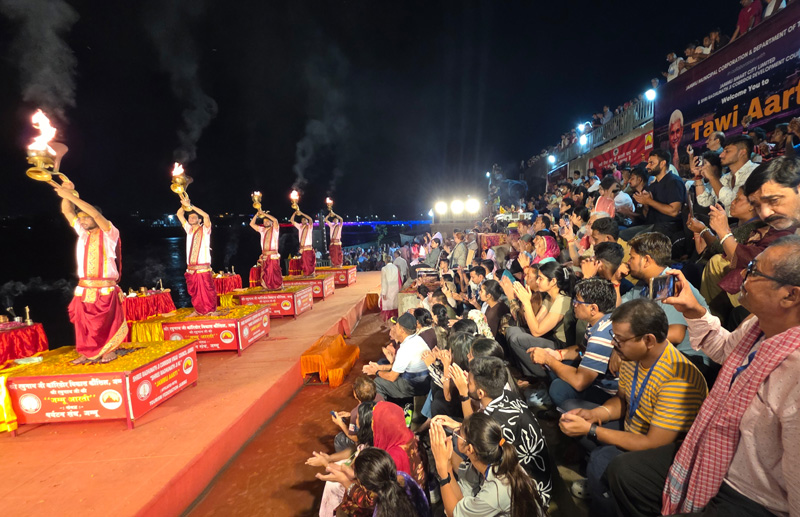
*Nearly 24,000 devotees attend since July 1
Govind Sharma
JAMMU, July 24: The recently inaugurated ‘Tawi Aarti’ on the banks of river Tawi in Jammu has swiftly emerged as a vibrant spiritual and cultural attraction, drawing thousands of devotees, pilgrims and tourists every day. Since its daily commencement on July 1, nearly 24,000 people, including Amarnath Yatra pilgrims and locals, have participated in this soulful evening ritual.
Follow the Daily Excelsior channel on WhatsApp
Modelled on the lines of the famed Ganga Aarti in Haridwar and Varanasi, the Tawi Aarti is held every evening from 7 PM onwards at the newly developed Aarti Ghat near the fourth Tawi bridge along the scenic Tawi River Front. The initiative has not only given a fresh spiritual identity to the city but is also being viewed as a major step toward enhancing Jammu’s potential as a hub of spiritual tourism.
The daily ritual, rich in spiritual fervour and visual splendour, is being organized through a collaborative effort of Jammu Municipal Corporation (JMC), Jammu Smart City Limited, Department of Tourism and Shri Raghunathji Corridor Vikas Council. The inaugural ceremony on July 1 was graced by Lieutenant Governor Manoj Sinha, underscoring the administration’s commitment to promoting Jammu’s cultural and religious heritage.
Speaking to the Excelsior, Devansh Yadav, CEO of Jammu Smart City Limited and Commissioner JMC, highlighted the broader vision behind the initiative. “The Tawi Aarti represents devotion, cleanliness, and cultural revival. Our aim is to foster spiritual unity, uphold the sanctity of the river, and position Jammu as a year-round destination for religious tourism,” he said.
The daily ritual is deeply rooted in Dogra culture, with the Tawi River-revered as Suryaputri or daughter of the Sun-holding immense spiritual significance. Earlier, the Aarti was performed only on select religious occasions and at scattered locations. Now, with the development of a permanent Aarti Ghat, the event has found a structured and sustained platform, attracting consistent participation.
“To facilitate easier access for Amarnath pilgrims, we have arranged dedicated bus services from Bhagwati Nagar Yatri Niwas to the Aarti site,” Yadav said, adding that various Bazaar Associations are now funding the daily ritual. “We are primarily providing basic infrastructure, including seating and tent arrangements, as well as water and toilet facilities,” he added.
Senior vice-president Baldev Khullar of Shri Raghunathji Corridor Vikas Council, stated that the response from devotees has been overwhelming. “On weekdays, around 800 to 900 people attend the Aarti, and on Sundays, the number rises to 2,000 to 2,500. The inclusion of Amarnath and Vaishnodevi pilgrims has added to the sanctity and popularity of the event,” he said.
He further emphasized that the event is being held in conjunction with the ongoing Amarnath Yatra, and there is a collective push to continue the ritual beyond the Yatra’s conclusion, with the aim of establishing it as a permanent cultural fixture.
“This initiative is not only a tribute to our traditions but also an invitation for the younger generation to reconnect with their roots,” Khullar said. He said it celebrates the rich heritage of Sanatan Dharma and Dogra ethos, while also contributing to the local economy by attracting tourists and pilgrims alike.”
As the Sun sets over the Tawi and the riverfront lights up with diyas, chants and devotional songs, the Tawi Aarti offers a unique and immersive spiritual experience-turning the riverbank into a symbol of divine reverence and cultural pride. With sustained efforts and growing public participation, the event is poised to become a signature spiritual offering of Jammu.
 Follow our WhatsApp channel
