

Prof K S Chandrasekar
India has about 1200 universities, around 50000 colleges which are now offering about 26 percent of GER. About 300 million students are studying in colleges and about 40 million in universities. Since 1948, we had multiple committees on education and last of it was in 2017-19 under Dr Kasturi Rangan. This paved way for the New Education Policy in 2020. The New Education Policy- 2020 aims to facilitate an inclusive, participatory and holistic approach, which takes into consideration field experiences, empirical research, stakeholder feedback, as well as lessons learned from best practices.It is a progressive shift towards a more scientific approach to education.The prescribed structure will help to cater the ability of the child – stages of cognitive development as well as social and physical awareness. The education policy should maintain a symbiotic relationship between the different regions of the country through the study of different languages.The quality of education provided in the country shall be such that it not only delivers basic literacy and numeracy but also creates an analytical environment in the country.The New Education Policy-2020 represents aspirations to become a knowledge powerhouse of the world inculcating the best of the global educational experiments. The global education development agenda reflected in the Goal 4 (SDG4) of the 2030 Agenda forSustainable Development, adopted by India in 2015 – seeks to “ensure inclusive and equitable quality education and promote lifelong learning opportunities for all” by 2030.
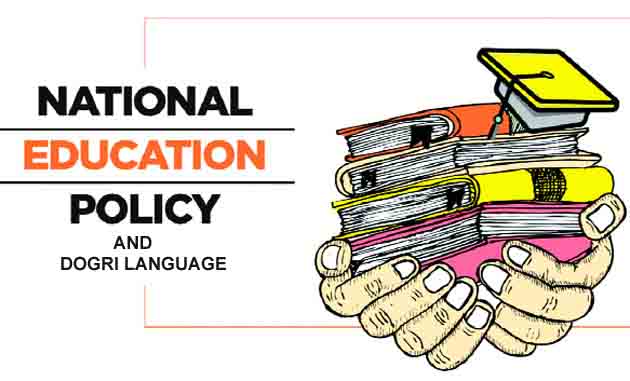
Early childhood care and Education (ECCE) is vital for the cognitive development of the students, and this is where the mother tongue becomes crucial. The modern parents are after the western languages including English, French and Spanish. They feel that these languages will help their child in their quest for global recognition. However, one should not forget their mother tongue. The author has witnessed many incidents where a Dogra family is reluctant to speak in Dogri as they feel inferior. Dogri is one of the 22 official languages recognised by the Government of India. Bodo. Dogri, Maithili and Santhali were recognised and included in the Eighth schedule by the 92nd Amendment act, 2003. National Educational Policy advocates for three languages formula.
Recently, based on the question raised by Vikram Randhawa, MLA in the assembly, The School Education Department has introduced Dogri as the third major language in Government schools up to the primary level, with the Jammu and Kashmir Board of School Education (JKBOSE) developing syllabi, curriculum, and textbooks in Dogri for classes 1 to 12. While the author had discussion with Sunil Singh, Director, Academics of JK BOSE in a function, there are steps taken in this direction and it will be compulsory subject from class 1 onwards as part of the three-language formula in NEP. The Government is also providing free Dogri textbooks to students in classes 1 and 2 under the district plan. I sincerely feel that it’s a right step in the direction to protect Dogri as a language which needs to be sustainable. For secondary classes (9th and 10th), Dogri is being taught as an additional/optional subject, and at the 10+2 stage, it is offered as an elective subject. From here, the Government has to plan undergraduate programs in Dogri as Major which can actually pave way for the master’s and also doctoral programs. Cluster university of Jammu is introducing from 2025-26, Certificate and Diploma programs in Dogri translation. This will eventually help students to find appropriate opportunities.
Dogri needs to be promoted by the Government by asking all those establishments in the Jammu region to put the Dogri language in the display boards. Regular competitions in Dogri will help the students to understand the importance of the language. Cluster university of Jammu organises every year inter collegiate competition called “Yuv Tharang”. This year along with existing categories which is being considered for the national entry, Dogri essay competition, Dogri elocution competition, Dogri Music, Dogri cuisine will be added to ensure and promote Dogri across the students and parents’ community. The newly introduced MPA program in the university will also give emphasis to Dogri Dance, Dogri Folk music etc. in the proposed National Research Foundation (NRF), there is a need to include Dogri for research purposes and for translational research.
There is a proposed National institute for Pali, Persian and Prakrit in the New Educational Policy. In the similar vein, there could be a National Institute for Dogri which will ensure that the language is protected. New Educational Policy advocates for the Literature and Scientific Vocabulary of Indian Languages and Dogri should find a slot in it. Research on languages is given priority and Jammu and Kashmir can take a lead in the same. New Educational Policy provides for e-content in regional languages and those technology students can be absorbed in providing Dogri based e-content. During 2023, University of Jammu under the leadership of Prof Umesh Rai introduced for the first time, Indian constitution in Dogri language which is a commendable achievement. Unless and until, the school system is able to provide Dogri in large numbers, it is difficult to provide students for the undergraduate or master’s degree. Considering the fact that only about 30% of those who pass ten plus two are able to go for higher education, adequate number of Dogri students are needed to ensure all universities at least in Jammu region are able to start a separate Dogri department.
“Aao Dogri gibadhava dene terakshakarne di yojnabanachai”
( The author is Vice Chancellor, Cluster University of Jammu)
 Follow our WhatsApp channel
