

* Calls for harnessing ONDC to promote e-commerce
Excelsior Correspondent
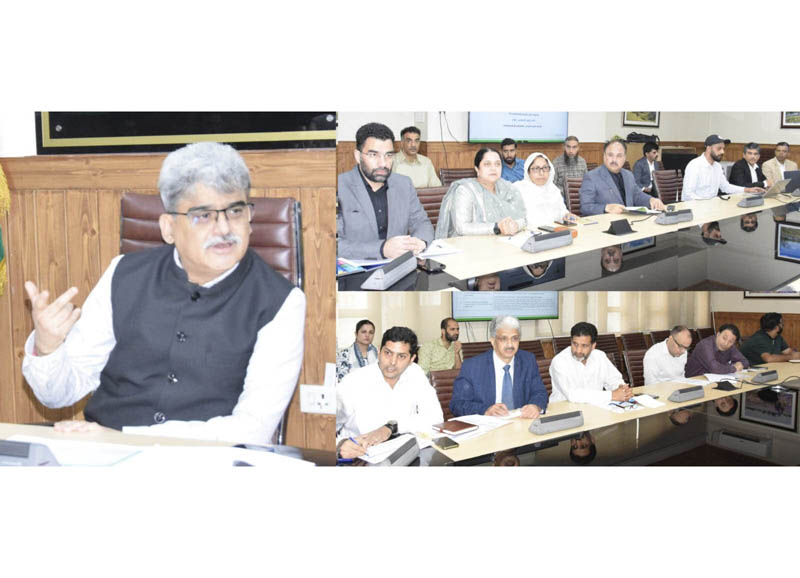
SRINAGAR, July 14: Chief Secretary, Atal Dulloo, today chaired a meeting to review implementation of the Ayushman Bharat Digital Mission (ABDM) in Jammu and Kashmir with a focus on ensuring seamless integration of healthcare data and digital services across the UT.
The meeting was attended by Secretary, Health & Medical Education; Managing Director, ABDM; Principals of Government Medical Colleges; Director Coordination (Medical Colleges) and other senior officers of the department.
Taking stock of the ongoing initiatives under ABDM, the Chief Secretary underscored the urgency of linking patient health records with ABHA (Ayushman Bharat Health Account) IDs, emphasizing that no stone should be left unturned to complete this vital digital transition without any further delay. He called for interlinking of Sehat, ABDM and HMIS portals, to create a unified digital ecosystem that empowers the patients, healthcare professionals and institutions to access and share data effortlessly through a single platform.
Dulloo stressed that continuous updating of patient health records must be ensured so that individuals need not carry paper records when visiting any hospital or doctor. He called for universal implementation of the Scan and Share facility across all health institutions. He directed the department to rationalize manpower, especially for data entry tasks critical to success of the HMIS module.
In a significant push towards improving accountability and data integrity, the Chief Secretary instructed the department to expedite the Health Professional Registry (HPR) and take strict measures against professionals delaying compliance. He also advised for seeking technical support from BISAG-N to professionally and swiftly conclude digitization targets under the ABDM framework.
During the meeting, Secretary H&ME briefed about the steps already taken to accelerate digital transformation.
Adding to the deliberations, MD ABDM, Anant Dwivedi, outlined the mission’s three core pillars including ABHA ID, Health Professional Registry (HPR) and the Health Facility Registry (HFR). He informed that J&K has made notable strides in all these domains.
As per the latest figures, it was informed that 94.49 lakh ABHA IDs have been created, covering 69.7% of the target population. It was further revealed that 100% registration of all 3,607 public health facilities (HFR) has been completed besides 87% registration of public doctors (6,713 out of 7,730) and 100% registration of public nurses (5,149) has been achieved.
Moreover, 20.58 lakh digital health records have been linked with ABHA IDs, with 1.44 lakh new records added since May. Additionally, 104 out of 105 health facilities are now actively using the HMIS (JK-e Sahaj) portal. Notably, 71.16 lakh Scan and Share tokens have been generated so far, as was informed in this meeting.
Meanwhile, in a move to catalyze the growth of small businesses through digital integration, Chief Secretary chaired a high-level meeting with the CEO of Open Network for Digital Commerce (ONDC) to explore opportunities for leveraging the ONDC platform to promote e-commerce in J&K.
The meeting was attended by Principal Secretary, Agriculture Production Department; Executive Director, J&K Bank; Secretary, Labour & Employment; Secretary, Tribal Affairs;Secretary in Industries & Commerce; Director General, Budget; Director, Labour & Employment; State Informatics Officer, NIC; Representative from BISAG-N besides other senior officers. During the deliberations, the Chief Secretary emphasized the immense potential of digital commerce in strengthening the local economy and creating new livelihood avenues. He underscored the importance of initiating the digital push with simple, scalable models, and expanding gradually by addressing implementation challenges in a phased manner.
Dulloo emphasised on the fact that J&K must embrace the digital shift by harnessing the capabilities of ONDC to empower the small and nano entrepreneurs first to serve locally. He directed the Labour & Employment Department to begin with a hyper-local delivery system within a defined radius around businesses.
He also called for onboarding service providers such as electricians, plumbers and other technicians on the digital platform, enabling the citizens to avail their services conveniently here.
The CEO, ONDC, shared success stories from other states, including that of Sri Vidhya Handlooms and Himira in Himachal Pradesh and their initiatives taken in Andhra Pradesh where ONDC played a transformative role in supporting the entrepreneurs to reach national markets in shorter time durations.
 Follow our WhatsApp channel
