

Prof Vandana Sharma
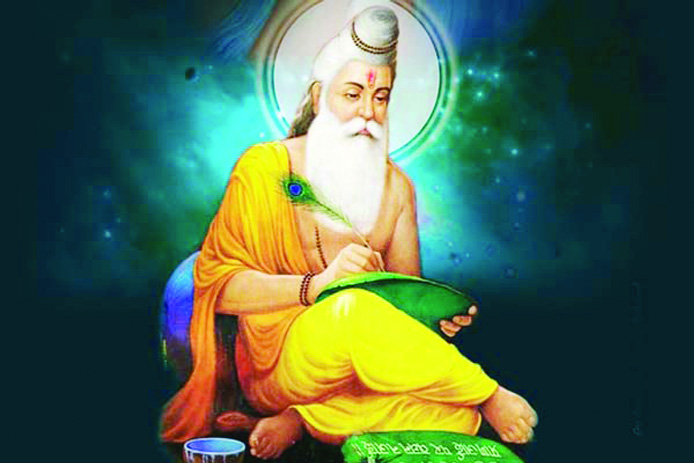
The auspicious occasion of Vyas Purnima also known as Guru Purnima which is celebrated on the full moon day ( Purnima) in the month of Ashadha ( June- July) falls on 10th July in the year 2025. Since the day marks the birthday of Veda Vyasa, the learned sage who composed Vedas, Mahabharta, Brahma Sutras and 18 Puranas, it is a day not only of spiritual importance but of immense symbolic enlightenment to offer reverence to gurus, mentors and teachers and to navigate the contemporary relevance of Bhartiya Guru-Sisya Parampara, an educational method which reflects timelessness of Vedic wisdom. Undeniably India is incredibly diverse and profoundly rich and this fact has been accepted worldwide. We are a civilization which produced the first book, Rig Veda; established one of the first universities, Takshashila (Taxila, present day Pakistan) and pioneered the authentic tradition of the Guru-Sisya Parampara-an unbroken tradition of personalized, oral transmission of knowledge deeply rooted in its spiritual and educational ethos. Before delving into it, let’s understand the sublime and divine nature of Sage Vyas’s contribution.
Universal Nature of Ved Vyas’s Contribution
The enormity of contributions and profundity of content composed by Ved Vyas situates this great sage of Hinduism at an unparalleled position. Vyas’s sagehood and learning began at a very young age when he undertook rigorous penance in forests. Among his major works are Vedas, which he organised into four canonical texts: Rig, Sama, Yajur and Atharva Veda preserving this knowledge for posterity. Since the Vedas have oral origin, their writing began around 500 BCE which were written on birch bark in scripts such as Sarada and Devanagari. There still exist some manuscripts of Rig Veda and around 30 notable Rig Veda manuscripts, were recognized in 2007 by UNESCO in its Memory of the World Register. The second notable work of Sage Vyasa is the Mahabharta, one of the longest epics in world literature and Bhagavat Gita- a philosophical dialogue between Krishna and Arjuna embedded within Mahabharat. Further, the great sage compiled 18 major Puranas which are storehouse of wisdom and knowledge pertaining cosmology, mythology ,self and devotion. Now, what needs to ponder is how is Rishi Ved Vyasa’s role and legacy still relevant?
It goes without saying that the core philosophical teachings of Ved Vyasa’s works reinforce right conduct, moral values and ethical practice which have universal relevance and transcends religious barriers. The sole crux of Vyasa’s teaching reinforce Dharma or righteous duty, therefore, acting according to one’s own duty and context. This is followed by Karma ( selfless action); Bhakti ( devotion); jana ( knowledge), discipline, meditation and ethics, thereby maintain personal integrity and societal harmony. Undeniably, every human being must assimilate the essence of these teachings because in this journey of life every one evolves to be a role model in any stage convincingly articulated in Bhagavat Gita Chapter 3, verse 21, when Lord Krishna says,
It translates to whatever action a great person performs, common men follow. Now the question is who is a great person- king, head of the state, head of the institution, teacher, father and mother are all natural leaders and role models. This established the universality of Vyasa’s vision and teaching.
Timelessness of Guru-Sisya Parampara
The second point of reflection on this day of phenomenal possibilities is to comprehend the sacred lineage of teacher-disciple transmission; its resilience and contemporary relevance and manifestations. Since the Gurukula was a traditional system of education prevalent in ancient India, etymologically meaning -the guru’s home-school- it was one of earliest residential models where students lived, learned, and absorbed values directly under their teacher’s care till their early 20s. Beyond the Vedas, education in Gurukula encompassed practical skills such as agriculture, metallurgy, warfare, arts, yoga, philosophy, ethics and many more, ostensibly not restricting the cognitive capabilities of a disciple. As Gurukula practiced lineage based memory system it survived even strategic losses such as the burning of Nalanda in 1193 which could not destroy the knowledge traditions of India as the Gurus recovered the knowledge which was not solely relying on texts but existed in oral form. Understandably, the relevance of holistic education imparted in Gurukula has been accepted worldwide and the modern education has adopted the timeless wisdom by focussing on experential learning. Plethora of research has been conducted on this Bhartiya education model, to name a few, Prof. Marmar Mukhopadhyaya book titled Total Quality Management in Education deriving insights from ancient education system has devised a concept of Multi-Channel Learning based on Gurukul Pedagogy whereas Ankur Joshi’s ethnographic research presents insights from a postcolonial perspective and its contemporary relevance.
NEP 2020 and Guru-Sishya Ethos
NEP 2020 is innovative and revisionist in many ways whereas one of the prime mandates of the policy has been to revive the essence of Guru-Sishya Parampara explicitly stated, “the teacher must be at the centre of fundamental reforms”. Further, it endorses experiential, storytelling, problem-solving, and discussion-based approaches-evoking the immersive, relational learning which is a hallmark of Guru-Sishya ethos. Since NEP-2020 re-imagines teachers as gurus by re -defining their role as mentors, embodiment of knowledge and facilitator who transmit through lived example, it revives the Guru-Sishya tradition. Whereas on the one hand, guru shapes the disciple’s character, values, discipline and emotional well-being by maintaining self-restraint, on the other, a sishya is expected to be dedicated to disciplined learning, active inquiry, critical reflections and approach the mentor with sraddha (faith), humility, and willingness to serve. This reciprocal framework modelled on Guru-Sishya Parampara is unparalleled, result-oriented and transformational. Bhartiya Shikshan Mandal is committed to work towards awakening and reviving national glory through education for more than fifty years. To inculcate the divine in humans with thrust on enhancing their immense capabilities, the mission is to regain lost glories of ancient Bhartiya education system by re-visionist methods and self- reliance in teaching and research.
May this Vyas poojan instill a sense of pride and immense joy in each Guru and Sishya to realise the timeless rich tradition of Guru-Sishya Parampara and curiosity to fathom the knowledge creation in Bharat across a wide array of fields from art and literature to science, medicine and governance. Let us all express our deep reverence to the immortal sage Ved Vyasa and the guru-disciple lineage which is being adapted retaining its transformative power.
( The author of Dean, School of Languages, Central University of Jammu)
 Follow our WhatsApp channel
