

Suhail Bhat
SRINAGAR, June 27: Amid concerns over post-harvest losses of cherries, farmers in Kashmir are finding relief as a portion of the perishable crop is now being processed in local factories, helping reduce wastage and stabilize income for growers.
CLICK HERE TO WATCH VIDEO
Kashmir produces 12,000 to 14,000 metric tons of cherries annually-nearly 95% of India’s total output. Ganderbal alone accounts for over 9,000 tons, followed by districts like Shopian, Srinagar, and Baramulla. But due to the fruit’s fragile nature and inadequate cold storage, much of the crop is either sold at throwaway prices or rots before it reaches markets outside the Valley.
Now, an estimated 2500-3000 tons are being processed in about two dozen canning units in Kashmir. These units prepare canned cherries for bakeries, hotels, and the hospitality sector across India.
Shahjahan Khan, Managing Director of Hyacinth Agro Products Pvt. Ltd. in Zanakote Industrial Estate, of Srinagar says his facility alone processes about 300 tons during the season, primarily the ‘Double’ or Monoceros variety, which is suited for canning and widely used in the bakery, hotel, and ice cream industries across India. “Cherry is a beautiful crop-Kashmir’s specialty. The double cherry is best for canning, and we supply it to big ice cream companies and bakeries across India,” he says.
Khan explains that his factory uses high-quality Turkish machinery for de-seeding, sorting, grading, and filling to ensure uniformity and hygiene. “We follow global food safety standards. No chemicals-only sugar, water, and food-grade syrups. After canning, the product is sterilized and vacuum-sealed, lasting up to two years without refrigeration,” he says.
He says that everything at the factory is traceable from farm to can: “Each can has a batch number and expiry date. The syrup, they use, is not just sugar water-it is balanced to preserve the natural flavor.”
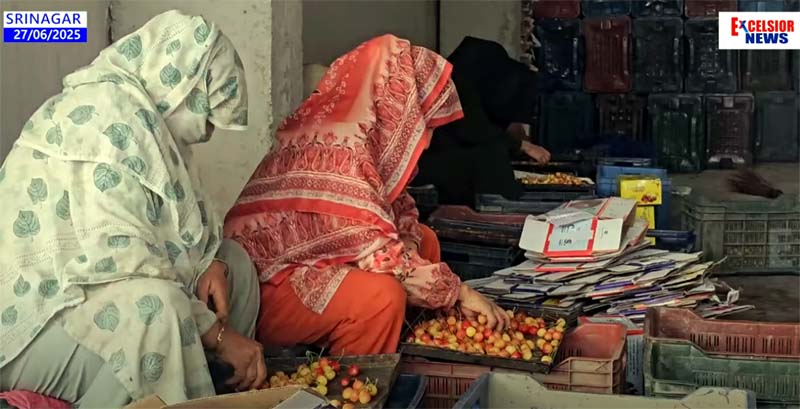
Khan said Kashmir has over 20 cherry processing units, each employing 50-100 people during the season. His factory employs 20-30 regular workers, with over 100 local women hired seasonally for manual sorting and cleaning. The process starts with farmers dropping off fresh cherries at local mandis or directly at the unit, where the fruit is immediately moved to cold storage.
Despite high domestic demand from states like Maharashtra, Karnataka, and West Bengal, he believes India is still importing processed cherries from countries like Turkey and China. “This shows the potential for more processing units here. But it’s a tech-driven industry with high compliance requirements, so only serious investors should step in,” he cautioned.
With cherries from Kashmir becoming increasingly popular across India, Khan hopes better technology and government support can help local processors reduce imports and expand into export markets in the future.
 Follow our WhatsApp channel
