

Dr Yudhbir Singh
Landslide events are a recurring and significant challenge along National Highway 44 in the Union Territory of Jammu and Kashmir. The region has grappled with these hazards since the infamous Nashri slide, which began in 1956-a phenomenon that perplexed geoscientists for many years.
For the past 20 years, I have dedicated my career to the study of geohazards, with a particular focus on landslides. My personal connection to this field stems from the hardships I faced during my early education due to these natural disasters. It is evident that the frequency and intensity of landslides in this region have increased dramatically in recent years, a consequence of a complex interplay of contributing factors.
The region’s geological vulnerability is undeniable. Prominent structural features, such as the Main Boundary Thrust, Murree Thrust, and Panjal Thrust, traverse the area, rendering the lithology inherently fragile. Natural triggers, such as intense rainfall, further exacerbate these weaknesses. However, the growing impact of anthropogenic activities is particularly alarming. Recent examples, including the Sangaldan slide (2010), the Thathri slide (2023), and the Pernote slide (2024), are a few that highlight the significant role human intervention plays in landslide initiation. Research findings on these events are readily available in the public domain.
I aim to raise awareness among the public and, crucially, among those who are responsible for the ongoing development work in Jammu and Kashmir, specifically the road widening project on NH44. The stretch between Nashri and Banihal presents particularly formidable challenges.
Findings from most of the aforementioned slides indicate enormous stress conditions and redistribution, with all kinds of water from each household continuously contributing to the failure mechanism, besides natural factors. It is important that each individual properly directs their house drainage to a suitable location for their own safety.
My recent visit to Ramban underscored the urgent need to shift from short-term fixes to sustainable, long-term solutions.
My primary concern centers on the Cafeteria More landslide, a site that poses a daily threat to the lives of commuters. Similarly, the Dhalwas slide Kela Nala Debris Slide, Shan Palace and Sita Ram Passi are a few prominent slides that are often responsible for damages, exemplifying the consequences of inadequate planning and execution. The Cafeteria slide at Ramban has a troubled history. The construction agency’s initial approach, involving slope cutting, proved ineffective. Subsequent attempts to build a tunnel resulted in repeated collapses. The current effort, an artificial tunnel, remains under construction, and its long-term viability is uncertain.
This situation serves as a stark illustration of the detrimental effects of poor strategic planning and a lack of collaboration with experienced geohazard professionals. The financial losses incurred, coupled with the ongoing risks to public safety, are immeasurable. It is imperative that those responsible for these failures be held accountable.
To ensure the safety and sustainability of infrastructure development in this geologically sensitive region, a more holistic and proactive approach is essential.
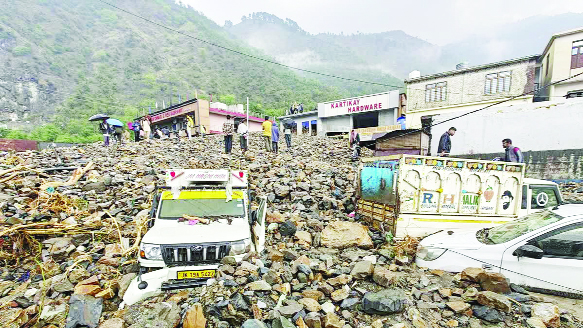
The devastation in Ramban town and its surrounding areas along National Highway 44-characterized by debris flows and flash floods on April 20, 2025-is more than just a natural disaster. It is fundamentally a reawakening of long-dormant and obstructed natural drainage systems, a consequence of prolonged neglect.
Having spent my childhood in this region and possessing vivid memories of the entire road network, I can attest to the long history of the Kela Nala and Seri debris flows. The disregard for past failures and the drastic landscape alterations-resulting from extensive construction, highway realignment, a tunnel entrance positioned at the mouth of the Nala, and indiscriminate muck dumping-have completely blocked the natural flow of perennial and seasonal streams, directly contributing to the current crisis.
The Shan Palace landslide offers another stark illustration. This is not a new hazard but rather the reactivation of a pre-existing unstable slope-a fact sharply etched in my memory. Over time, rapid and unchecked construction in the vicinity has further encroached upon the natural drainage path. Its reappearance today serves as a grim reminder of past warnings ignored-warnings that have repeatedly manifested in debris flows, damaging the Shan Palace hotel on numerous occasions.
Furthermore, the flooding near the trauma hospital in Ramban is yet another stark reminder of flawed planning. The current access road to the trauma hospital-situated between Parihar Mohalla and Raju Mohalla of Dussra Ward-was built directly on an old watercourse, raising serious questions about risk assessment and long-term foresight.
Middle School Ramban and Higher Secondary School Ramban-where I received my early education-have also experienced past destruction due to flash floods. A perennial stream known as Nag Wali Nali, flowing from Nai Basti, was forced to take a sharp turn due to obstructions by the PHE Department, leaving no clear path for this stream to safely discharge its flow. This stream carried debris towards Ramban Market, eventually trickling through the grounds of the Higher Secondary School and Girls’ High School near the old DC office. Even in my childhood, this watercourse lacked a clear outlet, and today, the situation has worsened. Heavy construction and extensive concretization have dramatically increased surface runoff, reducing the amount of water absorbed into the ground and further aggravating the situation.
This current disaster is not an act of fate but a direct consequence of our collective actions and decisions. Across Ramban, similar vulnerabilities now exist. Despite repeated warnings and visible signs, these concerns are often dismissed or overlooked. My intention is not to assign blame to any individual or institution but to highlight our persistent failure to recognize, respect, and preserve natural drainage systems. Our short-term planning and disregard for long-term environmental stability have led us to this critical juncture.
I write this not out of frustration but with hope-to awaken public consciousness. Our resilience lies in learning from the past. We must rethink development practices, prioritize sustainable planning, and ensure that infrastructure is built in harmony with nature, not in opposition to it.
Through this article, I aim to raise awareness among the agencies responsible for the ongoing development work along NH44, specifically the road widening project between Nashri and Banihal, to shift from short-term fixes to sustainable solutions. The use of various “hit and trial” methods, beginning with ineffective slope cutting and subsequent attempts, further aggravate the situation. This series of failed attempts clearly demonstrates the consequences of poor planning and a lack of coordination with experienced geohazard professionals, as well as a disregard for human life. Even a short spell of rainfall disrupts vehicular movement, and even on sunny days, the risk to life persists. The financial losses and the risks to human life are immeasurable. It is imperative that we adopt a paradigm shift in our approach to prevent future disasters.
National Highway 44, envisioned by former Prime Minister Atal Bihari Vajpayee and Road and Highways Minister Major General (Retd.) B.C. Khanduri, holds the potential to significantly improve travel in the region. However, its realization hinges on adopting sound strategies and methodologies. Construction agencies must recognize that standardized approaches are not suitable for this region. Site-specific solutions are essential, and “hit and trial” methods are simply unacceptable.
We need to look towards a mechanism that needs to be implemented with an iron fist in the domain of life, whether it’s the construction of a new house anywhere or road widening-a task that the current administration seems well-equipped to handle. I hope this article will encourage agencies involved in development projects across the region to adopt site-specific methods and prioritize sustainability, ensuring that development benefits the community without compromising safety.
(The author is Assistant Professor Department of Geology)
 Follow our WhatsApp channel
