

Rakesh Kumar Sharma
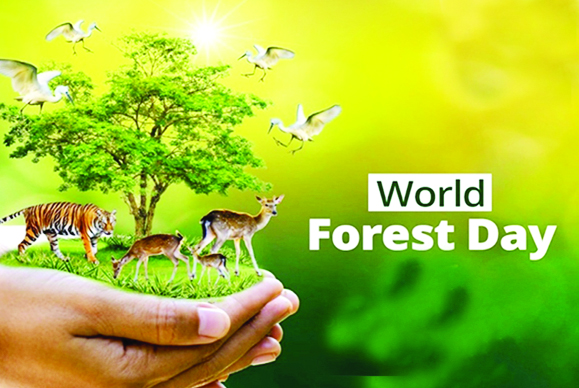
Today, on 21st March, the world celebrates International Day of Forests or World Forest Day. This global observance was established by the United Nations General Assembly in 2012, with the first celebration held in 2013. Since then, this day has been dedicated to raising awareness about the importance of forests and their crucial role in sustaining life on Earth. The objective is to promote forest conservation for future generations and to ensure a clean, pollution-free environment.
A Brief History of Deforestation
The practice of cutting down trees dates back to 10,000 BC, when early humans began clearing forests to create space for crops and livestock. The shift from a nomadic lifestyle to permanent settlements increased the demand for land. This demand grew exponentially with the Industrial Revolution, as forests were cleared to accommodate factories, housing, and to extract raw materials and fuel. Even today, agriculture remains the primary cause of deforestation, contributing to habitat loss and environmental degradation.
World Forest Day
Forest and Food
Sustainable management of forests and utilization of their resources contributes significantly to the development and well-being of both current and future generations. This responsible approach also helps countries meet the Sustainable Development Goals (SDGs), including poverty alleviation, food security, ensuring healthy lives, and mitigating climate change. The theme of this year’s World Forest Day is “Forest and Food.”
Forests have been a primary source of food for humans since time immemorial. Even today, a large portion of the world’s population depends directly or indirectly on forests to fulfill their food needs, as well as those of other creatures sharing this planet. Forests provide edible plants, fruits, nuts, medicinal herbs, and are also home to wildlife that sustains many indigenous communities. Preserving these ecosystems ensures food security and biodiversity for future generations.
India’s Rich Forest Cover
Despite ongoing deforestation, India remains one of the most ecologically diverse countries, with a wide range of ecosystems-from tropical rainforests to alpine vegetation. According to the India State of Forest Report (ISFR) 2023, forest and tree cover together account for approximately 25% of India’s total geographical area. Of this, 21% represents forest cover, while 3% consists of tree cover in urban areas and agricultural lands.
The northeastern states-including Mizoram, Arunachal Pradesh, and Meghalaya-boast the highest forest cover due to their dense landscapes and favorable climatic conditions. Mizoram leads with 85% forest cover, while Haryana has the lowest at around 4%. Such variations reflect differences in topography, climate, and conservation policies across the country.
India’s forests play a vital role in maintaining the ecological balance by absorbing carbon dioxide, regulating the water cycle, and conserving biodiversity. India is home to approximately 92,873 species of fauna (7.5% of the world’s total) and around 29,000 plant species (9% of the global total). The country’s geographical diversity-from the Himalayas in the north to coastal regions in the south-supports a wide variety of ecosystems, including grasslands, deserts, wetlands, and dense forests. These ecosystems shelter many endangered species, such as the Bengal tiger, Indian elephant, one-horned rhinoceros, and snow leopard.
The Jammu and Kashmir and Ladakh regions are known for their lush green forests and rich biodiversity, covering approximately 20,230 square kilometers-20% of the region’s geographical area. The Himalayan foothills of Kashmir alone are home to 3,054 species of flora, with 506 species found in Jammu. This region hosts 7,100 species of fauna and thousands of plant species, contributing significantly to India’s biodiversity. These forests are crucial for preserving the environment, supporting wildlife, and ensuring a healthy ecosystem.
India’s Efforts for Preservation of Forests
India is making rapid progress in industrial development and ease of living by utilizing natural resources responsibly. Efforts are being made through legislation, policy frameworks, and conservation programs without harming forest cover. National Afforestation Programs, the Green India Mission, and Nagar Van Yojana aim to increase forest cover and curb deforestation.
It is a challenging task given excessive population and rapid development initiatives. Nevertheless, the efforts of the central and state governments have been yielding encouraging results. According to reports, there has been a consistent and progressive increase in forest and tree cover across the country. This progress is due to planned strategies and sustained government initiatives. Key legislation like the Forest (Conservation) Act, 1980 and the Wildlife (Protection) Act, 1972, along with other laws and programs, have produced remarkable results in preserving forests and protecting biodiversity.
A Call for Conservation at the Individual Level
We are all part of biodiversity, and it is the responsibility of every human being to contribute towards making our planet Earth a better place to live. It is our duty to ensure that future generations inherit a pollution-free and safe environment. While governments and organizations are making significant efforts in forest conservation, individual actions are equally crucial. Everyone can play their part by contributing in any way possible.
In rural areas, individuals can pledge not to cut trees and to plant at least one tree every year on this day. In urban areas, where space is limited, the concept of rooftop gardening offers a practical solution. Rooftops and balconies can be transformed into green spaces by growing plants, vegetables, and even small trees. Through small yet meaningful actions, every individual can contribute to a cleaner environment and adopt a rewarding and sustainable hobby.
Conclusion
The International Day of Forests reminds us of the urgent need to protect and restore our forests. All stakeholders, including the United Nations, developed countries, and organizations, should continue striving to make this planet a beautiful place to live. Individual efforts, even at the micro-level, should be encouraged because, as the saying goes, “A journey of a thousand miles begins with a single step.”
(The author is Air Veteran and a Retired Tehsildar)
 Follow our WhatsApp channel
