

J&K received investment proposals worth Rs 1.69 lakh cr
46 new Industrial Estates being set up in UT, FCI Jammu being upgraded
Excelsior Correspondent
JAMMU, Mar 15: After detailed daylong discussions, the Jammu and Kashmir Legislative Assembly today passed grants of five departments amounting to a total of Rs 7019.34 crore.
Follow the Daily Excelsior channel on WhatsApp
The demands, introduced by the Deputy Chief Minister Surinder Choudhary, include Rs 1086.32 crore for the Industries and Commerce Department, Rs 5283.7463 crore for Public Works Department, Rs 353.4446 crore for Labour and Employment Department and Rs 225.6103 Crore for the Skill Development Department.
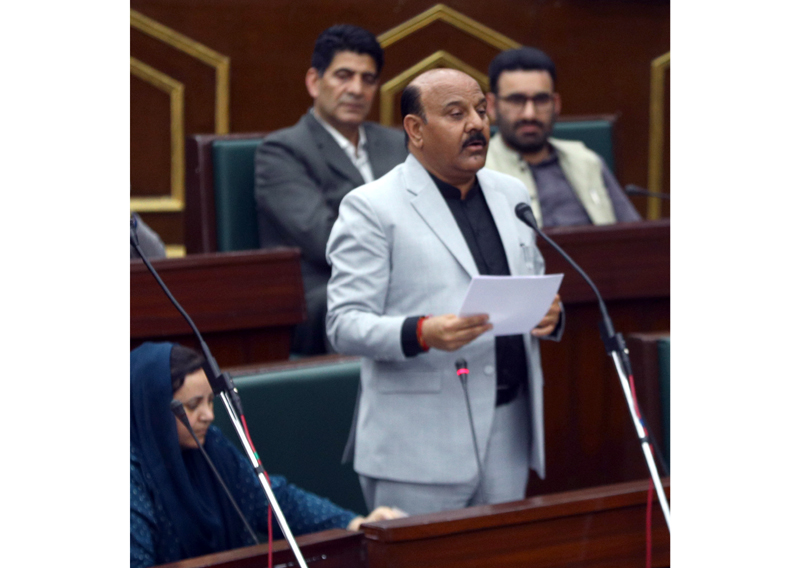
Winding up the discussion on Demands for Grants, Choudhary said that currently, the Public Works Department is maintaining an extensive road network of 40,000 km with priority to provide high-quality roads and connectivity to the last unconnected village.
“The department is making every possible effort to ensure that the roads built with public funds stand the test of time. In 2025-26, we are targeting 4,000 km of road blacktopping under various schemes such as PMGSY, Cities & Towns, CRIF and NABARD, significantly improving travel conditions for the people of J&K”, he added.
The Deputy Chief Minister said the department receives funding from three main sources; Centrally Sponsored Schemes like PMGSY and CRIF, NABARD Loan Assistance and UT Sector Funding for roads and bridges.
“Through PMGSY, which started in 2001, we have successfully connected 2,132 out of 2,140 identified villages, laying down 17,585 km of roads and constructing 210 bridges at an investment of Rs 10,939 crore. The remaining work will be completed by 2025-26. Under PMGSY Phase II and III, we have upgraded 1,927 km of roads and constructed 9 bridges, while the remaining 505 km of roads and 64 bridges will be completed soon”, he elaborated.
To further strengthen the rural connectivity, the Deputy Chief Minister said that the Government of India has approved PMGSY-4 (2024-29), which will connect habitations with 250+ populations as per the 2011 Census.
This included special provisions for tribal-majority villages and Aspirational Districts.
“A survey conducted through advanced technology has identified 2,508 road alignments and we are actively preparing Detailed Project Reports (DPRs) to secure approval for over 1,000 new projects in 2025-26”, he added.
“Under the CRIF scheme, 294 projects worth Rs 4,337 crore have been sanctioned by the Ministry for Road Transport and Highways, out of which, 194 have been completed. Several important bridges are also under construction,” the Deputy Chief Minister maintained.
While referring to NABARD, the Deputy Chief Minister said currently, 1,098 projects have been sanctioned under the scheme and 213 projects have already been completed in 2024-25.
“The macadamization and resurfacing of roads remain a priority under UT Sector Funding. In 2024-25, we have already blacktopped 3,251 km of roads including 1,610 km of roads in cities and towns, with a final target of 4,000 km. Alongside roads, bridges are equally important for connectivity and 153 bridges are under construction with a total cost of Rs 569 crore. So far, 83 bridges have been completed” the Deputy Chief Minister informed the House.
“The Road Maintenance Policy 2021 ensures timely upkeep, preventing early deterioration of roads. A Two-Tier Quality Control Mechanism has been introduced for strict monitoring and third-party inspections are now mandatory for all major projects”, the Deputy Chief Minister said.
To attract businesses, Surinder Choudhary said that the Government has introduced 14 policies and schemes that provide financial support, tax benefits and land for industries.
“A major initiative, the New Central Sector Scheme (NCSS) 2021, was launched with Rs 28,400 crore to help industries set up and grow. This scheme offers investment incentives, tax relief and interest support. The response has been positive-971 industrial units have been approved, bringing in Rs 10,471 crore of investment and creating 51,897 jobs” he added.
“Jammu and Kashmir’s industries are mainly driven by small and medium enterprises which provide highest employment in the region. There are 7.10 lakh MSMEs in J&K, of which, 4.47 lakh have been registered on the Udyam Portal. This sector contributes 8% to economy of J&K and employs 90% of the people working in the industrial sector. Supporting MSMEs further will help create more local jobs and boost the economy”, he maintained.
To provide more space for industries, the Deputy Chief Minister said that the government is building 46 new industrial estates in addition to the 64 existing ones.
These estates will be ready from March 2025 onwards and will bring more businesses and jobs to J&K. He said that land for 15,994 additional industrial plots has also been identified for future development.
Referring to investment in industries, the Deputy Chief Minister said that in 2023-24, investments worth Rs 3,389 crore were made creating 1,46,317 jobs, which is a 57% increase from the previous year.
He added that in 2024-25, 381 new units have started production, adding Rs 3,887 crore of investment and 10,715 more jobs.
Over the past five years, 2,031 industrial units have started operations, bringing in Rs 1 0,516 crore and employing 65,982 people, he elaborated.
He said that the Single Window Portal, where businesses can apply for approvals online, has received 8,537 applications, so far, proposing Rs 1.69 lakh crore in investments and the potential to create 6.06 lakh jobs.
The Deputy Chief Minister said that the Handloom & Handicrafts sector is backbone of J&K’s economy, employing 4.22 lakh artisans who make world famous products like Pashmina shawls, Kashmiri carpets, Basohli paintings, walnut wood carvings and embroidery items.
Referring to export of J&K’s handicrafts, the Deputy Chief Minister said that these have doubled post COVID, in 2023-24 exports crossed Rs 1,162 crore compared to Rs 563 crore in 2021-22.
He said that J&K has also improved its national Export Promotion Index ranking from 35th in 2020 to 17th in 2022, showing strong growth in trade and business.
The Deputy Chief Minister said that J&K’s startup ecosystem is booming with the number of registered startups growing from 237 in 2020 to 1,011 today recording a 326% increase.
Out of these, 373 startups are being led by the women. Additionally, over 1,600 startups have been registered with the EDI. Many startups are now receiving funding from the investors, proving the strength and potential of local entrepreneurs, he added.
“The New Startup Policy 2024-27, launched in February 2024, provides seed funding, venture capital, patent assistance, mentorship and infrastructure support to new businesses. A Rs 250 crore Venture Capital Fund has been set up with Rs 25 crore initially infused by the Government to support startup growth” he maintained.
To improve governance in the mining sector, the Deputy Chief Minister said that the implementation of an e-auction system has made the allocation of mining blocks more transparent and competitive.
“In order to address illegal mining activities, the Government is addressing these issues by integrating modern technology into the sector. Advanced surveillance techniques including drone monitoring, GPS tracking and real-time digital supervision are being employed to curb illegal activities and promote responsible mining”, maintained the Deputy Minister.
To tackle the issue of illegal mining, the Deputy Chief Minister said that the government has established Multi-Departmental District-Level Task Force Cells, headed by the respective Deputy Commissioners, with District SSPs as key members.
“The government has also intensified its crackdown on illegal mining operations. In 2024 alone, 4,040 vehicles and machines involved in illegal extraction were seized and 153 FIRs were registered against the offenders. As a result of these strict measures, Rs 10.12 crore have been collected in penalties,” the Deputy Chief Minister maintained.
“The department has made substantial progress in formalizing mining activities. So far, 202 mining leases have been granted through e-auctions while 08 leases have been allocated to the Public Sector Undertakings (JKPCC and JK Minerals),” he said.
Additionally, he said, 6 mining leases have been sanctioned on private lands, along with 03 quarry licenses on private properties and 01 cluster quarry on state land.
“A total of 23 quarry licenses have also been issued for the government projects,” the Deputy CM said.
He added that a significant step towards enhancing surveillance is the upcoming Mine Surveillance System, developed in collaboration with the BISAG. This system, successfully implemented in other states for major minerals, is now being customized for the unique requirements of Jammu and Kashmir to strengthen real-time monitoring, he added.
He said that the Jammu and Kashmir Environmental Impact Assessment Authority (JKEIAA) has already approved the District Survey Reports in nine districts while reports for the remaining districts are under review and will soon be submitted for approval.
The Deputy Chief Minister said that the government has focused on addressing unemployment, which remains a major challenge due to the limited presence of large industries in J&K.
He said currently, 3.77 lakh unemployed youth are registered with the District Employment & Counselling Centres.
Recognising the importance of entrepreneurship, the Deputy Chief Minister said the Government has planned Mission YUVA, a landmark initiative that aims to create 1.37 lakh new enterprises and generate 4.5 lakh jobs over the five years.
He said that to ensure its success, a detailed survey was conducted across J&K, covering 23.64 lakh households and 1.1 crore individuals, using a tech-enabled approach.
“The findings will help in identifying potential entrepreneurs, understanding skill gaps and designing better training programs. In the upcoming financial year, 27,400 new enterprises are expected to be created, generating 85,000 jobs” he maintained.
He said during February 2025 alone, 4,236 new workers were registered under the J&K Building & Other Construction Workers Welfare Board and in the current financial year, 44,988 workers have been added.
“A total of Rs 5,903.25 lakh has been disbursed among 70,323 beneficiaries under various welfare schemes. The board ensures all payments are made through the Direct Benefit Transfer (DBT) mode, ensuring transparency and efficiency,” the Deputy Chief Minister added.
“To boost employment opportunities, placement drives were organized in various polytechnics, where 15 companies visited and 261 students received job offers,” he said.
The Deputy Chief Minister said that under the SANKALP initiative, 2,867 candidates have received skill training through the District Skill Committees and 700 women have been trained under the Recognition of Prior Learning (RPL) program in collaboration with Central University Jammu and University of Kashmir.
Certification for training programs at FCI Jammu has also been made QR-code based, making it one of the few institutions in India to adopt this system, he added.
Looking towards the future, the Deputy Chief Minister said that the Food Craft Institute Jammu is set to be upgraded to the Institute of Hotel Management (IHM), allowing it to offer a three-year degree in Hotel and Hospitality Administration.
He said that the Ministry of Tourism, Government of India, has committed Rs. 11.75 crore to this project while the J&K government will contribute Rs. 10.79 crore.
The Deputy Chief Minister said that a new initiative focused on global employment opportunities is also being launched in collaboration with NSDC International to provide specialized training for overseas jobs. Additionally, 3,000 women from Self-Help Groups will be trained in entrepreneurship to improve their financial status.
“To further promote modern education in ITIs, 12 new-age courses such as IoT, Smart Healthcare, Milk & Dairy Processing, Baker Confectioner, Solar Electrician, Electric Vehicle Mechanic and Data Annotation will be introduced in the next financial year with an allocation of Rs. 13.90 crore, informed the Deputy Chief Minister.
The cut motions on Demands for Grants were withdrawn by the legislators. Later, the House passed the Demand for Grants moved by the Deputy Chief Minister by voice-vote.
 Follow our WhatsApp channel
