

Mohammad Haziq
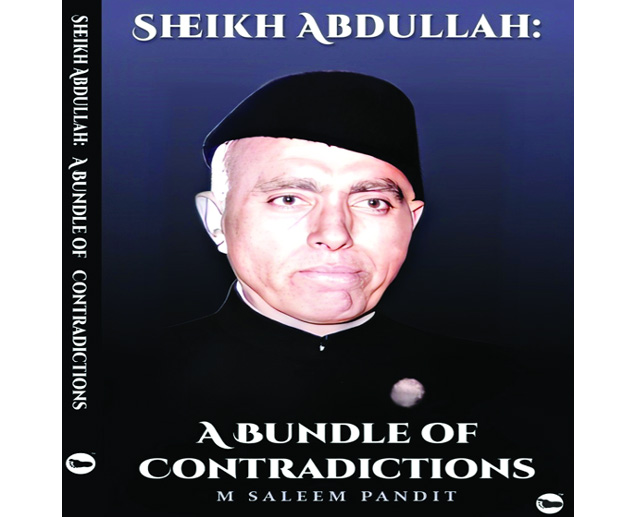
Name of Book : Sheikh Abdullah:
A Bundle of Contradictions
Author : M. Saleem Pandit
Sheikh Abdullah is often characterized as a “bundle of contradictions,” highlighting the complexities of both his personal character and political life. He skillfully balanced conflicting traits, attempting to function as a Muslim leader while projecting a secular image to align himself with the Indian Congress. He aimed to leverage this relationship against Muslim Pakistan and carve out the Kashmir Valley as an independent region for himself, contemplating a future trade of Jammu and Ladakh with India.
Notably, on September 26, 1947, Sheikh Abdullah offered Maharaja Hari Singh an apology (Mafai Nama) and presented him with gold coins. This gesture was part of the condition Hari Singh laid before Pandit Nehru for appointing Sheikh as the emergency administrator of Jammu and Kashmir, a role that brought Mehr Chand Mahajan, who later became the Chief Justice of the Supreme Court, into the picture.
The book outlines the contents of Sheikh Abdullah’s apology, which sought forgiveness for the troubles caused to the Dogra ruler and reaffirmed his allegiance to Maharaja Hari Singh going forward. In “Sheikh Abdullah: A Bundle of Contradictions,” Saleem Pandit a prominent journalist and author delves into the intricacies of Sheikh Abdullah’s character and his political journey. During the turbulent early 1930s, he managed to navigate a precarious leadership landscape as a Muslim leader while upholding a secular viewpoint, often aligning closely with the Indian Congress under the guidance of Pandit Jawaharlal Nehru. Sheikh Abdullah’s aspirations included securing the Kashmir Valley through strategic territorial negotiations, envisioning a scenario where Jammu and Ladakh could be exchanged with India after a temporary accession, ultimately waiting for a moment when Pakistan might reconsider its claims over the predominantly Muslim region.
Sheikh Abdullah’s plans faced significant challenges as Nehru fully integrated Kashmir into India, treating it as just another state, backed by his statements in favor of India in various international forums. The situation intensified in 2019 when the BJP-RSS coalition strengthened Jammu and Kashmir’s status within the Indian Union by revoking Articles 370 and 35A, reshaping the political environment drastically. Ironically, the current leaders from Abdullah’s lineage now seek statehood for Jammu and Kashmir within the Indian framework.
Abdullah’s political narrative was filled with contradictions, attempting to exert pressure on Pakistan, India, and the Kashmiris, which shaped the political dynamics of the region and left a contentious legacy. The book “Sheikh Abdullah: A Bundle of Contradictions” details his journey from a modest school teacher to an emergency administrator, eventually becoming the Prime Minister of Jammu and Kashmir, appointed with the approval of the autocratic ruler Maharaja Hari Singh and Nehru.
The book also captures Sheikh Abdullah’s lack of tolerance for dissent during his rule from 1947 to 1953. Incidents are recounted, such as the dragging of journalist Som Nath Tickoo by Sheikh’s supporters for writing an unfavourable editorial or the violent silencing of another journalist, P.N. Bazaz, who faced gunfire, imprisonment, and subsequent exile for his critical views.
Furthermore, the text points out that Sheikh Abdullah never permitted a plebiscite in 1949, despite the UN Security Council’s nomination of Admiral Chester W. Nimitz as the plebiscite administrator to oversee the process intended to resolve the conflict between India and Pakistan regarding Jammu and Kashmir. The plebiscite was thwarted by various political intricacies and Abdullah’s adamant refusal to grant self-determination rights to the Kashmiris. He notably turned down the proposed plebiscite that year, prioritizing his grip on power over the potential assimilation of Kashmir into Pakistan.
Sheikh Abdullah was later imprisoned by Indian Prime Minister Pandit Nehru in 1953 on the charges of conspiring with Pakistan and the USA to wage war against India to secede Kashmir from India. Sheikh was even accused of getting money, weapons, and other material to be used against India from Pakistani military intelligence. However, the sheikh was released in 1965 and the Kashmir conspiracy case was dropped following the Hazratbal holy relic theft on December 27, 1963, which was recovered on January 5, 1964, but the agitation orchestrated by his supporters continued till Sheikh Abdullah was released by PM Nehru. However, this agitation only helped Sheikh to move out of jail, and he was not rehabilitated back into the government. This compelled Sheikh Abdullah to come down to his knees to enter into the Delhi Accord with Prime Minister Indira Gandhi in 1975, where he got his nomination as Chief Minister of the state.
In 1982, near the end of his life, Abdullah expressed regrets about his misleading roles and actions, comparing them to witchcraft and reflecting on the divine-like aspirations he held for the liberation of Kashmiri Muslims. Sheikh Abdullah posed as a divine figure, having been sent by God to help Kashmiri Muslims against Hindu Maharaja Hari Singh, but after taking over as emergency administrator in 1947, he created a force called the Peace Brigade (Khuftan Fakir), who would drag residents out of homes in the evening for listening to Radio Pakistan and talking about the administration of Sheikh.
The book explores the political intricacies surrounding Kashmir, particularly emphasizing Abdullah’s fraught relationships with India and Pakistan. Despite feeling that his leadership aspirations were thwarted, he reportedly expressed conspiratorial sentiments while imprisoned, allegedly receiving support from Pakistan. The Kashmir conspiracy case, which arose from these tensions, was eventually dropped in 1964 amid the controversy surrounding the theft of the Hazratbal holy relic.
Additionally, the book quotes Abdullah’s stark criticisms of Pakistan during a public address at Lal Chowk after the “Delhi Accord” with Prime Minister Indira Gandhi in 1975. It also touches on Abdullah’s opulent lifestyle as Chief Minister, supported by the Congress party, where he made headlines for travelling with a lavish motorcade packed with family and relatives, besides Kashmiri chefs and a troupe of chosen young Kashmiri girls, on a Delhi trip. The book quotes the principal secretary of the book on Sheikh, who highlighted an incident where then-Prime Minister Morarji Desai debunked Sheikh for carrying a dozen girls along when the PM Desai had come to join a dinner party. But Morarji hurriedly left the party after taking only a cup of milk and some cashew nuts.
 Follow our WhatsApp channel
