

Excelsior Correspondent
JAMMU, Mar 6: Maintaining that economy was shifting from manufacturing sector to biotechnology, Union Minister Dr Jitendra Singh today predicted bio-economic revolution in Jammu and Kashmir.
Follow the Daily Excelsior channel on WhatsApp
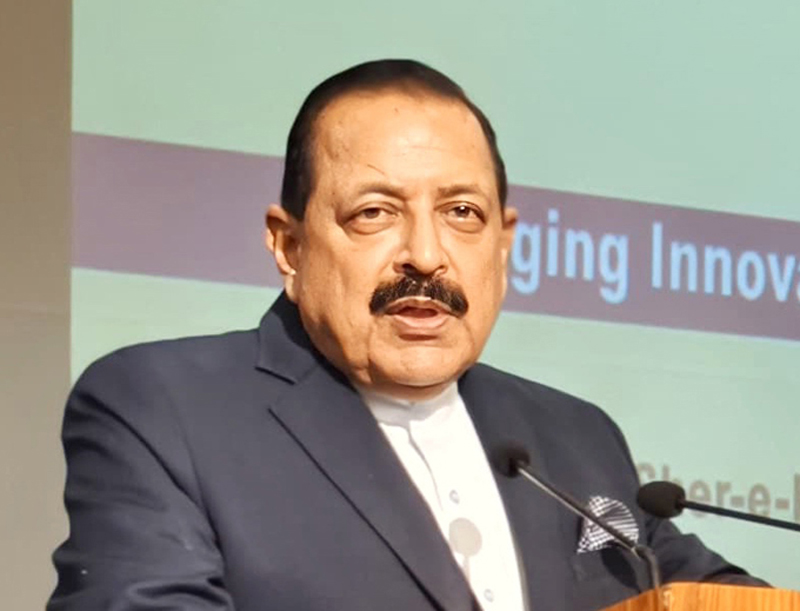
“Even as the biotech potential of Himalayan territories remains still underexplored, J&K holds promise to boost India’s bio-economic revolution, particularly through its agro-biotech,” he said while delivering inaugural address at the PBBCON-2025, 2-day International and National Conference on “Emerging Innovations in Biochemistry and Biotechnology for Holistic Development of Agriculture” conference, at SKUAST Jammu.
The Union Minister underscored the transformative potential of Agri-Biotechnology in J&K, with a special focus on the success of initiatives like the Aroma Mission and the floriculture revolution.
“These programs have helped local farmers cultivate aromatic plants and flowers, creating a thriving industry for essential oils and floriculture products, enabling more than 3000 agri-startups here to each earn around 65 lakh rupess per annum,” he said, while elaborating how biotechnological innovations were reshaping traditional agriculture into a lucrative startup industry.
Dr Jitendra Singh urged the youth of J&K to prepare for the region’s crucial role in India’s growth story, emphasizing that J&K, with institutions like SKUAST University, can be at the forefront of driving innovation in Agri-Biotech and other emerging sectors. He encouraged young minds to leverage the opportunities created by India’s expanding biotech sector and global scientific leadership.
The Union Minister highlighted the ongoing Bio-revolution in India, comparing it to the IT revolution in the West and underscoring the importance of India’s rich natural and biodiversity resources in fueling this transformation. He underscored the rise in DBT’s Budget from 1,485 crores in 2013-14 to 3,447 crores in 2025-26 almost marking 130 percent increase.
“India’s biotech economy, which soared from a $10 billion valuation in 2014 to over $130 billion in 2024, is set to reach a massive $300 billion by 2030,” he said.
Dr Jitendra Singh also shared some key highlights from India’s biotech sector in 2024, including the development of the world’s first HPV vaccine, a breakthrough indigenous antibiotic ‘Nafithromycin’, and the pioneering gene therapy experiment for Hemophilia. He attributed these achievements to the Mission Suraksha initiative, which facilitated the creation of indigenous DNA-based vaccines during the COVID-19 pandemic.
He noted the New BioE3 Policy, launched under Prime Minister Modi’s leadership, which places a special focus on biomanufacturing and bio-foundries, marking a new era for India’s biotechnology sector.
“The Anusandhan National Research Foundation (NRF), allocated Rs 50,000 crores in the 2024 budget, which is set to foster innovation, with a 60 percent contribution from the private sector. This will play a crucial role in nurturing India’s growing deep-tech and biotech startup ecosystem, which has seen exponential growth-from just 50 biotech startups in 2014 to nearly 9,000 today,” he said.
In addition to biotechnology, Dr. Singh also touched upon India’s growing prominence in nuclear energy. “Once met with skepticism, India’s nuclear energy program is now recognized globally for its peaceful and sustainable ambitions. India has set an ambitious target of 100 gigawatts of nuclear energy by 2047.This vision is reshaping global climate strategies, with India’s nuclear policy, envisioned by Homi Bhabha, now seen as a model for responsible energy development,” he said.
Earlier, Vice Chancellor SKUAST Jammu Prof B N Tripathi and President National Society of Biochemistry & Biotechnology in Agriculture, Dr Sharma also addressed the audience.
 Follow our WhatsApp channel
