

Mohammad Hanief
Artificial Intelligence is revolutionizing the role of teachers by excelling at delivering personalized learning experiences. These advanced AI programs can swiftly and accurately pinpoint what a student knows and doesn’t know in each subject, allowing lessons to be designed around their unique aptitudes without any judgment. AI paves the way for individual students to catch up in areas of learning loss where they’ve fallen behind. It enables the creation of customized one-to-one learning plans for every lesson across all subjects-a feat that would be impossible in traditional classrooms where a single teacher faces the challenge of addressing up to 30 diverse student needs, simultaneously.
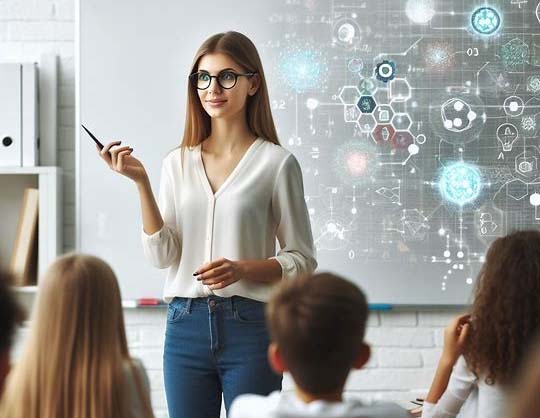
Artificial intelligence (AI) enabled tools are becoming mainstream in the education domain – with both teachers and students exploring its capabilities with equal interest. Most of the conversations have been around how students may tend to learn less by using AI tools that may result in superficial understanding of concepts without true comprehension or deeper knowledge retention. Of equal significance is also about teachers – exploring their evolving roles, how pedagogy will change, and how teachers will adapt in the classroom.
Recent advancements in AI within the educational sector have been nothing short of transformative, offering tools that range from personalised learning algorithms to intelligent digital tutors capable of adapting to individual student needs. Despite fears that these technological strides could render human teachers obsolete, the reality is quite the opposite.
Human educators are irreplaceable for their ability to provide empathy, ethical guidance, and the nuanced understanding that fosters deep intellectual and emotional growth in students. AI serves as a complement to these human attributes, providing data-driven insights that teachers can use to refine their instructional strategies, giving them more time to focus on the creative and interpersonal aspects of teaching that machines cannot replicate. As AI handles more administrative and analytical tasks, teachers are freed to engage more deeply with students, fostering a learning environment enriched by technology but led by the irreplaceable human touch.
This shift in the educational landscape is redefining the roles of educators, evolving them into architects of bespoke educational experiences that not only impart knowledge but also foster essential competencies for the future.
The traditional lecture-based classroom model, where one teacher has to manage the learning levels and abilities of 30 students at once, is failing too many students. Existing academic gaps widened after the pandemic, especially between low- and high-income school districts. Educators are forced to “teach to the middle,” consequently neglecting students who need more attention and leaving more advanced students restless and disengaged. Billions of dollars in Covid relief funds aimed at fixing the problem haven’t done the job. When you’re a teacher in a classroom with such a diverse range of aptitudes and abilities, it’s a big task to get them all back on track.
Educators who use AI programs find it frees up more time to get to know their students on a personal level, understanding what motivates them, what challenges they face and where they need help the most. Our guides take an individualized approach to each student’s learning, helping them achieve their unique goals.
AI tools also excel at tailoring lessons to each student’s unique interests and learning preferences. One child might claim to “hate reading” until they discover content related to their passion, like Formula 1 racing, marine mammals or space travel. It can introduce alternative learning formats, like tech-assisted audio books to accommodate a learning challenge. We’ve seen instances where students believe they are “bad at math” due to personal experiences or falling behind, until re-discovering math in a way that connects to their interests.
Imagine learning averages through current baseball stats, fractions through baking cakes or geometry through hands-on woodworking projects. The connection of academics and real-world interests with diverse learning modalities can transform perceived weaknesses into strengths, helping kids realize they are limitless in what they can learn. That’s what we believe at my schools, and we’ve seen countless examples of success employing this method with our students.
Technological advancements are often met with fear and resistance. Some parents and educators express concerns that AI-based learning tools won’t work in traditional school systems, particularly for all types of learners. They question whether students, especially younger ones, won’t have the discipline or maturity to learn with self-directed edtech. They also worry that AI won’t cultivate creativity or independent thinking but will instead encourage academic dishonesty through cheating and plagiarism.
Successful implementation of an AI-driven educational model does require buy-in from all stakeholders: educators, parents and students. Guardrails need to be in place. It’s also true that this approach requires motivated students. My decade-long experience with AI in schools has shown that students will rise to meet high expectations when given the right tools, motivation and support.
We know that technology isn’t perfect. The adoption of new tools, from desktop computers to the internet, comes with setbacks and learning curves, but not enough to dismiss the upsides. In the 10 years of experimenting with AI in my schools, I’ve seen its capacity to deliver incredible outcomes, building student confidence, mastery and independent thinking while allowing educators to shine in roles they find fulfilling.
With the growing importance of environmental issues, Sustainability Educators will teach students about deep ecology, climate change, and the importance of sustainable development. Each of these roles reflects the ongoing shift in educational priorities and methodologies, emphasising the importance of adaptability, continuous learning, and a broad skill set that goes beyond traditional academic knowledge.
In this rapidly changing educational landscape, the integration of AI and cutting-edge technology is not just enhancing teaching – it’s revolutionising it. Teachers of the future will need to be as adept with digital tools as they are with traditional pedagogy, morphing into facilitators of a highly personalised learning environment. These new roles will be essential in equipping students with the ability to navigate an unpredictable future, ensuring that learning is a lifelong, adaptable journey matched to each individual’s talents and potential. As we stand on the threshold of this educational evolution, teachers are becoming the architects of a new world of learning, where technology meets humanity in the classroom of tomorrow.
 Follow our WhatsApp channel
