

Anoop Khajuria
The inevitable had to happen and two big events emerged one after the another. The World Meteorological Organisation confirmed that the year 2024 was the warmest year on record, based on six International datasets and continuing with its warming streak, the past 10 years from 2015 to 2024 have been the warmest on the planet.
Further, 2024 has been the first calendar year with a global mean temperature exceeding 1.5 degree C above 1850-1900 average or the preindustrial era.
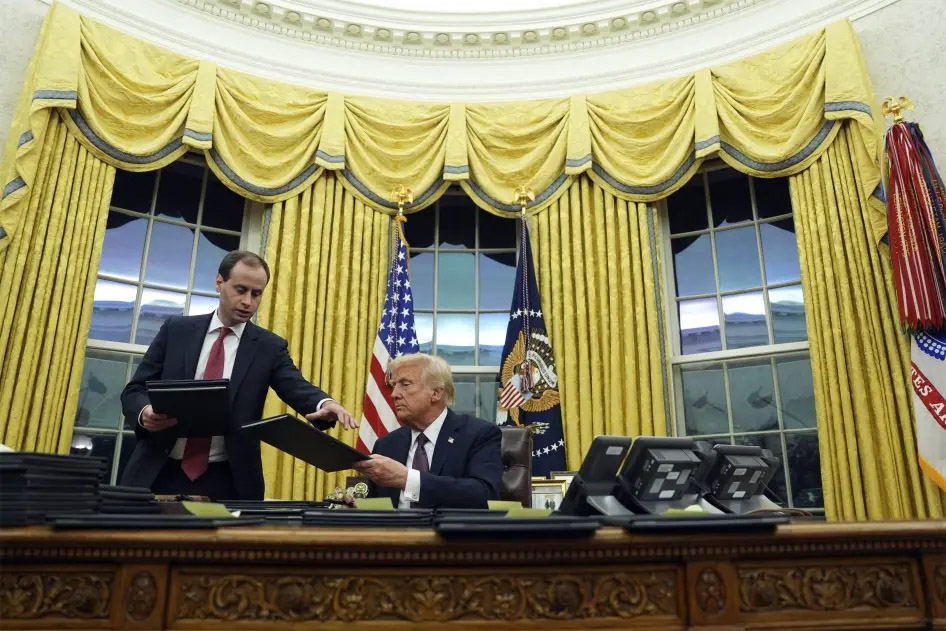
Another event that will have a huge impact on mitigating the impacts of climate change on the planet is the signing of the executive order by the 47th President of the United States of America (USA) who moved swiftly to impose its will on the US government as he assumed office to pull out of the Paris agreement and World Health Organisation.
In Paris in 2015, nearly 200 countries agreed to adopt a series of measures to tackle climate change which were designed to avoid some of the worst consequences of rising temperatures.
And the year 2024 has been recorded with unprecedented rising land and sea surface temperatures that can cause the upward latitudinal shift of the ocean fauna resulting in ecocide of both Ocean and land ecosystems.
USA is the second largest polluter after China, and its pulling out of the Paris agreement can further erode on the achievements gained so for under the UNFCCC.
In order to further understand the commitments to which the parties have agreed to pursue efforts to limit Global temperature rise to 1.5C, and to keep them well below 2.0C above the pre-industrial average temperature, the subtle nuances of the committed goals are important.
The Paris agreement also resolved to achieve net zero condition – A balance between green house gases that humans put into the atmosphere and the gases they actively remove. And the target was the second half of this century.
Richer countries will help poorer Nations by providing funding known as climate finance and under which the COP27 held at Egypt had managed to institutionalize the loss & damage fund which was further made operationalise by COP29 held at Dubai.
Pulling out of the Paris Agreement would mean that the USA will no longer compensate or contribute to the least developed Nations by any means. US President Donald Tump signed an executive order which says that the Paris agreement does not reflect our country’s values or our contributions to the pursuits of economic or environmental objectives and it unfairly burdens the US with escalating cost to the tax-payers.
However, the US or no US in the Paris agreement but the startling scientific facts put forth by the Intergovernmental panel on climate change (IPCC) in Assessment Report 6 (AR 6) are worrying. IPCC have been working since 1988 collecting data on the warming planet and its impacts on the flora, fauna and the overall biodiversity impacted by rising temperatures from 1.5 degree C to 2.0 degree C. It has categorically stated that extreme hot days would be 4 degree C hotter at the mid-latitude when tropics and poles would have 1.5 degree C temperatures.
Sea level rise will cause more flooding above 1.5 degree C exposing up to 10 million people and beyond. 99% of the coral reefs would be lost. Climate related risks will increase above 1.5 degree C making people susceptible to poverty and disease by 2050 than at 1.5 degree C.
The impacts of the climate change are pretty obvious now. The flooding, excessive rains, droughts, land-slides and other such climate related disasters are on the rise. The p[arties are trying to address the disaster risk reduction under Sendai framework (2015) but funding is crucial to mitigate the impacts of climate change especially for the least developed Nations and small island developing Nations.
I may quote one example. Look at the misery and difficulties of Vanuatu – A small island Nation in the pacific ocean ravaged by a series of earthquakes beginning from 17th of December 24 that hit the island at 7.17 am with a magnitude of 7.3 at richter scale and after the series of aftershocks lasting as big as the magnitude of 6.1 R on 22nd of December erupting just 31 kms from Port Vila, Vanuatu. Our media hardly covered it with significance and the world may have passed the News with a shrug, “Where is this Vanuatu?”
In our own country, the Bay of Bengal from Andhra to Odisha and Sunderbans, the rising sea levels have engulfed many villages. How seven villages in district Kendrapada Odisha, were destroyed by rising sea levels making its villages climate refugees has been documented in my documentary film” Invading waves, Rising sea levels.” The climate central – an independent organisation has forecast that many places of the Indian eastern coastline will be considerably under water by 2050.
Though Donald Trump has signed the executive order, as per UN convention, the USA is required to be in the Paris agreement for next one year. However, ” Paris agreement remains as essential as ever. UN climate negotiations are the only platform where every nation has a voice on one of the most pressing challenges of our times. Whether it is to tackle the catastrophic climate impacts they face or tap into rapidly growing green technologies, countries recognize the critical value of the International process. That’s why it is the firm belief of the International community that all nations will stay committed to the Paris agreement despite the United State’s departure,” comments an activist. And it seems prudent and future will certainly concur with the larger sentiments believing in the united efforts to save the planet.
(The author is a film maker & member of Asia Pasific group of Journalists and Broadcaster)
 Follow our WhatsApp channel
