

Chetan Prabhakar
After the lapse of British paramountcy over princely states, Maharaja Hari Singh wanted Jammu and Kashmir to be an independent state.But the sudden invasion by the Pakistan supported Pashtun tribesmen on 23 October 1947 compelled a change of mind. Maharaja Hari Singh requested the military assistance from the Government of India. In return for India’s military intervention, the Maharaja accepted and signed the Instrument of Accession to the Dominion of India on 26 October 1947 for specific matters such as Defence, External Affairs, Communication and Ancillary matters such as elections to the dominion legislature, offences against laws; inquiries and statistic and; jurisdictions and powers of Courts with respect to any of the aforesaid matters. The Maharaja accepted the aforesaid matters as the matters with respect to which the Dominion Legislature may make laws for the State of Jammu and Kashmir.
On 25 November 1947, Maharaja Hari Singh declared in a proclamation that the Constitution of India shortly to be adopted by the Constituent Assembly of India shall in so far as it is applicable to the State of Jammu and Kashmir, govern the Constitutional relationship between the state and the contemplated Union of India and shall be enforced by Maharaja, his heirs, and successors in accordance with tenor of its provisions; that the provisions of the said Constitution shall, as from the date of its commencement, supersede and abrogate all other constitutional provisions inconsistent therewith which were in force at that point in time in the state of Jammu and Kashmir.
On 17 October 1949, in India’s Constituent Assembly, N. Gopalaswani Ayyangar senior member of the Constituent Assembly moved the motion for adoption of a new Article-Article 306A.
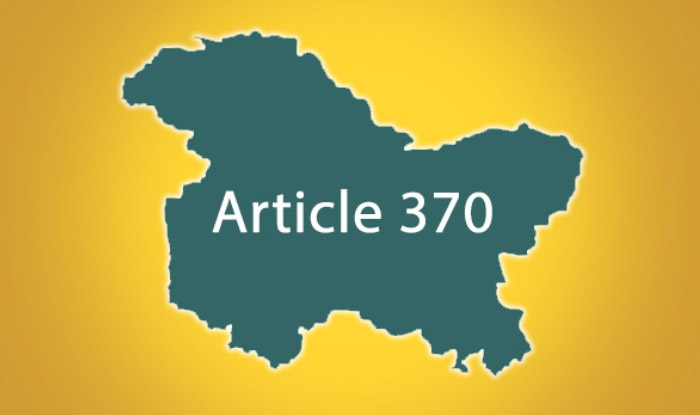
On 26 November 1949, Article 306 was finally adopted and included in Part-XXI of the Constitution (Temporary and Transitional Provisions) and renumbered as Article 370, with the marginal note: “Temporary Provisions with respect to the State of Jammu and Kashmir”. An analysis of Article 370 is given below:
a) Only Article 1 of the Indian Constitution, along with Article 370, was to apply to the state of Jammu and Kashmir. By virtue of Article 1, the State of J&K thus became an integral part of the Union of India.
b) All the other provisions of the Constitution of India were to be applied to that State only through Presidential Orders, subject to such exceptions and modifications as the President (of India) may be order specifically.
c) Clause 1 of Article 370 expressly limited the powers of India’s Parliament to make laws for the state of Jammu and Kashmir to three matters: defence, external affairs, and communication, but no orders in these matters were to be issued except in consultation with Government of Jammu and Kashmir State.
d) Such other provisions of the Constitution of India were to apply in relation to the state of Jammu and Kashmir, subject to such exceptions and modifications as the President may by order specify; but no such order was to be issued except with the concurrence of the State Government of Jammu and Kashmir.
e) Notwithstanding anything in the provisions of Article 370, the President of India was also empowered (by Clause (3) of Article 370) to declare by public notification that Article 370 ‘shall cease to be operative or shall be operative with such exceptions and modifications and from such date as the President may specify, but under the proviso to Article 370 (3), the recommendation of the Constituent Assembly of the State ‘shall be necessary’ before the President issues such a notification.
On 05 August 2019, the Government of India in exercise of the powers by clause (3) of Article 370 read with clause (1) of Article 370 of the Constitution, the President, on the recommendation of Parliament, was pleased to declare that, as from 6 August 2019, all clauses of said Article 370 shall cease to be operative. The new Article 370 was introducednot by an amendment to the constitution but by the presidential order which provided that all the provisions of the constitution (as amended from time to time) without any modification or exceptions would henceforth apply to the territory, and to the people in state of Jammu and Kashmir.From 6 August 2019, the state of Jammu and Kashmir ceased to be a State, upon Parliament passing the Jammu and Kashmir Reorganization Act No. 34 of 2019. It created two new union territories: the Union Territory of Ladakh and Union territory of Jammu and Kashmir.
It is important to note here that Article 370 had been sought to be abrogated by inserting clause (4) in Article 367, by Presidential Notification dispensing with the obligatory condition in the proviso to Article 370 (3) which provide that recommendation of Constituent Assembly of the state shall be necessary. Constitution challenges were made to abrogation of Article 370 on the following key issues:
1) Is Article 370 a temporary provision of the Constitution of India?
2) Can Article 367 be used to amend the meaning of ‘Constituent Assembly’ to mean ”Legislative Assembly’?
3) Can the President strike Article 370 without the recommendation of the Constituent Assembly of Jammu and Kashmir?
4) Is the Jammu and Kashmir Reorganization Act, 2019, which bifurcated J&K into two Union Territories constitutionally valid?
On 11 December 2023, the Constitution Bench of the Supreme Court of India upheld the abrogation of Article 370. The Constitution Bench inter-aliaobserved that a) Article 370 was a temporary provision;b)the power of the President under Article 370(3) was unaffected by the dissolution of the Constituent Assembly of Jammu and Kashmir; c) once the Presidential proclamation has been approved by both Houses of Parliament, to reflect the will of the people, the President has the power under Article 356 to make irreversible changes; d) since the State of Jammu & Kashmir was under President’s Rule and the State Legislature was already dissolved to seek its views affecting area, boundaries or names of the state, the functions of the State Legislature were performed by the Union Parliament as such, converting the state into two union territories was valid and e) The power under Article 370(1)(d) read with Article 367 cannot be used to do indirectly, what cannot be done directly and Paragraph 2 of C.O. 272, which amends Article 367(4) is ultra vires Article 370.
Shri Fali S. Nariman, Indian Jurist and foremost constitutional law expert said in an interview with Karan Thapar that the abrogation of Article 370 is politically correct because it enabled a complete union but constitutionally it was wrongly done.
(The author is an Advocate of
Supreme Court and J&K & L High Court)
 Follow our WhatsApp channel
