

Prof R.K. Gupta , Dr Devinder Sharma
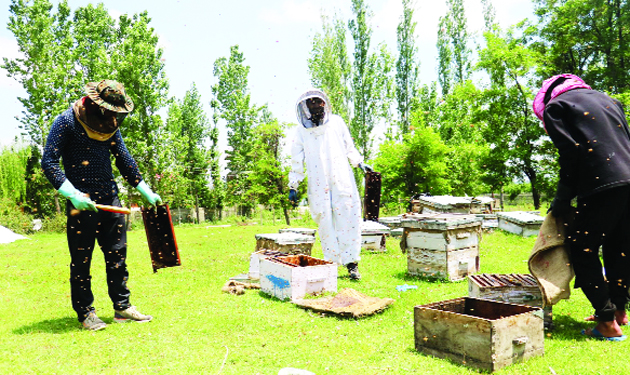
The historical roots of beekeeping in the Jammu region run deep. Indigenous species such as Apis dorsata, known locally as Bhor Makhi, Apis cerana, or Gan Makhi, and Apis florea, referred to as Nikki Makhi, have long been part of the region’s ecological and cultural fabric. Traditional beekeeping with A. cerana in wall and log hives eventually evolved into a more organized practice with the introduction of the exotic Apis mellifera in the early 1970s. This marked the beginning of modern apiculture in the region.The early adoption of A. mellifera was not without resistance. Concerns were raised in the early 1970s regarding viral outbreaks, especially the sacbrood virus and the so-called Kashmir Bee Virus, which some feared could threaten native colonies. However, subsequent scientific evaluations laid these fears to rest. This transition laid the groundwork for a modern apiculture industry across both regions.SKUAST-Jammu has played a central role in this transformation. Its Center for Experiential Learning and Innovative Beekeeping has been instrumental in training beekeepers, providing scientific solutions, and encouraging entrepreneurship, especially among youth and women in rural areas. The university has developed location-specific protocols for colony management, introduced smart hive monitoring technologies, and facilitated organic certification for honey producers. SKUAST-Jammu has played a central role in this transformation.SKUAST-Jammu has also introduced early diagnostic kits for bee diseases, queen breeding units, and small-scale honey processing technologies. Floral mapping, seasonal calendars, and climate-adaptive practices further support productivity. These interventions have contributed significantly to the Honey Mission and the broader vision of a Sweet Revolution in India.For instance, over the last ten years, the Jammu region has witnessed exponential growth in the number of bee colonies and overall honey production. In 2012, the number of registered beekeepers stood at approximately 261, managing around 11,390 colonies. The total honey production at the time was approximately 522 quintals, with an average yield of 4.58 kilograms per colony. By 2022, the beekeeper base had expanded to 3,295 individuals, managing 71,264 colonies. Honey production soared to over 8,182 quintals, with a commendable average yield of 11.48 kilograms per colony. This growth is largely attributed to the adoption of migratory beekeeping, which allows colonies to be moved across regions to follow seasonal floral blooms, thereby enhancing nectar flow and improving productivity. Beekeeping in migratory mode proved to be nearly five times more profitable than stationary practices.
Despite the success, challenges persist. The current density of bee colonies in Jammu and Kashmir is alarmingly low just 0.2 colonies per hectare compared to the required minimum of 3 to 5 colonies per hectare for optimal pollination. Current estimates by SKUAST suggest that Jammu and Kashmir has the potential to sustain over 600,000 colonies, produce up to 9,000 tonnes of honey annually, and generate employment for more than 12,000 rural families.
However, the rise of commercial beekeeping with Apis mellifera has had unintended ecological consequences. Native species such as A. cerana, A. dorsata, and A. florea have seen population declines of 81 percent, 73 percent, and 80 percent respectively over the past six decades in Jammu. These declines have been attributed to habitat loss, climate change, and competition from the more dominant A. mellifera. The introduced species often outcompetes native bees for floral resources, leading to reduced pollination of wild plants and the disruption of local ecosystems. Moreover, environmental changes have altered the timing and quality of floral resources, exacerbating stress on both wild and managed colonies.The dependence on artificial inputs represents a sharp departure from the natural resilience of native bees. As such, conservation of genetic diversity and the creation of safe environments are essential to ensure the long-term sustainability of apiculture and agriculture in the region.Looking ahead, SKUAST-Jammu is charting a robust roadmap to further strengthen apiculture in the region. Central to this vision is the development of a region-specific bee breeding programme aimed at enhancing honey productivity while simultaneously building resistance against diseases and controlling Varroa mite infestations. The university also plans to boost the profitability of hives by promoting the diversification of hive products, encouraging beekeepers to harvest not just honey but also pollen, propolis, royal jelly, and bee venom-each of which holds significant commercial and medicinal value. To ensure product integrity and farmer confidence, there is a strong emphasis on establishing a dedicated quality control and monitoring facility, which will standardize processing, certify purity, and open access to premium markets. In parallel, SKUAST-Jammu is set to roll out comprehensive training modules on natural and organic beekeeping, empowering farmers to adopt sustainable practices in line with global organic standards. Lastly, recognizing the pivotal role of bees in agricultural productivity, the university is also working on scientifically designed modalities for pollination services, enabling more effective use of honeybees in improving crop yields and supporting food security.The future of beekeeping in Jammu depends on balancing economic growth with ecological responsibility. There is an urgent need to protect and promote native bee species, enhance floral diversity, and ensure that policy frameworks support both commercial beekeepers and conservation goals. Educational initiatives aimed at schoolchildren and youth can play a vital role in fostering awareness and encouraging peaceful coexistence between humans and honey bees.
The story of Jammu’s beekeeping journey serves as a powerful example of how traditional knowledge, scientific research, and institutional support can converge to create a sustainable and productive future. With SKUAST-Jammu leading the charge, the region is well on its way to becoming a national hub of apiculture innovation. It is time we recognize the bee not just as a honey-maker, but as an indispensable ally in our pursuit of ecological harmony and agricultural prosperity.
(The authors are from Division of Entomology, SKUAST-Jammu)
 Follow our WhatsApp channel
