

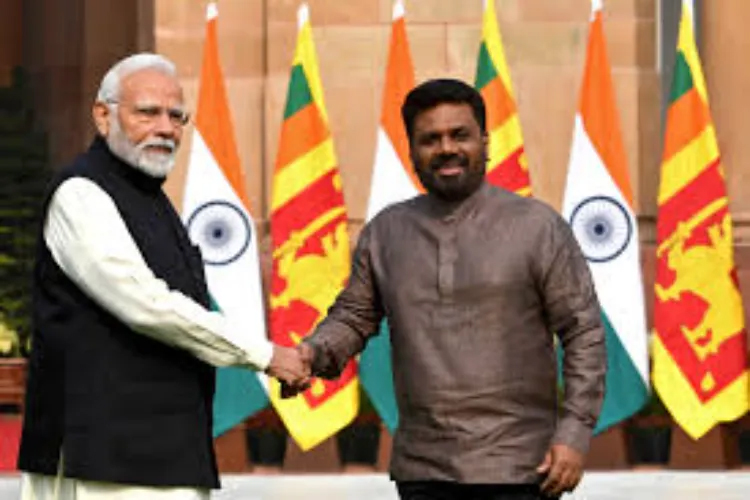
COLOMBO, Dec 31: Prime Minister Narendra Modi’s visit to Sri Lanka in 2025 marked an upswing in bilateral ties, as the island nation showed signs of recovery from the economic stress.
During the April visit, military cooperation between India and Sri Lanka was also institutionalised, with PM Modi asserting that the security of both nations is interlinked and dependent on each other.
Modi visited Sri Lanka at a time when the island nation was showing signs of recovery from economic stress. The country was reeling under a massive economic crisis three years back, and India extended financial assistance worth USD 4.5 billion.
Ahead of the visit, President Anura Kumara Dissanayake said Prime Minister Modi is visiting Sri Lanka due to the “stability of the country”.
Although the Modi-Dissanayake talks yielded over 10 concrete outcomes, the defence cooperation pact emerged as the centrepiece, as it signalled an upward trajectory in defence relations.
India also made it clear that its approach to Sri Lanka’s Tamil minority issue remains the same and urged the early holding of the stalled provincial council elections as a first step.
In September, at the UN human rights sessions in Geneva, India urged Sri Lanka to hold the provincial elections early.
A resolution, adopted by the UN Human Rights Council (UNHRC) in October without a vote, also extended the mandate of the Office of the High Commissioner for Human Rights (OHCHR) on Sri Lanka for two more years. Sri Lanka strongly rejected the resolution.
Foreign Minister Vijitha Herath said that it was a waste of time to rally international support as a rights body resolution relevant to Sri Lanka had been lost on the international community with the turn of events in Gaza.
The opposition parties termed it a diplomatic failure, as the government was not even able to garner support from its allies.
In November, Sri Lanka was hit by a catastrophic tropical cyclone, severely straining the island’s disaster-response capacity. India became the first country to help the island nation during this difficult time.
More than 400 people died and over 300 others went missing due to catastrophic floods and landslides caused by extreme weather conditions since November 16.
India launched ‘Operation Sagar Bandhu’ – a generous and timely intervention to help Cyclone Ditwah-hit Sri Lanka.
In December, External Affairs Minister S Jaishankar travelled to Colombo, where he announced a reconstruction package of USD 450 million to Sri Lanka. The assistance package included USD 350 million in concessional Lines of Credit and USD 100 million in grants.
Jaishankar, who visited Lanka as PM Modi’s Special Envoy, said that the assistance will cover sectors worst affected by the cyclone, including rehabilitation and restoration of road, railway and bridge connectivity; support for the construction of damaged houses, support for health and education systems, agriculture, and working towards better disaster response and preparedness.
Overall, Operation Sagar Bandhu delivered over 1100 tonnes of relief material, including dry rations, tents, tarpaulins, hygiene kits, essential clothing and water purification kits. About 14.5 tonnes of medicines and medical equipment were also provided. Nearly 60 tonnes of equipment were also brought to Sri Lanka to assist the relief operations.
India’s record to bail out Sri Lanka from the recent disasters – the Covid pandemic in 2020 through vaccines, USD 4 billion support when the country was reeling in the impact of the economic crisis in 2022, to the Ditwah aftermath stands as a testament to its Neighbourhood First Policy.
The policy emphasises stronger physical, digital, and cultural connectivity with neighbouring countries such as Bhutan, Nepal, Sri Lanka, the Maldives, Myanmar, Bangladesh, and Afghanistan.
On the domestic front, the high taxes which caused the rise in state revenue under the crisis government of 2022-24 still persisted.
Critics say that the past year saw no change from the previous 76 years of governance by the National People’s Power (NPP) predecessors, which the NPP was critical of and used as a vote-buying tactic.
In the first 10 months of the year, some 70 arrests of former high-ranking ministers and 118 public officials have been made by the anti-graft commission under the new anti-corruption laws adopted by the previous regime.
The 38 convictions by October end included two former ministers being sentenced to 20 years for using state property for elections a decade back.
The arrest of the former President Ranil Wickremesinghe in August for misuse of state funds to visit a private event of his wife in the UK drew widespread condemnation even from some sections of Indian politics.
His arrest was seen as settling scores by the NPP’s dominant party, JVP. Wickremesinghe was widely seen as a key figure in the government crackdown of the JVP 1987-90.
The Government spin was that they had touched the untouchables and held them to accountability, a major election pledge.
The Government, now saddled with Ditwah recovery, is expected to face many electoral challenges with the opposition going into fighting mode in the new year.
In May’s local election, the NPP lost over 2 million votes despite winning control of the majority of councils. In the provincial council election, it would be a serious test of public approval of the Government. (PTI)
 Follow our WhatsApp channel
