

Rs 15.94 cr compensation, jobs also pending
*Govt Deptts, security forces owe Rs 3747 cr electricity dues
Sanjeev Pargal
JAMMU, Apr 2: Notwithstanding the agreement signed between Jammu and Kashmir and Punjab Government way back in the year 1979 for 20 percent power supply to J&K out of total power generated at Thein Dam and Shahpur Kandi barrage, the UT is not getting any such supply because of lack of transmission infrastructure.
Follow the Daily Excelsior channel on WhatsApp
Not only this, compensation to the tune of Rs 15.94 crore to be given to the people affected by construction of dam and, in some cases, the jobs for youth as promised by Punjab Government, are also pending.
Click here to watch video
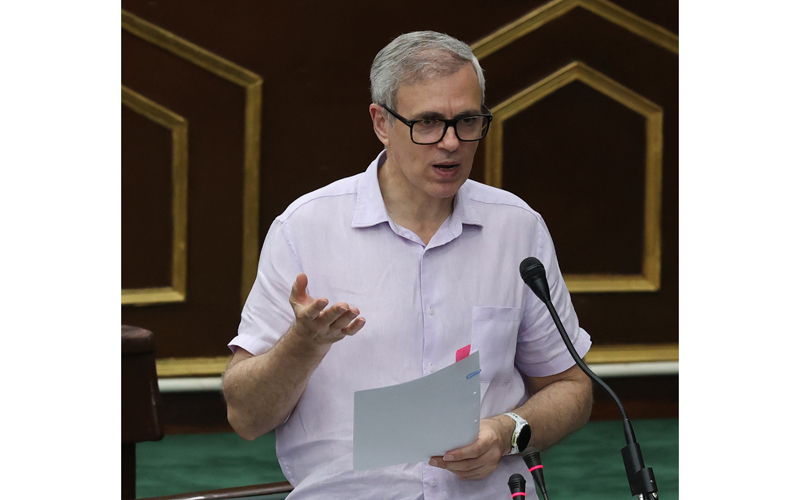
Chief Minister Omar Abdullah, who also holds charge of the Power Development Department today admitted this in written reply to a question of BJP Basohli MLA Darshan Kumar Singh.
“As per agreement of the year 1979 signed between J&K and Punjab Governments, 20 percent of total power generated at Thein Dam and Shahpur Kandi Barrage at busbar cost of generation was to be made available to J&K. Of late, power sale agreement was signed between PSPCL and JKPCL on 11.10.2019 for sale and purchase of power from the dam now known as Ranjit Sagar Dam project. As on date, no power is injected into our system due to lack of transmission infrastructure,” Omar said.
Out of the total Rs 85.48 crore allocated, he said, about Rs 71.15 crore has already been released by Punjab, leaving nearly Rs 15.94 crore pending, including interest components.”
Omar noted that delays in disbursement are partly due to some claimants not submitting required documents such as Aadhaar, PAN, and bank details, despite several notices issued to expedite the process.
On employment, he added that issues affecting more than 800 families have been raised with the relevant authorities.
However, he acknowledged that the jobs provided so far do not meet expectations and that further discussions with Punjab will be necessary to ensure that commitments made under the agreement and subsequent rehabilitation policies are fully implemented.
“Our objective is also to ensure that the money reaches the beneficiaries as soon as possible. However, it is also true that we cannot disburse the funds until all necessary formalities and procedural requirements are completed,” Abdullah said.
Asserting that he will address the issue of pending commitments related to the Ranjit Sagar Dam with his Punjab counterpart, the Chief Minister stated that he would remind the Punjab Government of the commitments laid out in the Memorandum of Understanding (MoU) signed during the project’s construction in 1979.
“This is not an individual agreement but a sovereign commitment between the Government of Punjab and the Government of J-K, so there is no question of turning away from obligations. We will formally remind them (Punjab Government) and emphasise that they must acknowledge and fulfill their commitments,” he said.
The Ranjit Sagar Dam, also known as the Thein Dam, is a major 600 MW hydroelectric project on the Ravi river near Basohli in Kathua, Jammu and Kashmir and Pathankot, Punjab, completed in 2001.
“We will review the matter with the concerned management and make efforts to ensure that the commitments made under the 1979 agreement are properly implemented within the stipulated framework and time period,” he said.
Accusing the Punjab Government of not fulfilling its commitments made in the MoU, BJP MLA Sham Lal Sharma, who raised supplementary to Darshan Singh’s question, requested the Chief Minister to take up the matter seriously with the Punjab Government.
Darshan Singh expressed concerns regarding the injustice faced by affected individuals, stating that those who have been provided jobs are often assigned roles such as cooks or labourers, with little opportunity for promotions.
“The agreement also stated that jobs would be provided near the project area, but instead, people have been sent to far-off places in Punjab. Highly educated youth, including Post Graduates, are being made to do clerical work despite being accommodated under low-grade jobs,” he said.
Meanwhile, in written reply to another question tabled by PDP MLA Aga Syed Muntazir Mehdi in the Assembly, the Chief Minister said that outstanding electricity dues across Government departments, public sector units and security establishments in the Union Territory have surged to over Rs 3,747 crore, with major liabilities concentrated in key infrastructure and utility departments.
“The total outstanding stands at Rs 3,74,735.42 lakh, including Rs 2,31,022.41 lakh under Kashmir Power Distribution Corporation Limited (KPDCL) and Rs 1,43,713.01 lakh under Jammu Power Distribution Corporation Limited (JPDCL). The Public Health Engineering (PHE) department has emerged as the single largest defaulter, with dues amounting to Rs 1,30,043 lakh, followed by the Irrigation and Flood control department at Rs 58,059.72 lakh,” Omar said.
Among security agencies, he said, the Central Reserve Police Force (CRPF) owes Rs 29,638.45 lakh, while the Army has pending dues of Rs 19,719.94 lakh and the Border Security Force (BSF) Rs 1,116.87 lakh. The Home department has accumulated dues of Rs 22,306.46 lakh, while the Housing and Urban Development department stands at Rs 14,449.47 lakh.
The Power Development Department itself has outstanding liabilities of Rs 10,756.53 lakh, and the Power Development Corporation Rs 2,277.51 lakh.
Municipal bodies account for a significant burden, with Municipalities alone owing Rs 24,163.80 lakh. The Revenue and Relief Department has dues of Rs 8,227.62 lakh, while the Health and Medical Education Department owes Rs 11,989.31 lakh.
Other major contributors include the Tourism Department (Rs 4,759.05 lakh), Education Department (Rs 2,866.40 lakh), Public Works (R&B) Department (Rs 1,951.21 lakh), and Rural Development Department (Rs 1,062.95 lakh).
The data also reflects dues from Central agencies and PSUs such as NHPC, NHAI, Railways, Power Grid Corporation of India, BSNL and Prasar Bharti, besides several development authorities and corporations including JDA, UDA, SIDCO and SRTC.
In his reply, Omar said that power distribution companies (DISCOMs) are actively pursuing recovery of outstanding dues from defaulting departments and establishments.
The disclosure highlights the mounting financial stress on the power sector in Jammu and Kashmir, with a substantial portion of unpaid dues locked in government and institutional consumption.
Meanwhile, Omar said the developments at the international level remain beyond the control of both the Union government and the people, asserting that the situation in Jammu and Kashmir will largely mirror the broader national scenario.
In a brief chat with media persons outside the Assembly, he said J&K is currently not facing any shortage of essential supplies, including fuel, and that stocks are sufficient for the next 10 to 15 days.
“Whatever the situation in the rest of the country, the same will reflect in Jammu and Kashmir,” he said, adding that there is no immediate cause for concern.
He, however, cautioned that in case the ongoing conflict prolongs and leads to shortages elsewhere in the country, its impact could extend to the Union Territory as well.
Referring to a recent review meeting chaired by Prime Minister Narendra Modi, the Chief Minister said assurances have been given that supplies are being maintained through multiple sources.
“There is no need to panic at this stage. If there is any change in the situation, we will inform the public,” he said.
Meanwhile, Omar said that over 16,000 kanals of land under the Jammu Development Authority (JDA) are currently being encroached upon, and that eviction drives are being carried out in a phased and time-bound manner.
In response to a question from BJP MLA Dr Narinder Singh Raina in the assembly, the chief minister stated that the total land managed by the JDA amounts to 80,976 kanals and 10 marlas, of which 16,127 kanals and 10 marlas are under illegal occupation.
Abdullah explained that encroachments are identified through inspections conducted by field staff and records maintained by the Revenue Department.
“Eviction notices are issued under the provisions of the Jammu and Kashmir Public Premises (Eviction of Unauthorised Occupants) Act, and regular eviction and demolition drives are conducted in coordination with the district administration and police,” the Chief Minister said.
 Follow our WhatsApp channel
