

Celine Kaya
celinek2621@gmail.com
Once defined by isolation, Jammu and Kashmir is steadily transforming into a region driven by connectivity, tourism, and economic growth. Over the past decade, sustained investment in infrastructure has begun to reshape both mobility and opportunity across the Union Territory. Highways, tunnels, and railway networks are not only reducing physical distance but also bridging long-standing economic and social gaps. This shift is now visible in rising tourist numbers and expanding local economic activity.
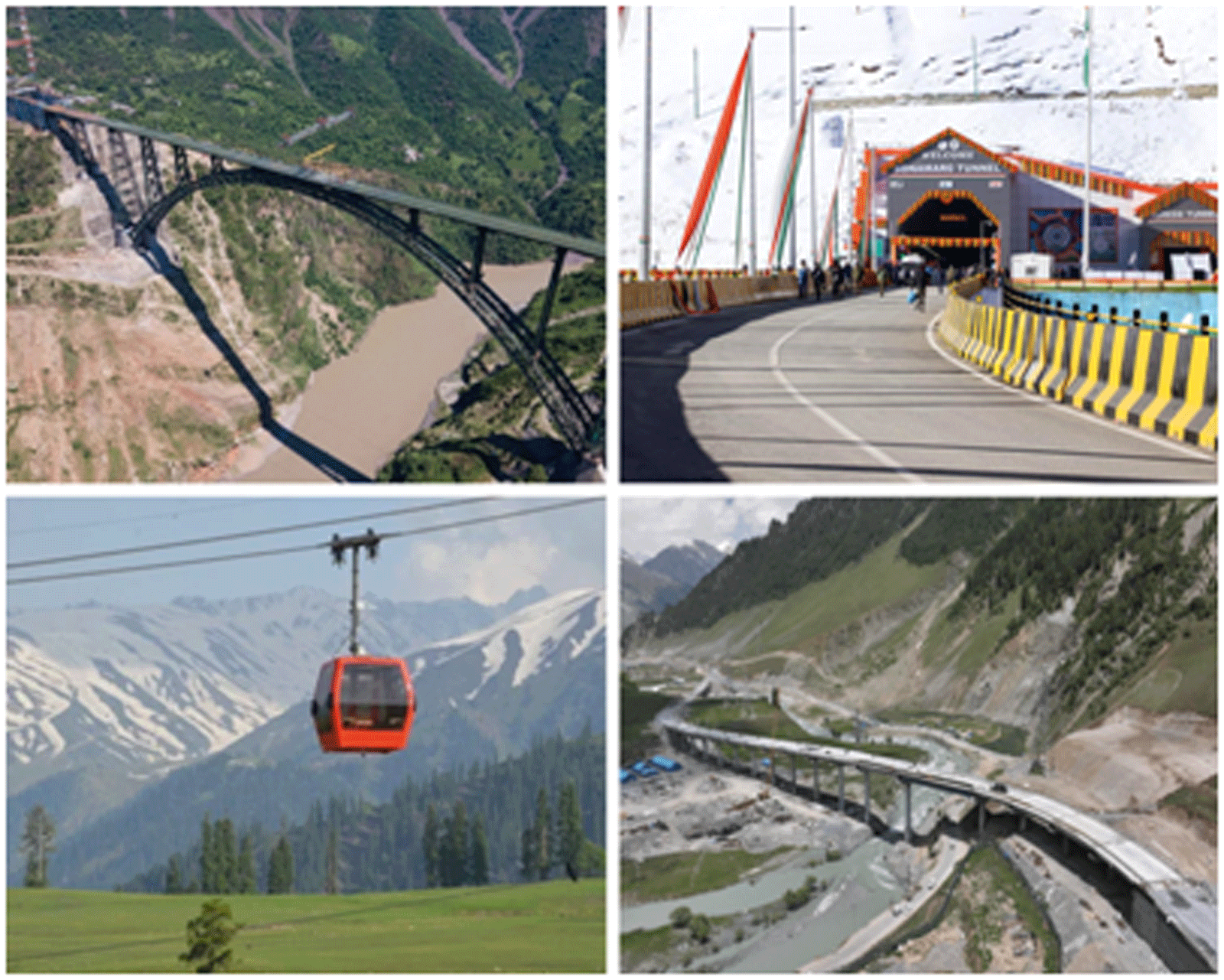
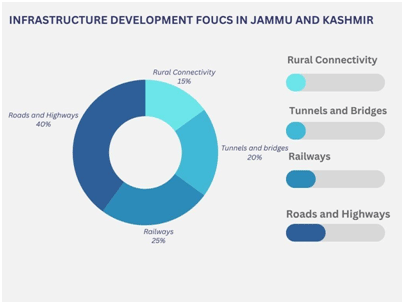 According to data from government departments, over ₹80,000 crore has been invested in infrastructure projects in Jammu and Kashmir since 2014. At the centre of this transformation is the 272-km Udhampur–Srinagar–Baramulla Rail Link (USBRL), one of India’s most ambitious railway projects. It includes landmark structures such as the Chenab Rail Bridge, standing 359 metres above the river and recognised as the world’s highest railway bridge, and the Anji Khad Bridge, India’s first cable-stayed railway bridge. Road infrastructure has also seen major upgrades through projects like National Highway 44, the Chenani–Nashri Tunnel, and the Banihal–Qazigund Tunnel. Ongoing projects such as the Zoji La and Z-Morh tunnels are expected to further strengthen all-weather connectivity between the Kashmir Valley and the rest of the country.
Rural connectivity has expanded significantly under the Pradhan Mantri Gram Sadak Yojana (PMGSY). More than 10,500 km of roads and 1,486 bridges have been constructed, improving access to remote and border areas. This has enabled better access to healthcare, education, and markets, while also integrating previously cut-off regions into the larger economic framework. Districts like Kupwara, Doda, and Ramban have seen visible changes, with improved connectivity supporting small businesses, local tourism, and market access.
The economic impact of this infrastructure push is most evident in tourism and trade. Official data shows that Jammu and Kashmir recorded 2.36 crore tourist visits in 2024, one of the highest figures in its history. This surge has directly contributed to employment across sectors, including hospitality, transport, handicrafts, and local services. Improved road and rail networks have also reduced travel time between Jammu and Srinagar, facilitating smoother movement of goods. Agricultural and handicraft exports particularly apples and saffron have witnessed estimated annual growth of 15 to 20 per cent, supported by better logistics and transport systems.
Looking ahead, the region’s development trajectory remains closely tied to ongoing and upcoming infrastructure projects. The Zoji La and Z-Morh tunnels are expected to ensure year-round connectivity, while the completion of the USBRL will mark a significant milestone in fully integrating Kashmir into India’s railway network. Continued expansion of rural roads under PMGSY is likely to further strengthen last-mile connectivity.
Together, these developments point to a larger structural shift. Jammu and Kashmir is no longer defined solely by its geography or past constraints but is emerging as a region of growing economic relevance. With sustained investment and improving connectivity, it is positioning itself as a key contributor to India’s broader development story.
 Follow our WhatsApp channel
