Ranjit Thakur
JAMMU, Apr 8: From the quiet confines of an orphanage to the grand stage of international sport, Payal Nag’s journey is as much a story of personal resilience as it is of unwavering mentorship. Once a child grappling with a life-altering tragedy, she found direction when coach Kuldeep Vedwan discovered her, brought her out of institutional care and nurtured her talent against all odds. Together, they have scripted a historic chapter-transforming adversity into achievement and redefining the boundaries of sport.
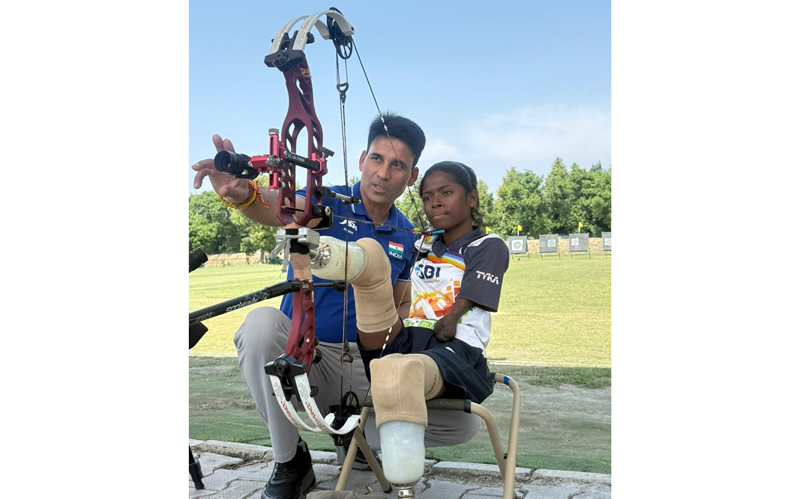
In a remarkable feat, 18-year-old Payal Nag from Odisha has become the world’s first quadruple amputee to win an International gold medal in archery. Her triumph at the World Para Archery Series final in Bangkok, where she outperformed her idol and Paralympic champion Sheetal Devi, marks a defining moment not only for Indian para-sports but also for the global sporting community.
Born in Balangir district to a daily-wage labourer, Payal’s early life was shaped by hardship. At the age of eight, an electrocution accident led to the loss of all four limbs, leaving her to rebuild her life from unimaginable circumstances. She was later housed in an orphanage, where, despite the odds, she displayed remarkable adaptability. A video of her painting with her mouth-widely shared on social media-offered a glimpse of her indomitable spirit.
That video caught the attention of Kuldeep Vedwan, an archery coach based in Katra, who saw in her a rare spark. Determined to reach her, he travelled to Odisha and located her in the orphanage. The path forward, however, was not immediate.
“In 2023, I saw her video on social media, and it stayed with me,” Vedwan recalled. “When I reached the orphanage, there were legal hurdles. I approached the District Magistrate of Balangir, explained my vision and after due verification, I was finally allowed to take her for training.”
At the Mata Vaishno Devi Shrine Archery Academy in Katra, Payal’s journey into archery began-one that demanded not only physical endurance but also complete reinvention of technique. With no limbs, even the most fundamental aspects of the sport had to be reimagined.
Vedwan, despite not being an engineer, undertook the challenge of designing a customised assistive device that would enable Payal to shoot. The device, later approved by international archery authorities, functions as a substitute for hands, allowing her to hold and release the bow.
“The device is like a hand,” he explained. “Without it, she would remain limited. With it, she can compete.” The training process was as demanding as it was innovative. Payal’s initial hesitation was natural. “When she first came to the ground, she was nervous. She asked me, ‘Sir, I don’t have hands or feet. How will I shoot?'” Vedwan said. “I told her she would-and that we would work towards it step by step.”
He began by focusing on building her core strength. Improvising with available resources, he tied a dumbbell with a rubber band and trained her to hold and control it. For three months, the focus remained entirely on physical conditioning, alongside the development of the assistive device.
Within that period, a breakthrough was achieved. Payal was able to lift the bow and release her first arrow.
“The happiness on her face that day was unforgettable,” Vedwan recalled. “I had seen that expression when athletes win medals. For me, that moment itself felt like an Olympic victory.”
From that tentative first shot to standing atop an international podium, Payal’s rise has been swift but deeply earned. Her gold medal in Bangkok is not merely a personal milestone; it is a powerful statement on inclusion, innovation and perseverance.
Vedwan’s contribution to Indian para-archery extends well beyond this singular success. He has previously trained Paralympic medallists Rakesh Kumar and Sheetal Devi, both recipients of the Arjuna Award, helping establish Katra as a significant hub for para-archery in India.
A native of Dhanaura Tikri village in Uttar Pradesh’s Baghpat district, the 42-year-old began his career in the Indian Army in 2000. Encouraged by a commanding officer to pursue archery, he gradually shifted focus to the sport. In 2008, he started a small academy in his village. Many of his trainees went on to join the armed forces and police services.
Driven by a broader vision, he later moved to Puducherry before being invited in 2017 by the then CEO of the Shri Mata Vaishno Devi Shrine Board, Ajeet Kumar Sahu, to establish an archery centre in Katra. Leaving behind a well-paying job, he took up the challenge at a time when the centre was virtually unknown. Over the years, the academy has groomed leading para archers such as Rakesh Kumar, Sheetal Devi and Payal Nag.
Today, the academy trains nearly 100 archers, including 15 para-athletes. Vedwan is now working towards expanding opportunities further, including initiatives in blind archery. One of his trainees, Pawan Sharma, has already won a gold medal at a national championship.
Despite his achievements, Vedwan remains modest, attributing his innovations to divine grace. He continues to design assistive devices aimed at enabling more children with disabilities to take up the sport. “My life’s only dream,” he said, “is to see India win multiple Olympic medals.”
 Follow our WhatsApp channel