

Col Shiv Choudhary (Retd)
shivchoudhary2@gmail.com
In public imagination, the Army is synonymous with war; soldiers marching in formation, tanks crossing borders, jets flying overhead, naval ships sailing in deep sea, soldiers in olive-green uniforms wielding weapons in combat zones, glimpses of ambulances carrying injured and martyred, sounds of patriotic nationalall over, camouflage nets covering military vehicles on roads, TV and print media in full swing, and war hysteria and phobia all over. These striking visualshave come to define the Indian Army in the collective civilian mind. Yet, when conflict is absent and guns fall silent, a persistent and often painful question arises: “If there’s no war, what does the Army do?” Answer to this question is both difficult and dismaying for soldiers.
This question reflects not only a lack of awareness but also a misconception that peace equals inactivity or dormancy in army activities. In reality, the Indian Army is arguably busier during peacetime, operating with unwavering discipline, focus, and complexity across domains that are rarely visible to the general public. The soldier’s duty does not begin with war, nor does it end with its absence. India’s so-called “peacetime” is, in fact, an ongoing state of heightened vigilance, demanding relentless commitment to national security, development, and civil support.
India’s geography, surrounded by two nuclear-armed adversaries-Pakistan and China-ensures that there is no true “peacetime” in the traditional sense. Despite formal ceasefires, border tensions persist daily in regions such as Jammu & Kashmir, Ladakh, Arunachal Pradesh, Punjab and Rajasthan. Soldiers man high-altitude posts like Siachen Glacier, enduring sub-zero conditions, avalanches, and frostbite, not merely to defend territory but to deter conflict through their presence. The Galwan Valley clash in 2020 and the Doklam standoff in 2017 underscore how quickly “peacetime” can pivot to confrontation.
In areas like Kashmir, soldiers engage in active counter-terror operations throughout the year. Infiltrations, IED threats, sniper fire, BAT action and radicalised youth picking up arms create an environment of continuous low-intensity conflict. This is not preparation for war; this is enduring silent war, and often under-reported. The Army coordinates with intelligence agencies, handles provocations with restraint, and maintains law and order in tandem with local authorities. Here, soldiers walk a razor-thin line between force and empathy.
Conflict zones aren’t confined to the northwest. In the Northeast, insurgencies in Nagaland, Manipur, and Assam require complex tactical responses that combine military operations with civil engagement and political sensitivity. In central India’s Naxal-affected areas, the Army supports internal security forces by training personnel, safeguarding key installations, and being ready to intervene during escalations. These areas witness asymmetric warfare tactics, such as ambushes and booby traps, which demand constant alertness and adaptive tactics. Though often missing from headlines, these are among the most operationally active zones for soldiers.
Far from being idle, the Army spends peacetime constantly preparing for every imaginable scenario. Military training is a continuous cycle whether it’s mountain warfare in Ladakh, desert combat in Rajasthan, counter-insurgency operations in the Northeast, or urban warfare simulations. Live-fire drills, night-time manoeuvres, tank formations, and helicopter involvements are all standard practice. These exercises ensure that soldiers remain physically, mentally, and tactically prepared for deployment anywhere, anytime. Movement and deployment of soldiers stationed in central Indian plains into the inhospitable heights of Kargil during 1999 within days is a classical example.
Modern warfare demands technological edge. The Army trains rigorously in cyber defence, drone deployment, missile technology, AI, and electronic warfare. International joint exercises with forces from the US, France, Russia, and others enhance strategic partnerships and interoperability. Lessons from global conflictsbe it Ukraine, Israel, or elsewhere, are studied intensively to update doctrines, strategies, and command structures for future.
India’s military operations depend heavily on intelligence, surveillance, and reconnaissance. Intelligence units work around the clock, monitoring adversarial movements, decoding electronic chatter, analysing satellite imagery, and executing cyber operations. Their analysis assists in operational decisions and defence policy. Whether it’s troop movements in Tibet, insurgent activity across borders, or developments in the Indo-Pacific, Indian military planners are constantly studying scenarios to forecast and pre-empt threats.
Much of the Army’s strength during conflict lies in the foundations built during peace. Military engineers and logistics corps develop and maintain roads, bunkers, bridges, communication posts, and forward basesoften in terrain as challenging as the Himalayas or deep jungles of the Northeast. Managing rations, fuels, variety of ammunition, spare parts, accessories and clothing to support large-scale troop mobilisations in extreme conditions is a daily task, not a wartime exception.
The uninterrupted logistics chain during the Kargil War, USA operations in Afghanistan and Iraq, and UN Peace operations are a testament to peacetime planning and preparedness. Every supply line, every route cleared, every tunnel bored through snowbound mountains, and everyone on the communication network,are part of the Army’s invisible work to ensure India’s rapid readiness.
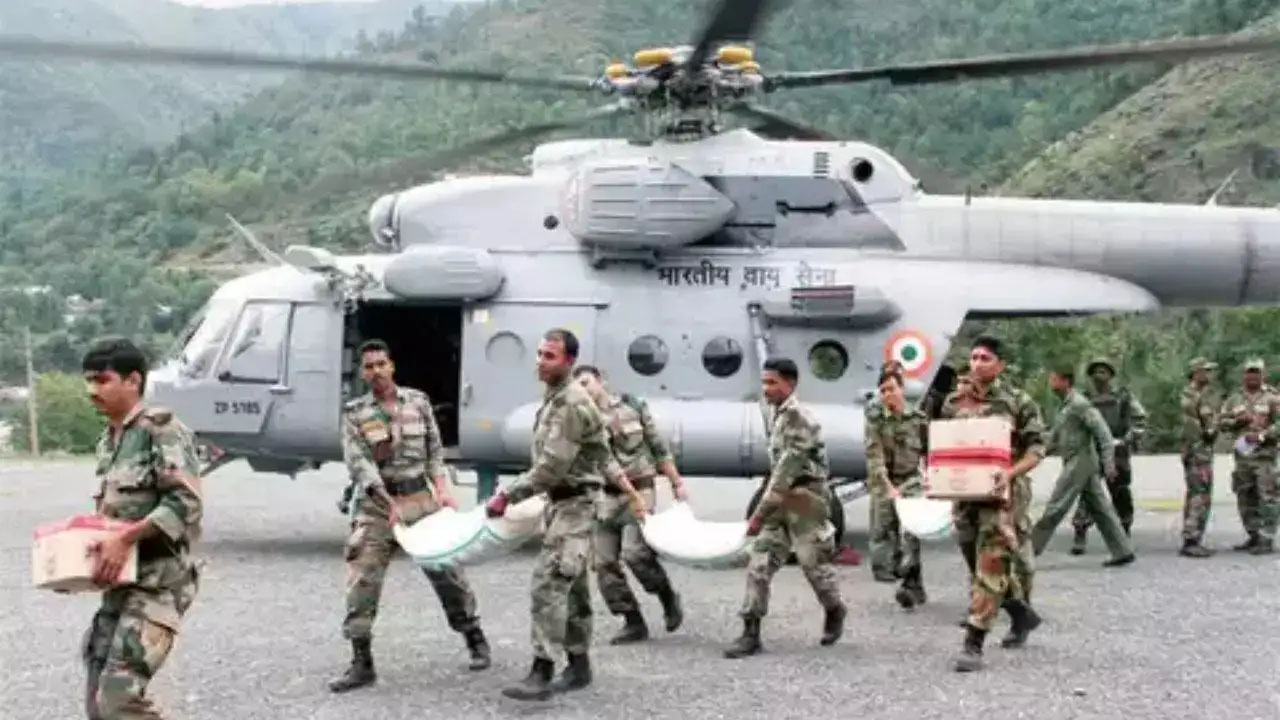
Time and again, the Indian Army has proved indispensable during natural disasters. Whether it’s flash floods in Uttarakhand, landslides in Himachal, earthquakes in Gujarat, or the COVID-19 pandemic, soldiers are often the first respondersconducting evacuations, building bridges, setting up temporary hospitals, and delivering critical supplies. Their efficiency stems from military discipline, logistics expertise, and rapid mobility.
In remote and high-altitude areas, Army medical teams provide healthcare where no civilian setup exists. Through initiatives like Operation Sadbhavana in Jammu and Kashmir, the Army runs schools, conducts health camps, and builds infrastructure winning hearts and minds (WHAM) and building trust where the civilian administration struggles.
The Army also plays a key role in youth development. Institutions like Sainik Schools, Army Public Schools, and the NCC infuse students with discipline, leadership, and patriotism thus planting the seeds of national responsibility in future generations.
Beyond national borders, the Army contributes to global peace. Indian troops regularly participate in UN peacekeeping missions across Africa, Asia, and Europeprotecting civilians, disarming combatants, supporting elections, and rebuilding war-torn societies. Joint exercises and defence diplomacy with strategic partners help India assert its position in global security frameworks. The Army acts as an instrument of national soft power, showcasing professionalism, humanitarianism, and capability on the world map.
With over 1.2 million active soldiers and nearly four million veterans, managing human capital is a vast responsibility. Peacetime is devoted to recruitment, training, psychological readiness, promotions, career progression, pensions, housing, and resettlement. Transitioning soldiers to civilian life, supporting war widows, caring for disabled veterans, health care, and running financial institutions systems demand dedicated attention. The Army functions as a self-sustaining ecosystemmore a family than a force, where the well-being of each member is as critical as national security itself.
Administrative branches like supply, finance, ordinance, medical, and legal keep the Army machinery running efficiently. Behind every soldier in uniform is an extensive support structure that maintains continuity, confidence, readiness, and morale.
Peace time also enables critical coordination between tri-services. Inter-service joint doctrines, new integrated theatre commands, and combined operations ensure seamless response in any conflict scenario. Increasingly, India is moving towards integrated defence structures where land, sea, air, cyber, and space domains operate in unison.
Globally, armies are embracing roles beyond traditional warfare. These include counter-terrorism, anti-narcotics, humanitarian assistance, and support to civil authorities. From flood relief in Indonesia to peacekeeping in Congo, or earthquake rescue in Nepal, our forces operate as eyes and ears tools of diplomacy, stability, observation and development.Many countries have formalised roles for man-made and natural disasters, peacekeeping, aid to civil authorities etc. Indian army too has adapted itself without losing sight of its core function: deterrence and defence.
To believe the Army rests in peacetime is to misunderstand its purpose and ignore the very reason peace prevails. Soldiers work, train, plan, build, protect, and serve every single day often silently under hostile conditions, always out of sight. Their presence deter adversaries, their preparedness prevents escalation, and their actions save lives long before the first bullet is ever fired. Peacetime is not rest time; it is preparation time. The next time someone asks, “What does the Army do when there’s no war?” The answer is simple: everything necessary to ensure there isn’t one.
(The writer is a motivational speaker and a change maker)
 Follow our WhatsApp channel
