

Dr. Abhimanyu Dev Singh Billawaria
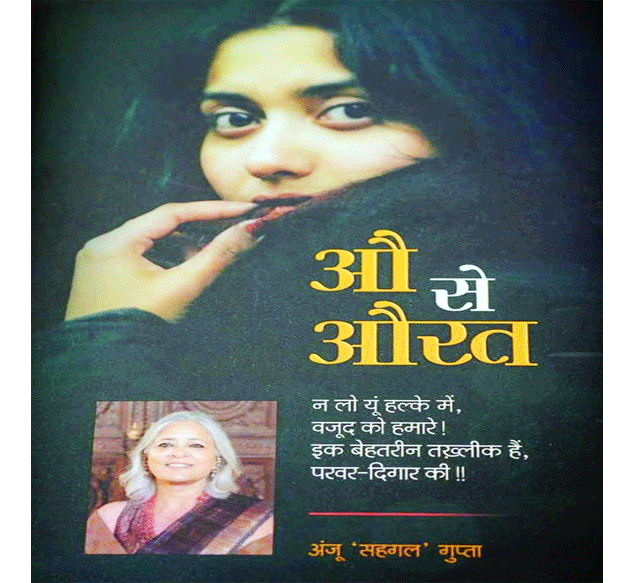
Anju “Sahgal” Gupta’s “O Se Aurat” is a reflective, socially engaged work that examines the condition, identity, and emotional realities of women in contemporary Indian society. The book moves beyond conventional celebratory narratives of womanhood and instead offers a balanced discussion of women’s struggles, sacrifices, capabilities, emotional depth, and social positioning. Through accessible language and experiential reflection, Gupta creates a text that is simultaneously literary, philosophical, and socially conscious. The work becomes particularly significant because it emerges not from abstract theorisation but from lived experience, observation, and emotional sincerity.
The book’s title itself is symbolically powerful. In the preface, Gupta recalls the elementary Hindi learning pattern “A Se Anaar, Aa Se Aam… O Se Aurat.” By selecting this familiar childhood phrase, the author transforms a simple linguistic memory into a profound commentary on womanhood. The title indicates that the identity of “Aurat” is not merely biological or social but deeply cultural and emotional. Gupta’s discussion suggests that while the word “Aurat” has long existed within language and civilisation, women themselves have often struggled for equal recognition and dignity. Thus, the book becomes an attempt to restore emotional and intellectual respect to the concept of womanhood.
The thematic concerns of the text are reflected clearly in the chapter titles, which themselves function as concise social statements. The opening chapter, “Bhartiya Naari Va Sabhyata” (Indian Woman and Civilization), appears to establish the historical and cultural foundations of women’s roles within Indian society. Through such framing, Gupta situates women not at the margins of civilization but at its centre. The chapter highlights that Indian civilization itself cannot be understood without acknowledging the contributions, sacrifices, and sustaining power of women.
Similarly, the chapter “Diya Gaya Doosra (Nichla) Darja” points toward the historical subordination of women within patriarchal structures. The phrase reflects the deeply rooted tendency of society to assign women a secondary status despite their indispensable role in family and social life. Gupta’s approach, however, does not appear overtly confrontational; rather, it is reflective and analytical. She encourages readers to recognize inequality not merely as a legal or institutional issue but as a cultural mindset that continues to shape relationships and expectations.
One of the most striking chapter titles is “Aurat Nahin Koi Vastu Tathastu!” This title directly challenges the objectification of women and emphasizes the necessity of viewing women as complete human beings with agency, emotions, and individuality. The inclusion of the word “Tathastu” gives the statement an almost philosophical and moral finality, as if the author is affirming a truth that society must now accept without hesitation. This perspective is central to the overall message of the book.
The chapter “Anaginat Visheshataein” further broadens the portrayal of women by emphasizing their countless qualities and abilities. Gupta repeatedly highlights that women possess emotional resilience, adaptability, patience, creativity, and intellectual capability. Importantly, the author avoids idealizing women unrealistically. In the preface, she openly acknowledges that while she has written about women’s suffering and sacrifices, she has also discussed their stubbornness and emotional complexities. This balanced treatment lends the text maturity and authenticity.
The question of identity emerges strongly in the chapter “Maa, Biwi, Beti Ya Behan Kya Hai Tumhari Pehchaan!” This title addresses a crucial social issue: women are often defined in relation to others rather than as independent individuals. Gupta appears to interrogate this inherited framework and asks whether a woman’s identity should remain confined to relational roles alone. The chapter likely encourages readers to recognize women as autonomous individuals with aspirations, selfhood, and personal dignity beyond familial labels.
The relational dynamics between men and women are explored through chapters such as “Humsafar Ya Pati: Ek Mard Mein Kya Hai Khota!” and “Achhe Jeevan Ka Sapna, Jab Taalmel Ho Apna!” These titles suggest that Gupta advocates mutual respect, emotional companionship, and balance within relationships rather than domination or rigid hierarchy. Marriage, in her perspective, appears not as a structure of authority but as a partnership requiring emotional understanding and cooperation.
Another important dimension of the book is its emphasis on women’s inner strength and self-reliance. Chapters such as “Tum Ho Kaynaat, Kisi Ki Kya Bisaat!” and “Poorn Aatma-Nirbharta, Hai Tujhme Itni Kshamata!” reflect motivational and empowering themes. Gupta repeatedly reminds women of their own capabilities and encourages self-confidence and independence. At the same time, her tone remains grounded and humane rather than rhetorically aggressive.
The chapter “Aurat-Aurat Ka Sahayog De, To Baat Bane!” is particularly significant because it highlights solidarity among women themselves. Gupta recognizes that women’s empowerment cannot succeed merely through external reforms if women continue undermining one another within social and domestic structures. This insight reflects the author’s practical understanding of social realities and her emphasis on collective moral responsibility.
The philosophical depth of the book is also visible in chapters like “Tumhare Jeevan Ke Mayne!” and “Mera Yogdaan, Chhota Sa Prayaas!” These titles suggest introspection and humility. Gupta does not present herself as an authoritative reformer; rather, she sees her work as a modest contribution toward dialogue and awareness. This humility enhances the emotional sincerity of the text.
The significance of “O Se Aurat” becomes even greater when examined alongside the life journey of its author. Anju “Sahgal” Gupta’s personal and literary evolution mirrors many of the themes explored in the book itself. Gupta was an academically bright student during her youth but entered married life at the young age of nineteen after becoming part of a business family. Like countless Indian women, her early adulthood became centered around domestic responsibilities, caregiving, and family obligations.
However, Gupta’s journey demonstrates that creativity and intellectual aspiration can survive even within restrictive social conditions. Despite fulfilling familial responsibilities, she continued nurturing her personal interests. She joined astrology and music classes, thereby preserving her connection with creativity and self-development. These pursuits later shaped the reflective and emotionally nuanced character of her writing.
A major turning point in her literary life came during the COVID-19 pandemic. The atmosphere of uncertainty and isolation encouraged deep introspection, leading her to transform her observations and experiences into literature. Her first Hindi book, “Jiyo-Ye Jeevan Hai,” emerged from these reflections and received encouraging responses from readers. Her second book, “A Broken Heart Can Beat Again,” written in English, demonstrated her desire to communicate with younger and more diverse readerships. Together, these works paved the way for “O Se Aurat,” which appears to synthesize her emotional experiences, social observations, and philosophical reflections.
Stylistically, Gupta’s writing is direct, accessible, and emotionally engaging. She avoids excessive ornamentation and instead relies on sincerity and conversational clarity. This simplicity allows readers from different educational and social backgrounds to connect with the themes of the text. The book’s strength lies not in theoretical complexity but in experiential authenticity.
From an academic perspective, “O Se Aurat” belongs to the tradition of reflective social literature rather than formal feminist theory. Readers searching for detailed sociological frameworks or theoretical feminist discourse may find the text more experiential than analytical. Nevertheless, its literary and social value remains substantial because it captures emotional truths and lived realities often overlooked in purely theoretical discussions.
In conclusion, “O Se Aurat” is an important contribution to contemporary reflective Hindi literature. Through emotionally sincere prose and socially relevant themes, Anju “Sahgal” Gupta successfully portrays women as complex individuals possessing dignity, strength, emotional depth, and independent identity. Simultaneously, the author’s own journey from homemaker to writer reinforces the authenticity of her message. The book not only encourages reflection on the status of women in society but also advocates empathy, mutual respect, and moral responsibility as the foundations of a healthier social order.
 Follow our WhatsApp channel
