

Troops rescue people using rope at Kanali Tibba in R S Pura sector on Tuesday.
-Excelsior/Rakesh
Troops rescue people using rope at Kanali Tibba in R S Pura sector on Tuesday. -Excelsior/Rakesh
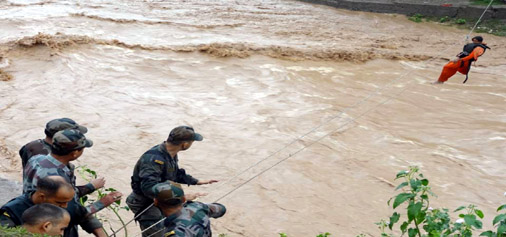
Army jawans rescue people from flood waters in Srinagar on Tuesday.
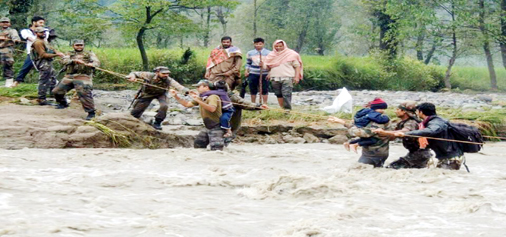
Army jawans rescue people from flood waters in Srinagar on Tuesday.
A view of Saddal village in Pancheri, which has perished in landslides. More pics on page Nos 3, 5 & 7. -Excelsior/K.Kumar

A view of Saddal village in Pancheri, which has perished in landslides. More pics on page Nos 3, 5 & 7. -Excelsior/K.Kumar
Illegal constructions
Sir,
The recent rains and consequent floods in Jammu city have exposed a reality which remained under cover so far. It is reported that the colonies that suffered most along the Tawi river were unplanned and unauthorised.
The Government should not have turned blind eye to all these developments. It should not have for petty political interests allowed these colonies to crop up.
Even in Sidhra area, there are colonies which are unplanned and unauthorised. These colonies too suffered during floods.
The Government should ensure that no illegal colony crops anywhere in or outskirts of the city, particularly along Tawi banks which remain prone to floods. These cololnies pose several problems to engineers who find it difficult to make arrangements for drinking water, electricity and roads. Result ? The people of these colonies then face shortage of water, electricity water logging and insanitation.
The Government should wake up to this reality and curb activities of land mafia who is responsible for this mess.
Yours etc…
Nikhil Verma
Gangyal
Zinc futures down 0.94% on subdued demand, weak global cues
NEW DELHI, Sept 9: Zinc futures prices today fell 0.94 per cent to Rs 142.95 per kg as speculators reduced positions amidst sluggish domestic demand and weak global trend.
At the Multi Commodity Exchange, zinc prices for delivery in September eased by Rs 1.35, or 0.94 per cent, to Rs 142.95 per kg in business turnover of 993 lots.
Likewise, the metal prices for delivery in October traded lower by Rs 1.30, or 0.90 per cent, to Rs 143.75 per kg in 40 lots.
Market analysts said the fall in zinc prices in futures trade was due to sluggish domestic demand in the spot market amidst a weak trend in base metals at the London Metal Exchange as stronger dollar reduced demand for commodities as an investment. (PTI)
Teachers and education
Sir,
Education is the most sensitive, fragile and sacred thing that deserves to be handled with extra care and tenderness but it is being handled by the uneducated and greedy people who defile its purity to swell their pockets. Consequently many ills and evils have crept into the system. The workers should be appreciated and nefarious elements and shirkers should not be spared. A fair selection should be made to sift competent from incompetent and truth from falsehood to reward the deserving people. Those who treat education as saleable commodity and open the big business houses to loot the gullible people in the name of education should be dealt with sternly to purge the system of all corruption. Some black sheep a few in number tarnished the image of the Education Department by their silly actions otherwise Education Department is a paradise of great savants and scholars of impeccable integrity. It is the education that has the power to change the complexion of the society.
Yours etc….
Rakesh Chambial
Billan Bowli
Udhampur
Improving school infrastructure
Sir,
The recent televised Prime Minister Narendra Modi’s interaction with school children on Teachers’ Day has brought to fore several shortcomings in our schools particularly those located in rural areas. What to talk of Internet connections, Television sets or smart classes, these schools do not have even proper accommodation for schools. The students study in shabby classrooms in which there are no desk to sit upon. The students feel privileged if they have coir mats to sit upon and study. Otherwise, most of the times they sit on dust covered floors.
Besides, these schools do not have water and toilet facilities. Students go in the open to defecate which at times becomes an embarrassment for them.
The Central Government in association with State Governments should embark on a national programme to provide sufficient infrastructure in schools besides taking care of the interests of teaching community.
The objectives of celebrating Teachers’ Day will be achieved only. Otherwise it will be a ritualistic affair as usual.
Yours etc….
Amit Aggarwal
Jammu
Pakistan and Military coups D’etats
Col J P Singh, Retd
Currently Pakistan is passing through critical times of its history. When the country was making sincere efforts to strengthen itself economically, socially and democratically and wanting to improve relations with India, the democratically elected govt was held to ransom. When hopes thrive in Pakistan something unusual happens making way for the army to stage a military coup d’etat.
There have been three successful and three unsuccessful military coups in Pakistan since its independence. The first coup attempt, though unsuccessful, was by Maj Gen Akbar Khan in 1949 against the govt of Liaquat Ali Khan, the first prime minister of Pakistan. The second was in 1958, when the first President of Pakistan, Maj Gen Mirza Iskander Khan dismissed Pak Constituent Assembly and the govt of prime minister Feroz Khan Noon and appointed Gen Ayub Khan as Chief Martial Law Administrator. 13 days later Mirza Iskander Khan was deposed by Gen Ayub Khan who himself became the President. He and his successor Gen Yaha Khan ruled till 1971. Gen Zia ul Haq was the next army chief to stage a third coup in Pakistan against Z A Bhutto. On the mid night of 4 July 1977, he ordered Bhutto’s arrest, dissolved National and Provincial Assemblies and suspended the Constitution. He ruled till 1988. The fourth and another unsuccessful plot was hatched by Maj Gen Tajammul Hussain Malik to assassinate Gen Zia ul Haq on the Pakistan Day on 23 March 1980. This plot was exposed and thwarted. In 1995 fifth coup attempt was made by Maj Gen Zahir Islam Abassi against Ms Benazir Bhutto. This attempt was supported by Islamic extremists but failed. The sixth successful attempt was made by senior officers loyal to Gen Pravez Musharraf in which they arrested Mian Nawaz Sharif and all his ministers after thwarting Nawaz Sharif’s attempt to dismiss Gen Musharraf. Musharraf ruled Pakistan till 2008. In its 67 years of independence Pakistan has been ruled by four military dictators for 35 years.
Mian Nawaz Sharif’s visit to India in May 2014 created a hope for lasting peace. Soon after his visit ceasefire violations and infiltration increased phenomenally. Pak started targeting civilian areas deep into Indian territory. India still fixed Foreign Secretary’s meet but Pak Envoy pre-empted the dialogue by meeting Hurriyat leaders even when India made it clear that Pakistan has to chose between the two. Since Pak Envoy ignored Indian concern, India cancelled the talks stating that killings of innocent civilians and peace initiatives can’t go together. Soon thereafter a Canada based Cleric Taheer-ul-Qdri and Cricketer turned politician Imran Khan launched anti govt protests in Pakistan creating conditions that the fears of military coup looked imminent. Initially the protests appeared to be turning into a civil war of the kind seen further West of Pakistan facilitating military coup d’état. Even though Nawaz Sharif has survived the crisis, the political turmoil has weakened him considerably and empowered Gen Rahil Sharif, the army chief, exponentially. Acting cautiously, Gen Rahil agreed to be neutral on the condition that govt concedes him considerable political space and leaves the foreign and the defence affairs with the army. Later he met the two protesting leaders. For the intervention he has exacted a price from Mian Sharif. Earlier having been deposed by Gen Musharraf, once again Gen Rahil has shown him who is the boss. Even if we don’t give much credence to the rumours, the unprecedented firing and infiltration in J&K draws parallels to Mian Nawaz Sharif’s India visit and army’s annoyance. For the rest of his term Nawaz Sharif will be a puppet prime minister. The world will not take him seriously. Thus, as of now, a silent military coup has already taken place in Pakistan.
In Pakistan, it is the Army which calls the shots. Army does not allow the democracy to flourish. A widespread belief in Pakistan is that army stoked the protests to destablise the govt because it was not happy with Nawaz Sharif attending premier Modi’s swearing in ceremony and handling of Gen Musharraf’s treason case. It was on army’s instigation that Imran Khan and Qadri started the agitation. Their demand that Nawaz Sharif should resign, a national govt be formed and elections held under the army supervision supports the logic of army’s tacit support. All the internal and external problems facing Pakistan today and in the past are due to its army. Bifurcation of Pakistan in 1971 was due to its army. What Pak army did to suppress civil unrest in East Pakistan in 1970 -71 and their cruelties are too shameful to be described. The army which surrendered to Indian Army should have been tried for war crimes. This disgraceful army should have been hounded out of Pakistan. Pak Army is ruthlessly killing civilians in North Wazirstan where it continued its massacre during the holy month of Ramzan. It has thrown lakhs of people out of their homes in NWFP. Over 5 lakh have been put in camps. Army atrocities on civilians and its treachery against own govt have been exposed by human rights activists and former US Ambassador Husain Haqanni who has narrated in his book ‘Incerdible Illusions’ how army generals have been manipulating American administration to over ride elected govts. Empowered position of Pak army is accepted by the people of Pakistan as fait accompli. I have neither seen nor heard anything good about Pak Army during my two tenures on the LOC. Hence Pak Army is a villain in Indo-Pak peace process. Knowing that it can’t succeed in a conventional war, it is carrying out a proxy war in Kashmir. It creates conditions such as Imran-Qadri protests. It drugs civilian youths and makes them criminals. It exports terrorism. It promotes drug mafia and helps in drugs trafficking. It pushes terrorists across the borders to spread mayhem in India, China and Afghanistan. It is nurturing terrorist organizations, training militants and using them as strategic assets. Pak connections with 9 / 11, sheltering Osama-bin-Laden in military cantonment in Rawalpindi, sending recruits in the service of recently declared Islamic Caliphate in Iraq are clear indications of its involvement in global terror. It makes lives of its own people on the LOC miserable by frequently resorting to firing and inviting retaliation.
Pakistan as a nation is against military rule as seen in their faith in democracy. In every election they elect a popular govt which somehow the army highjacks. Pak army does not respect democracy. It does not tolerate civilian control. Invariably we hear our great strategists suggesting govt to open channels of communications with Pak Army. But how can India dialogue with a rogue army. India should talk to the elected govts irrespective of the Army’s control over foreign policy of Pakistan. Instead India should expose treachery of Pak Army. It is the Pak army which is promoting terrorism in the sub continent which is effecting sub continental development and economic growth.
Our issues with Pakistan are complicated beyond imagination. On top of that Pakistan is a complicated problem for the entire sub-continent. Can India sort out problems with Pakistan. My take is No unless India first sorts out Pakistan. There is hardly anything Narendra Modi can do except to resume dialogue. After November 2008 Mumbai attack, India snapped diplomatic ties with Pakistan despite which Dr Manmohan Singh met President Zardari in June 2009 in Shinghai on the sidelines of Shinghai Cooperation Council and a month later Dr Singh met his Pak counterpart in Sherm-el-Sheikh on the sidelines of NAM. Yet the talks remained suspended. It will please the critiques if two Prime Ministers meet at the sidelines of UN General Assembly later this month for which Mango diplomacy of Nawaz Sharif is a welcome gesture. Lasting peace with Pakistan will remain our dream unless the following happens. (i) US, China and the SAARC exert coercive pressure on Pak military collectively to let the democracy prevail. (ii) Pak polity exerts coercive pressure on military to remain confined to the barracks. (iii) India exposes sectarian conflicts in Pakistan and gets involved in her internal affairs as she does in ours. (iv) The monster created by it consumes it and (v) There is another division of Pakistan. Till that happens Pak will keep bleeding India with its thousand cuts.
Cleaning the Ganges
B M Kohli
By giving a special focus on Holy river Ganges, which has been significantly mentioned in our ancient holy books and is worshiped as Ganga Ma since the time immemorial, Modi Government has not only tried to soothe the troubled feeling of entire Hindu Population of India but has done a great job in favour of those living in whole of the Ganga Basin irrespective of caste and creed. The life line of 500 million people , depending on her for all aspects of daily life , from drinking water to farming and MOKSHA, have become cause of its onisery while passing through 1450 km in Uttaranchal &UP , 445 KM in Bihar in addition to forming 110 km common border between two states and 520 km through West Bengal finally enters Bangla Desh before merging into sea. The amount of 2037 crores kept in the very first budget for its preservation and cleaning has depicted the will of the Government to save this river from further deterioration Rs 4200 crores has also being planned in next 5 years for improvement of ghats in addition to making it navigational from Allahabad to Haldia. This was not the first time a Prime Minister has revered Ganga as the nation’s identity. In 1946, Jawaharlal Nehru, the first prime minister of India, wrote in his Discovery of India:
“The Ganges above all is the river of India, which has held India’s heart captive and drawn uncounted millions to her banks since the dawn of history. The story of the Ganges, from her source to the sea, from old times to new, is the story of India’s civilization and culture, of the rise ..”
Our former Prime Minister Late Rajiv Gandhi also expressed its importance “The Ganges is a symbol of our prosperity, our culture, our heritage, our civilization, our philosophies…We have to see that Ganga does not remain just a symbol, but it should be such a symbol that will become a part of our everyday life and become a part of the future of India and make India strong.”So what makes Ganga so unique and sacred and referred to by many as Mother Ganga (Ganga Ma) and is so important to protect Her and to recognize as part of India’s national identity its self purifying properties and its water kept in every Hindu’s house. But pure is pure till you maintain its purity. Some Social groups decided this year to celebrate 14 Feb as a valentine day at the banks of Ganga stating it as past , present and future companion as their valentine . She must be allowed to flourish if India is to flourish. Getting its strength from 115 small rivers, Ganga River Basin largest in the world , covers 29 cities with population of over 1 lac, 23 cities / towns between 50,000 to 1 lac and other 178 inhabitations. Emerging from Gangotri Glacier, one of largest in Himalayas , presently 30.2 Km long and 0.5 to 2.5 Km wide, this most revered River is also on the verge of losing its sanctity for being declared now as one of the most polluted one in the world. The receding discharge of the river due to squeezing of Glaciers caused by global warming & as per UN 2007 climate change report which suggests the glacier flow may stop by 2030 and Ganges may reduce to a seasonal river during monsoon. Even now ,it has squeezes to a mere depth of two to two and a half feet in summer till it gets increased flow at Sangam with Yamuna river at Allahabad. Each state, it passes through, has a significant role in polluting Ganges. Countless tanneries , textile mills, chemical plants even distilleries, slaughter houses and hospital waste, all untreated, is dumped in to it resulting in a major concern. An estimated 2.9 billion liters of sewerage is dumped into Ganges and its tributaries every day much of which is untreated. Tons of plastic and other waste/ trash are thrown into Ganges which contributing to its chocking . A systematic classification done by Uttarakhand Environment Protection and Pollution Control Board (UEPPCB) on river waters placing into the categories A: safe for drinking, B: safe for bathing, C: safe for agriculture, and D: excessive pollution, put the Ganges in D category. Coliform bacteria levels in the Ganges have also been tested at 5,500 in some places, a level too high to be safe for agricultural use let alone drinking and bathing. The leather industry in Kanpur which employs around 50,000 people in more than 400 tanneries uses chemicals such as toxic chromium compounds take refuge in Ganges for its waste. This chromium levels have not decreased in the Ganges effectively even after a common treatment plant was established in 1995. It now stands at more than 70 times the recommended maximum level. Varanasi, a city of one million people and as many pilgrims visit to take a “holy dip” sewage into the river each day, leading to large concentrations of fecal coliform bacteria. According to official standards, water safe for bathing should not contain more than 500 faecal coliform per 100ml, yet upstream of Varanasi’s ghats the river water already contains 120 times as much, 60,000 faecal coliform bacteria per 100 ml, as per the reports issued in 2012. As reported in Indian Express dated June 3, 2012 by Tarun Nangia “the Parliamentary Standing Committee on environment and forests has slammed the Environment Ministry for the deteriorating water quality of the Ganga, in spite of Rs 39,000 crore being spent on the Ganga Action and allied Plans (GAP).” The committee has also stated that it’s tributary Yamuna in spite of spending Rs. 1062 crores under Yamuna Action Plan 1 and II, has been allowed to turn into a ‘nala’. Consortium of 7 IITs which is preparing the Ganga River Basin Management Project (GRBMP) has recommended some measures thereby restoring the bactericidal, health promoting, non-putrefying and self purifying properties of water of Gages.
* In place of present policy of allowing treated sewerage into the river, adopting zero discharge into the river and promote reuse and recycle of waste water after proper treatment for its further use.
* Industries must treat their effluents and use only the recycled water.
* Organic forming should be promoted
* Also Ganges must be constitutionally declared as National River and issue National Ganga Act that ensure preservation and its protection with her unpolluted flow.
* Promoting living that is needful and not greedful in order to maintain and protect the Ganga River Basin and our scared natural resources.
David Graham of UK’s Newcastle University, who had done extensive studies on river Ganga, also charts out the priorities for Modi sarkar summarizing “solutions include routing wastes elsewhere, improving waste treatment prior to release, and motivating ‘social engineering’ to change behaviours and attitudes related to water quality in the river,”
Indians denied permission to participate in march in South Aus
MELBOURNE, Sept 9: A group of retired 15 Indian defence officers in south Australia have been denied permission to participate independently in an annual march that commemorates the day 15,000 Indians with Australian and New Zealand forces landed in Turkey to fight during World War-I.
While ANZAC Day Committee Chair, the organisers, have invited the group to join the centenary ANZAC March next year, the group known as ‘SA Indian defence officers club’ have sought their inclusion under Indian ex-servicemen contingent every year which has not been accepted.
They were refused on the grounds that the march is only for the ANZACS and those foreign veterans who fought with them as allies. India was a British colony when the war was fought.
“We took the case with Director of Veterans Affairs for us to participate in the March held every year after realising that in other states it was happening,” said Retired Major General Vikram Madan of the Club.
“We already knew Indian veterans marching in WA and Victoria and for last two years we were aware of NSW Indian veterans marching,” he said.
He said that request when formally taken up with Director of Veterans Affairs, also the Chair of ANZAC Day Committee, was refused and they were offered that they march in next of kin category if they, in the Indian community, had a direct descendant of a soldier at Gallipoli.
“We would like to march next year and onwards under Commonwealth countries like in other states where Indian representation has been marching as Indian ex servicemen contingent,” Madan said.
“It is a request to Returned & Services League (RSL) and organisers to allow us to pay homage to those Indian soldiers who died along with ANZACs in Gallipoli,” he said, adding that if allowed the group would be marching in civilian clothes with medals.
Meanwhile, RSL of Australia (SA Branch) which organises all major ANZAC Day activities in the state per an appointed ANZAC Day Committee, said, “Indian veterans of conflicts in which Australia and India served as allies have always been welcome to participate in our ANZAC Day March.”
RSL said in a statement that an invitation to join the ANZAC Day March was extended to the broader Indian community in 2012 but added that there was no place for simply marching as a group because the group have served in the armed forces of a country with which Australia were friends.
“In the last three years ‘British India’ has appeared on the ANZAC Day Order of March, a sign has been prepared and a Army cadet nominated to carry that sign,” the statement said said.
About 15,000 Indians served alongside the 50,000 Australians at Gallipoli in Turkey, helping maintain supply lines over an eight-month offensive. Around 1500 Indians were killed in the fighting. (PTI)