

Shivaji Sarkar
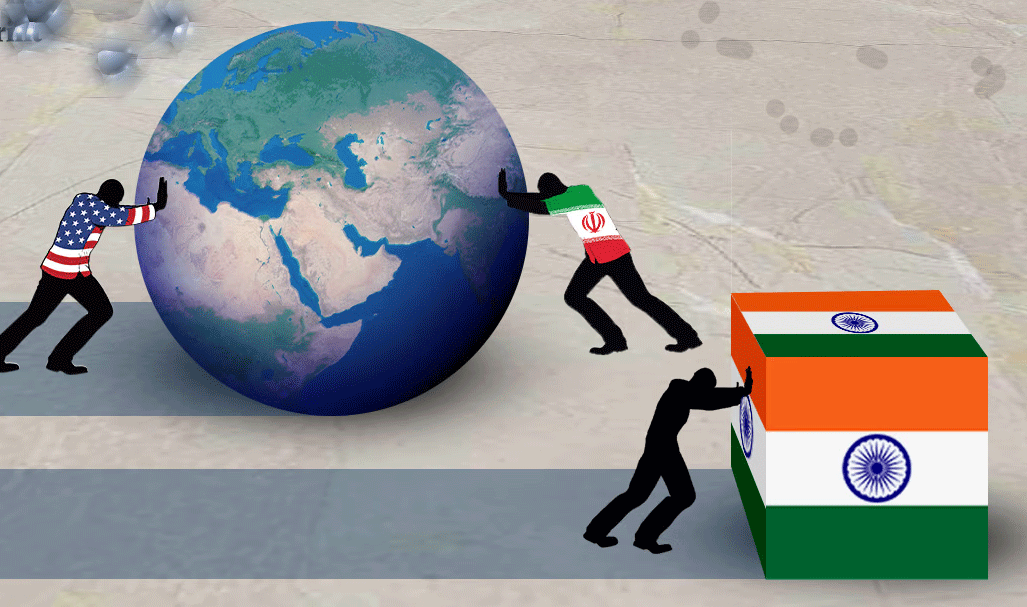
The Gulf crisis has not triggered India’s economic distress—it has merely exposed and intensified a slowdown long in the making. Prime Minister Narendra Modi’s warnings on cutting gold purchases, fuel use, edible oil imports, and even restraining domestic and foreign travel are not isolated cautionary steps; they are signs of deeper strain.
The economy’s troubles did not begin with COVID-19 pandemic. They stem from years of ignored structural weaknesses, inherited distortions left uncorrected, and policy choices that may have worsened the burden. Even solutions like work-from-home are being presented as relief, though they often raise hidden operational costs and strain telecom systems. Beneath optimistic growth projections lies a widening gap between official claims and economic realities—one that can no longer be easily overlooked.
Large constructions have finally been flagged by NITI Ayog as drain on resources. And global gold prices started soaring with the Reserve Bank of India gold buying spree for reducing reliance on the US dollar.
The concern is not that India’s economy is collapsing, but that its foundations may be weaker than official figures suggest. A 2026 study by the Peterson Institute for International Economics, authored by Abhishek Anand, Josh Felman, and Arvind Subramanian, argues that India may have overstated annual GDP growth by up to two percentage points between 2012 and 2023. Instead of the official 6 per cent, actual growth may have been closer to 4–4.5 per cent. The study estimates real GDP could be overstated by 22 per cent and real consumption by 31 per cent, suggesting living standards are significantly lower than believed—potentially reshaping the narrative of India’s economic rise.
The International Monetary Fund issued a most unusual rebuttal on April 24, 2024. Its spokeswoman Julie Kozack told reporters in Washington that executive director Krishnamurthy Subramanian’s growth forecast of 8 per cent for India did not represent the views of the IMF, which still maintained a projection of 6.5 per cent for the country.
Inflation is being blamed on the Gulf situation. It’s partially correct. Since 2015, petroleum prices, key to transport, many chemicals and raw materials, were kept at a high even when crude prices fell to around $40 a barrel, levying various taxes and cesses. The obvious reason stated was a petrol bond of the UPA regime. It was around Rs 3 lakh crore. But Rs 39 lakh crore extra was realised. Now the government is flushed with Rs 36 lakh fund. It has caused severe overall inflation and hit purchasing power.
The exaggerated highway toll rates and rising debt of the NHAI are worrisome as also adding to overall inflation. India’s economic weaknesses are increasingly visible in manufacturing, exports, and household finances. Despite the “Make in India” push, manufacturing’s share of GDP fell from 16.7 per cent in 2013-14 to 15.9 per cent in 2023-24, with weak job creation and continued dependence on imports.
An overvalued rupee has weakened export competitiveness, especially for small and medium producers, while making imports cheaper. Equally alarming is the sharp erosion in household savings. Gross household savings fell from 23% of GDP in 2012-13 to 17% in 2018-19, while net financial savings dropped to a nearly 50-year low of 5.1–5.3% in FY23, down from 11.6% in FY21—a sign that families are increasingly dipping into reserves and relying more on borrowing to cope with rising financial pressures.
Major Indian PSUs are under pressure in May 2026 due to high oil prices, rising bond yields, and broader stock market volatility. Oil marketing companies like Indian Oil Corporation (IOCL), Bharat Petroleum Corporation Limited (BPCL), and Hindustan Petroleum Corporation Limited (HPCL) are estimated to have lost nearly Rs 1 lakh crore since mid-March because of surging crude prices.
The PSU banks are also facing heavy mark-to-market losses as rising bond yields reduce the value of their large government bond holdings. Limited reforms in the Union Budget have further weakened sentiment. Long-standing structural problems—including high debt, outdated technology, and low efficiency—are adding to the pressure.
Between 2017 and 2018, Oil and Natural Gas Corporation (ONGC) played a key role in resolving financial issues linked to Gujarat State Petroleum Corporation (GSPC). It acquired GSPC’s 80% stake in the KG basin gas block for $1.2 billion (₹8,000 crore), widely seen as a bailout of the debt-hit state firm. The Centre also paid ₹8,392 crore on ONGC’s behalf to settle a royalty dispute with Gujarat, while ONGC earlier received relief in a ₹1,000 crore VAT case. Together, these moves stabilised GSPC and reduced ONGC’s liability burden.
Bank loans are surmounting. The public sector banks (PSBs) played a major role in supporting post-COVID economic recovery by sharply expanding lending, especially for infrastructure and construction by giving loans of Rs 8.84 lakh crore. In the first two months of the 2020 lockdown, PSBs sanctioned Rs 5.66 lakh crore in loans across sectors. The Union Budget 2021-22 further boosted construction activity with Rs 3.3 lakh crore allocated to infrastructure-linked spending, much of it backed by bank credit. Under the Emergency Credit Line Guarantee Scheme (ECLGS), PSBs had sanctioned Rs 76,044 crore by August 2020, providing critical support to MSMEs, including firms linked to construction and allied sectors.
Highways Infrastructure Trust (HIT), an infrastructure investment trust backed by KKR, said it has raised Rs 8,250 crore in debt. The financing plan, structured as a rupee term loan with a tenure of up to 17 years, is backed by seven leading financial institutions, including State Bank of India. The slow graduated recovery has thinned bank deposits and most are managing costs with manpower cuts.
Blame Game
Blaming previous governments is routine, but economic correction depends on the policies and judgment of successors. India’s current economic slide suggests that measures such as 2016 Indian banknote demonetisation, a steep GST, reduced welfare concessions, and reliance on food doles instead of jobs and skill-building may have worsened structural weaknesses.
If former Prime Minister Manmohan Singh failed for incentivising the industry with liberal loans to large houses hurting banks with severe Rs 50 lakh plus NPAs, his successor, Modi too committed the mistake of emptying bank coffers with long-term loans – though technically not NPA, for less necessary large constructions and road and infra projects. Demonetisation, in particular, disrupted India’s informal cash economy—a vital buffer during past global crises—hurting small traders and workers. The push toward digital payment also raised banking system costs, exposing policy contradictions and adding stress to already burdened banks.
The road ahead needs policy revamp and a sharp economic vision away from Manmohanomics and globalisation for self-sustenance as also fast overall growth.—INFA
 Follow our WhatsApp channel
