

Dr Mrinalini Atrey
atreymrinalini@gmail.com
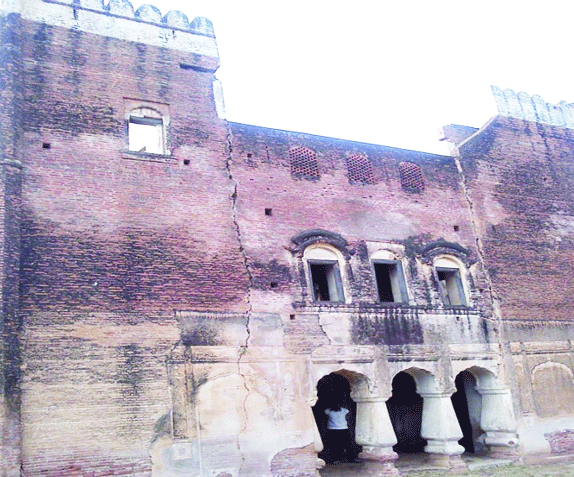
The first time I saw the photographs of General Zorawar Singh’s Haveli in Vijaypur, Reasi – from 1975, 1999, and now in 2026 – I felt a deep shock, a wrenching sense of loss. What was once a proud palace has withered into near ruin. These images are not just records of a building; they are mirrors reflecting our indifference.
ASI reports, and eyewitness accounts describe the Haveli as a three-storeyed marvel of nanakshahi bricks and soorkhi mortar, with pillared entrances, parapets, turrets, and courtyards. Its walls were once alive with murals inspired by the Pahari School of painting, depicting the Ramayana, Krishanleela, and Hindu mythology. It was more than a residence – it was a cultural canvas and a statement of Dogra authority.
Today, all that remains is a façade battered by lightning strikes, the 2005 earthquake, and decades of neglect. The descendants, who lived there until the 1990s, lack the means to preserve it and remain entangled in litigation, abandoning what they should have cherished. Encroachments have blocked its entrance, and heritage itself has been reduced to a courtroom dispute, while the Haveli crumbles into silence.
As a heritage professional, I felt deep remorse. What are we doing to our heritage? Can we, as a local community, escape our responsibility? In this case, the government cannot be faulted – it has already allocated funds for conservation. The palace has been declared a state-protected monument by the Department of Archives, Archaeology and Museums, Mubarak Mandi, Jammu, under the Monuments and Sites Preservation Act. Yet the work cannot begin because the descendants refuse to vacate the land and have taken their dispute to court.
So do we simply sit with folded hands and watch the Haveli of a General slip into oblivion? What will we tell future generations? How will we help them grasp the richness of our legacy? If this neglect continues, there is every likelihood that Zorawar Singh will be reduced to a mere folkloric hero – remembered in stories, but with no landmark to bear witness to his name.
At this juncture, we must confront a painful truth: why do we have to dig so hard to reconstruct the historical narrative of Jammu, lamenting the absence of evidence, and why do we still stand without a coherent account of the Dogras? This is not an accident but the direct outcome of our own neglect – of forgetting our ancestors and their contributions, of allowing memory to fade into silence. And yet, we are the very community that proudly proclaims: Dogre ha akhne ha shaane ke… us jeetina Junge ghamsane ke… If we truly believe these words, then we must reclaim our history with conviction, not let it slip away into fragments. Who can deny that Jammu’s antiquity stretches back to prehistoric times? Archaeological and geological evidence confirms human presence here from the Stone Age onward, giving the region a civilizational continuity that few places can claim – from early man to the Harappan era, through Alexander’s invasion, and into the present. Yet when we turn to conventional sources, the record appears meagre. Much of our past has slipped into folk narrative, dismissed by scholars and officials alike as unreliable. This disregard has fractured our collective memory, leaving us with fragments where there should have been a proud, continuous story.
It is precisely this neglect that makes Zorawar Singh’s Haveli more than just a crumbling structure – it is a stark symbol of our fractured historical consciousness. To lose it would be to sever yet another link in the civilizational chain that connects Jammu’s prehistoric past to its Dogra legacy. This realization compels me to revisit General Zorawar Singh and his legacy, to shake the conscience of the Dogras. The time for hesitation has passed; it is high time we began conserving our landmarks. Tourism may be incidental, but identity is fundamental. These monuments are not mere relics or revenue-generating assets – they are the living testimony of who we are. How can we allow them to vanish into dust, when in their survival lies the survival of our pride, our memory, and our history?
Few figures in Indian history can rival the daring of General Zorawar Singh – one of the rare commanders from this subcontinent to march victoriously into Tibet, where his memorial still stands, revered by locals. If even the enemy camp can honour him, why do we, the inheritors of his legacy, remain indifferent? What set Zorawar Singh apart was not only his courage in battle but his ability to transform loyalty into state-building. He became the indispensable pillar on which Raja Gulab Singh consolidated power and expanded territories, reshaping the Dogra kingdom into a state with a new political personality. Dogra identity had long existed, rooted in community and tradition, but under Zorawar Singh’s campaigns and Gulab Singh’s leadership, it was elevated into a sovereign expression – a state that carried the Dogra name onto the map of northern India. His rise was adventurous, yes, but more importantly, it was decisive in altering the course of Jammu’s history, ensuring that the Dogras were remembered not merely as a people but as architects of their own statehood.
Born in Kahlur (Bilaspur, Himachal Pradesh), Zorawar Singh left his ancestral lands after a family feud. Oral traditions recount that at Haridwar, a holy dip in the Ganges transformed him from a troubled youth into a warrior with calm resolve – a turning point that symbolised discipline, daring, and destiny. He first served under Raja Jaswant Singh of Marmathi (modern Doda district), but it was under Gulab Singh that his genius truly flourished. In 1815, Gulab Singh entrusted him with the defence of Bhimgarh Fort in Reasi, anchoring him permanently in the region. From Reasi, Zorawar Singh secured Dogra territories and laid the foundations for their expansion.
As commander of the Dogra forces, Zorawar Singh became a military hero of India and of the JAK Rifles regiment. He secured Ladakh and Gilgit-Baltistan and in 1841 launched an invasion of Tibet, advancing to the sacred Kailash-Manasarovar region and routing a combined Chinese-Tibetan force. Within months, his army had pushed deep into Tibetan territory, north-west of the Mayyum Pass. But a powerful Tibetan force descended from Lhasa and confronted the Dogras at Tirthapuri, near Lake Manasarovar. Cut off by heavy snows and unable to receive reinforcements from Leh, Zorawar Singh fought a series of pitched battles before falling in combat on 12 December 1841.
Although Zorawar Singh perished mid-campaign in December 1841 near Lake Manasarovar, his initiative reshaped the frontier. The following year, in September 1842, a treaty was signed between representatives of the Chinese and Lhasa governments on one side and the Khalsa Darbar and Gulab Singh on the other, extending the Sikh – and hence Indian – frontiers to their present boundary and bringing Ladakh firmly into Indian territory.
His campaigns left behind more than territorial gains; they introduced military innovations that influenced Indian armies for generations. He pioneered high-altitude combat with small, mobile units, organised the use of local guides and scouts, built a network of frontier forts to secure supply lines, and emphasised winning local trust as a strategic tool – ideas later adopted by the British and now central to modern mountain warfare. These achievements permanently reshaped the map of northern India, adding Ladakh and Baltistan to Jammu & Kashmir after the Anglo-Sikh Wars, territories that today form part of the Union Territory of Ladakh. Zorawar Singh remains one of the greatest military commanders of nineteenth-century India, a general whose tactics are still studied in Army training.
Such a great man’s legacy must be preserved not only in words but through the monuments that embody his life. His forts and palaces – especially the Haveli at Vijaypur overlooking the Chenab – were not mere residences; they were cultural canvases and statements of Dogra authority. Yet today, only ruins remain.
The neglect of Zorawar Singh’s Haveli cannot be excused as a private dispute. The Jammu and Kashmir Heritage Conservation and Preservation Act, 2010 (Act No. XV of 2010) empowers the government to intervene in the conservation of privately owned heritage buildings of historical importance. Section 3 authorizes the state to declare monuments, precincts, or sites of historic, cultural, or architectural significance as protected heritage, while Section 4 further empowers it to acquire or take possession of such sites for conservation. In other words, the law was designed precisely to prevent situations where private disputes or neglect could endanger monuments of collective importance. Under this framework, the Haveli qualifies as a protected monument, and the state has both the authority and responsibility to acquire adjoining land, restore the structure, and ensure its survival for future generations. Allowing litigation to stall conservation undermines the very spirit of the Act, which was created to safeguard heritage in the public interest.
With Jammu and Kashmir now a Union Territory, the scope for the Archaeological Survey of India (ASI) intervention must be explored. The government can acquire the surrounding land, create a garden and visitor’s gallery, and restore the Haveli as a living heritage site. For the local community, it would be a source of pride; for the nation, a reminder of a warrior who marched to Mansarovar and left an indelible mark on history.
The Haveli of General Zorawar Singh is not just a protected monument; it is a protected memory. Allowing it to collapse would mean erasing a chapter of Jammu’s history. The time has come for the state, the judiciary, and the community to unite in safeguarding it. The Haveli must rise again – not as a relic of neglect, but as a beacon of pride. To let the heritage of a nation-builder crumble is nothing short of a national tragedy, for in losing his Haveli we risk erasing not merely stone and mortar, but the very memory of Dogra courage and statehood.
(The author is Heritage Professional Secretary-General ICICH- ICOMOS Co- Counselor, ICOMOS- India)
 Follow our WhatsApp channel
