

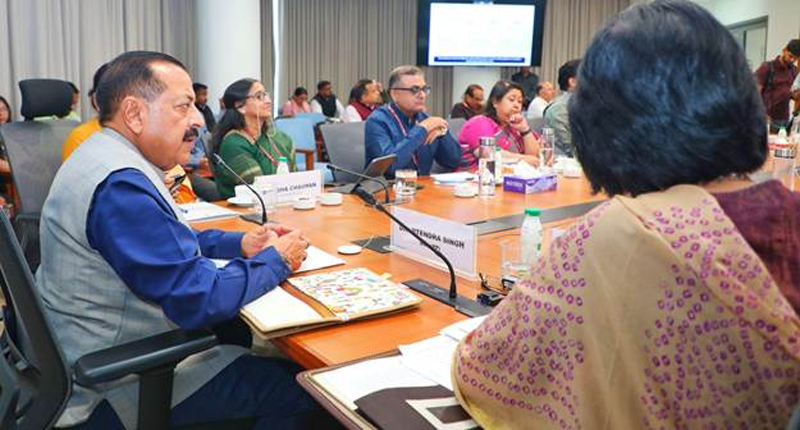
NEW DELHI, May 15: Union minister Jitendra Singh on Friday said that administrative training and governance institutions across the country must reinvent themselves and shun stereotype models to remain relevant.
Addressing the concluding session of the National Departmental Summit on “Institutionalising Capacity Building: From Training to Performance-Linked Governance” through virtual mode, he said Mission Karmayogi is steadily moving towards an AI-integrated governance framework linking capacity building, competency development, technology and public service delivery.
The National Programme for Civil Services Capacity Building (NPCSCB), popularly known as the Mission Karmayogi, aims to create a competent civil service rooted in the Indian ethos, with a shared understanding of the country’s priorities, working in harmony for an effective and efficient public service delivery.
Singh, the Minister of State for Personnel, said governance reforms today require transparency, timeline discipline, ease of procedures and optimum use of technology supported by innovation and human sensitivity.
Referring to governance reforms undertaken in recent years, he said annual grievances received on the Centralised Public Grievance Redress and Monitoring System (CPGRAMS) portal have increased from nearly two lakh in 2014 to more than 25-30 lakh presently, reflecting growing public trust due to improved responsiveness and accountability.
Singh also referred to the success of Digital Life Certificates, noting that nearly 10-11 crore certificates have already been generated, enabling pensioners to complete formalities digitally without physical visits.
The day-long summit brought together senior officials from the Department of Personnel and Training, Capacity Building Commission, Karmayogi Bharat, state governments, Union Territories and administrative training institutions from across the country to deliberate on strengthening institutional capacity-building frameworks and performance-linked governance systems.
Key takeaways from the summit included a broad consensus on transforming administrative training institutions from conventional training centres into digitally integrated, outcome-oriented governance hubs aligned with Mission Karmayogi.
Singh, while addressing the valedictory session of the summit, also said governance institutions can no longer function through silos and must move towards integrated and interdisciplinary learning systems involving institutions beyond conventional government structures, including IITs, IIMs and specialised domain institutions.
He said artificial intelligence would remain an important enabler in governance, but technology alone cannot substitute human intelligence, ethical conduct and behavioural sensitivity in public service delivery.
Stressing the need to encourage innovation and free flow of ideas within institutions, the minister called for creating platforms for willing trainers, promoting region-specific best practices and strengthening collaboration among states and training institutions.
Singh said governance reforms ultimately succeed only when citizens experience responsiveness, dignity and sensitivity at the ground level, adding that Mission Karmayogi provides a transformational opportunity to build integrated, innovative and future-ready governance systems for the country.
Department of Personnel and Training Secretary Rachna Shah emphasised the importance of comprehensive capacity-building plans across ministries, departments and states to identify competency gaps and align governance learning systems with future administrative requirements.
Capacity Building Commission Chairperson S Radha Chauhan said training institutions must undergo structural and strategic transformation to remain relevant in an AI-enabled governance environment. (PTI)
 Follow our WhatsApp channel
