

Historical Settlements of Jammu
Lalit Gupta
lalitguptajammu@gmail.com
The small yet historically significant settlement of Lakhanpur is located on the right bank of the river Ravi, about 100 kilometres southeast of Jammu and 12 kilometres from Kathua. It functions as a strategic gateway for entering the Jammu region from the Punjab doabs. In antiquity, this area formed part of the territory known as Darva-Abhisara.
Situated just below the Shivalik Hills, Lakhanpur is bounded on the north by the Karaidhar Range, which separates it from Basohli; on the east by the Ravi; on the south by the plains; and on the west by the Ujh River, a tributary of the Ravi.
Prehistory
Lakhanpur occupies an important place on the archaeological map of Jammu owing to the discovery of Palaeolithic tools in its vicinity, indicating human habitation along the banks of the Ravi since the Ice Ages. The river Ravi itself, celebrated in the Nadi Sukta of the Rigveda as Parushani or Iravati, was referred to as Hydrotes by Greek historians. Originating in the Himalayas and opening out near Basohli, the Ravi flows past Lakhanpur before skirting Kathua and entering the plains of Punjab, serving as a natural boundary between the Jammu region and the adjoining territories of Pathankot, Chamba district, and Gurdaspur district.
Historical Background
According to Hutchinson and Vogel’s History of the Punjab Hill States, Lakhanpur was originally part of the princely state of Jasrota. It emerged as an independent principality in the early fourteenth century, around 1320 CE. The state was founded by Sangram Dev, the son of Kalas Dev of Jasrota. With Lakhanpur as its capital, the principality extended over the tract lying between the rivers Ujh and Ravi. Its rulers belonged to a branch of the Jamwal Rajputs, who subsequently came to be known as the Lakhanpuria clan. The state was also known as Thein, after the name of a strong fort situated on a lofty cliff overlooking the right bank of the Ravi.
Lakhanpur state finds mention in the Ain-i-Akbari as Lakhnor. The Persian historical work Ma’asir-ul-Umra, a directory of high-ranking nobles and jagirdars in the Mughal administration, mentions Balabhadar, also called Balidhar, as the Raja of Lakhanpur. He was involved in a revolt during Akbar’s reign in 1588-89. Following his surrender, the state was annexed and placed under a Mughal amir.
Lakhanpur remained a bone of contention among the neighbouring states of Jasrota, Basohli, and Nurpur. After the decline of Mughal power, the tract was seized by Jasrota, which at that time was under Basohli. It finally fell to Nurpur in the latter part of the eighteenth century. At the time of settlement after the First Sikh War, Lakhanpur became British territory, having formed part of Nurpur State.
Following the First Sikh War, the hill tracts between the Ravi and the Indus, including Chamba, were transferred to Gulab Singh of Jammu under the Treaty of 16 March 1846. The Raja of Chamba, however, expressed his unwillingness to be placed under Jammu. Consequently, an arrangement was made whereby Lakhanpur was ceded to Gulab Singh in place of Chamba and was incorporated into the then Jasrota district.
The Fort
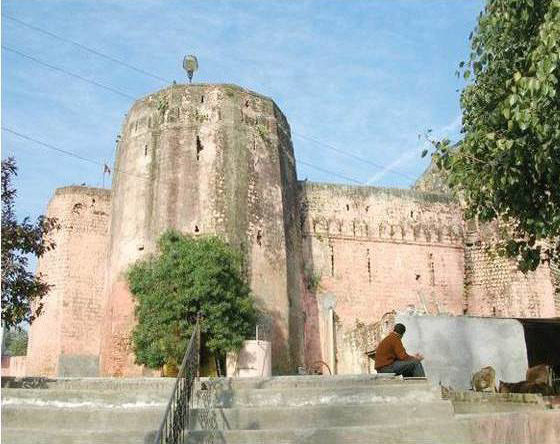
According to historians, the original fort of Lakhanpur stood on a lofty cliff overlooking the right bank of the Ravi. The present fort stands near the bank of the river. Comparatively small in size, its precinct comprises a large irregular tract of land divided into two terraces. Entry to the site is from the north side facing the road, while the entrance to the fort itself lies on the western side.
The fort, covering an area of around 450 square meters, is located on the upper terrace. Along the southern periphery of the fort stands a single-storey structure that served as a stable, while a temporary store and shed have been constructed on the eastern side. Many structures exist on the lower terrace, including an octagonal temple within an artificial pool. Other constructions include a square temple building, a large rectilinear structure, and a small Shiva temple. The fort is built of stone masonry and is almost quadrangular in plan, with bastions at the four corners and another near the entrance gateway.
Lakhanpur and the Entry Permit System
Under the Dogra rule, Lakhanpur emerged as an entry point, toll post, and customs checkpoint. Access to Jammu and Kashmir was regulated, if not selective. In 1948, an entry permit system was introduced by the post-Independence emergency administration of Jammu and Kashmir following the region’s accession to India. In many ways, this system drew upon the earlier Dogra-era State Subject laws introduced in 1927, which sought to discourage outsiders (gair-mulkis) from owning land and property in the state.
Lakhanpur became one of the principal physical checkpoints where any Indian citizen wishing to enter Jammu and Kashmir was legally required to obtain a government-issued entry permit or identity document.
The system faced massive protests led by Bharatiya Jana Sangh founder Syama Prasad Mookerjee, who was arrested at the Lakhanpur border in May 1953 for entering the state without a permit. Following his tragic death in custody, widespread public outrage compelled the government to abolish the entry permit system completely in 1954.
Lakhanpur in the Contemporary Period
In the post-Independence period, Lakhanpur gradually emerged as a major town and a notified area committee in Kathua district. Today, the town begins from the Madhopur Ravi Bridge and extends along both sides of National Highway 1A.
Apart from being the site of one of the major toll collection plazas in the state, Lakhanpur also served for decades as an important checkpoint for traffic and goods entering the Union Territory. After the toll was officially abolished on 1 January 2020, the long queues of trucks, commercial vehicles, buses, and private cars waiting for inspection and payment of entry fees became a thing of the past.
Yet Lakhanpur continues to retain its distinct local flavour through its famed delicacy, Pahlla, a popular spicy street food made of lentil fritters topped with grated radish and tangy chutneys, which remains a must-try for both tourists and locals alike.
Recently adorned with an equestrian statue of Maharaja Gulab Singh near the entry plaza, Lakhanpur, the principal gateway to Jammu and Kashmir, has acquired renewed importance for hosting significant administrative centres and offices. It has also emerged as a junction for the all-weather Lakhanpur-Bhadarwah-Doda Highway, which will connect major tourist destinations such as Basohli, Bani, Sarthal, Bhadarwah, and Doda.
 Follow our WhatsApp channel
