

Folklore, archaeology, and oral traditions suggest towards Vaishnav traditions in the mountains of Ramban
Robin Koul
robinkoul0307@gmail.com
With this study, I attempt to open a new direction for research into the history of Ramban- the possible presence of an ancient Vishnu cult in the mountains of the present-day Ramban district. Historically and archaeologically, Ramban has largely been known for its horseman stone sculptures, the mysterious Pakkhars, and the strong traditions of Naga worship followed by local clans. However, very little evidence indicating the presence of Vedic deities in the regular religious traditions of the region had earlier been reported.
The recent discovery of ancient stone idols of Lord Vishnu in the Ukhral and Bhajmasta-Sumbar regions has significantly changed this perception. These discoveries, together with local folklore and oral traditions, suggest that Vaishnav traditions may once have had a stronger presence in the hills of Ramban than previously understood.
At the same time, it is important to note that many conclusions presented here remain interpretative in nature. Due to the absence of inscriptions, scientific dating, and systematic archaeological surveys, this work should be viewed as an attempt to open a new field of inquiry rather than present final historical conclusions.
Historical Background
The earliest archaeological remains associated with Ramban are the horseman stone sculptures and the mysterious Pakkhars, though their exact dating remains uncertain. For the broader context of this study, the region’s early historical background may tentatively be understood through three major phases:
Buddhist Era (3rd century BCE onwards): Buddhist influence in northern India expanded during and after the reign of Emperor Ashoka.
Kushan Era (1st-3rd century CE): Buddhism flourished further under the Kushan rulers, especially Kanishka.
White Huna Period (5th-7th century CE): The influence of the Alchon Huns or White Hunas in the Jammu-Kashmir region is generally placed between c. 450-600 CE.
From this framework, the earliest identifiable historical phase linked with the region may broadly be placed between the 3rd century BCE and 600 CE.
Rajput Migrations and Naga Traditions
According to local traditions, many Rajput clans that settled in the hills of Ramban trace their origins to Central India. Oral narratives suggest that these groups migrated northwards through Himachal, Kishtwar, and Kashmir before finally settling in the mountainous areas of Ramban.
These clans traditionally preserved strong forms of Naga worship centred around local serpent deities and ancestral hill cults. Their migrations are generally associated with the period of political instability and repeated invasions in the plains of northern India between the 10th and 16th centuries CE.
Even today, many communities in Ramban continue to follow Naga traditions alongside the worship of mainstream Hindu deities such as Shiva, Rama, Krishna, Kali, and Ganesha.
This creates a noticeable chronological gap between the decline of White Huna influence around 600 CE and the later expansion of Naga-oriented Rajput traditions around 1000 CE.
Vaishnavism and Shaivism in Kashmir
Vaishnavism remained influential in Kashmir from roughly the 4th to the 12th centuries CE, with especially strong prominence during the Karkota dynasty between the 7th and 10th centuries CE. During this period, the worship of Vishnu received royal patronage, and several Vaishnav temples were established across Kashmir.
At the same time, Kashmir Shaivism gradually emerged as one of the dominant religious traditions in the Valley between the 8th and 12th centuries CE. Increasing royal patronage towards Shaivite traditions gradually overshadowed organised Vaishnav institutions.
By combining these developments, it may be possible to suggest that Vaishnav traditions spread beyond the Pir Panjal range into the hills of Ramban sometime between the decline of White Huna influence and the later spread of Naga-centred Rajput traditions.
The proximity of Kulgam and Anantnag district (the hub of Vaishnavism once) to the Pir Panjal passes may also have facilitated the movement of religious communities and cultural traditions into the mountainous regions of Ramban.
Folklore and the Survival of Vaishnav Memory
The present population of Ramban does not retain a strong social memory of direct Vishnu worship as a dominant regional tradition. Historically, the region remained closely associated with Naga worship and local hill deities.
However, several folk traditions, local legends, temple remains, and oral narratives still appear to preserve traces of an older Vaishnav influence in the region.
During my interactions with people living in remote villages of Ramban, I repeatedly encountered references to Molmola Devta, whom local communities identify as an incarnation or manifestation of Lord Vishnu.
Initially, I did not attach much importance to these accounts because I believed that Vedic deities had limited influence in these mountain regions during ancient times.
However, while documenting folklore in the Kanga area, I recorded several oral traditions associated with Molmola Devta that appeared to hint towards an older Vaishnav layer in the region’s religious history.
Later, ancient stone sculptures depicting Vishnu were discovered in the Pogal area. Even then, I initially considered them isolated exceptions.
My understanding changed significantly after the discovery of ancient Vishnu idols in the Bajmasta-Sumbar region.
Discovery of the Vishnu Idols
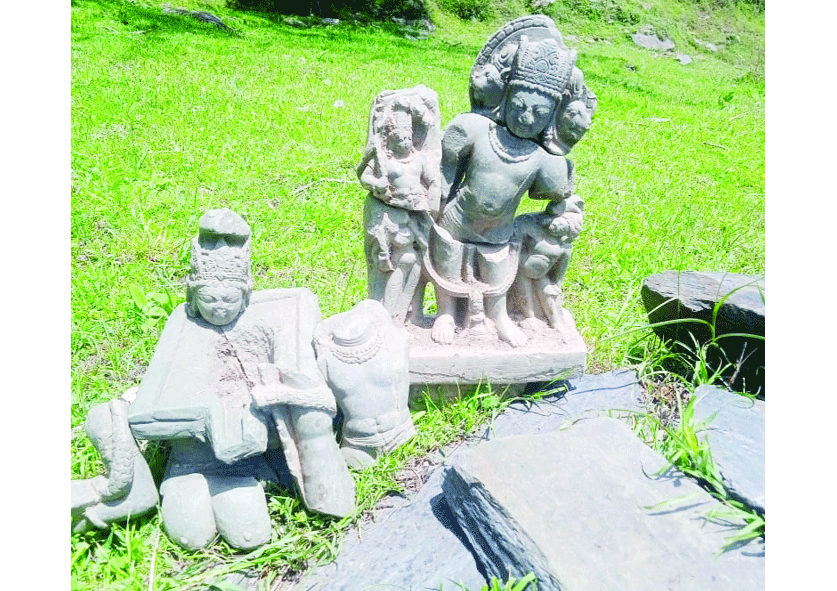
Several standing Vishnu sculptures were found preserved inside a small ancient stone temple in the Bhajmasta-Sumbar area. Interestingly, local people also referred to the shrine as Molmola Devta, similar to the shrine worshipped in Kanga.
This recurring association appeared highly significant and suggested that “Molmola” or “Molmala” may represent a localised folk form that gradually evolved from earlier Vishnu worship traditions.
The discoveries also helped establish a connection between two important sites in Ramban district: the ancient stone shrine in Kanga, where villagers recall that the principal deity once possessed a serpent hood and was stolen nearly forty years ago; and the similar stone shrine in the Bhajmasta-Sumbar region.
What proved most astonishing was the discovery inside the Bhajmasta-Sumbar shrine itself. After opening the stone doors of the temple, several genuine ancient stone sculptures of Vishnu were found preserved within the shrine, although many survived only in broken fragments.
This discovery appeared to strengthen the connection between the worship of Molmola Devta and an older tradition of Vishnu worship in the mountains of Ramban.
Description of the Vishnu Idols
The Vishnu idols discovered in the Bhajmasta area are remarkable because they depict the deity in a standing posture rather than the more commonly recognised reclining form associated with Vishnu resting upon Sheshnag.
The deity is shown wearing a sacred thread across the shoulders. Above the head rises a serpent hood consisting of six cobra hoods arching upward in a protective manner.
One hand holds the Chakra in a rosette-like form, while another carries the conch (Shankha), an important symbol associated with Vishnu. A third hand appears to hold a plough, which may indicate a regional or syncretic interpretation of the deity. Due to weathering and damage, the fourth hand remains difficult to identify.
Decorative motifs are visible around the waist, wrists, and forearms. Around the neck, the deity is adorned with a double-beaded necklace or garland. Curly locks of hair emerge from beneath an elaborately decorated Mukuta (crown), and floral ornaments are visible above both ears.
Other fragmented sculptures found within the shrine also display evidence of refined artistic workmanship and iconographic sophistication.
Legends of Molmola Devta of Kanga
Molmola Devta is regarded as the Kul Devta of the people living in the Kanga region of Ramban district. Local communities believe him to be an incarnation of Lord Vishnu.
According to local traditions, the original idol of Molmola Devta was stolen nearly forty years ago. Elders recall that the ancient idol depicted the deity beneath the hood of a serpent (Sheshnag), with protective hands extended over two children standing on either side.
Villagers also recount that on the night the idol was stolen, heavy rain and thunder struck the area, which people interpreted as a sign of divine sorrow.
Today, worship continues in the same ancient stone temple, where another old stone idol is worshipped with devotion.
A popular local legend explains that an ancestor from the area was producing charcoal near the banks of the Chander Bhaga River when the idol of the deity miraculously appeared within the charcoal. Because of this, local people believe that Molmola Devta emerged from fire. The jogan (attendant goddess) associated with Molmola Devta is known locally as Sargbagani Wali Mata.
Conclusion
By connecting folklore, migration traditions, oral narratives, and archaeological discoveries, it appears increasingly possible that Vishnu worship once held a more important place in the hills of Ramban than previously recognised.
Although this tradition gradually declined or transformed over time, traces of it may have survived within the cultural memory of local communities through the worship of Molmola Devta.
The discoveries in the Kanga, Pogal, and Bhajmasta-Sumbar regions highlight the importance of folklore in reconstructing the forgotten religious history of remote mountain regions.
At the same time, further archaeological surveys, scientific dating, and comparative iconographic studies remain essential before definitive conclusions can be established regarding the chronology and extent of Vishnu worship in Ramban.
The disappearance of ancient idols, fading oral traditions, and neglect of remote heritage sites also underline the urgent need for documentation and preservation of the cultural heritage of the Ramban district.
Acknowledgements: Special thanks to Sh. Sanjeev Verma, IAS, for his guidance, teachings, encouragement, and continued support throughout this work. I am also deeply thankful to Sh. Mulkraj Singh Katoch and Sh. Pradeep Singh Buthyal for their valuable support, local knowledge, and assistance during field explorations.
(The author is a Folklorist based in District Ramban)
 Follow our WhatsApp channel
