

Used water management emerges as major challenge
Majority of proposed STPs at bid evaluation stage
Mohinder Verma
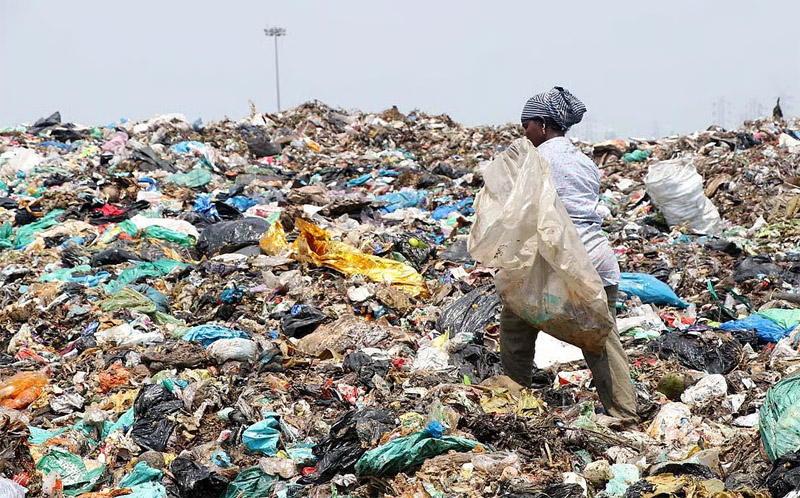
JAMMU, Sept 24: The Urban Local Bodies (ULBs) in Jammu and Kashmir continue to grapple with serious shortcomings in waste and sewage management, with as many as 21 ULBs still lacking solid waste processing facility. Moreover, a staggering 22.52 lakh metric tonnes (MT) of legacy waste has accumulated as of now.
Follow the Daily Excelsior channel on WhatsApp
The grim situation has been highlighted in an affidavit filed by the Government of Union Territory of Jammu and Kashmir before the National Green Tribunal (NGT) in compliance with directions regarding implementation of Municipal Solid Waste Management Rules, 2016 and other related environmental issues.
In the earlier affidavit dated October 15, 2024, it was revealed that 32 ULBs out of total 78 had waste processing setups (Material Recovery Facility and composting unit) with operational capacity of 446.24 tonnes per day (TPD). In the latest affidavit, the Government has mentioned that at present 52 ULBs (10 in cluster mode while Srinagar and Jammu have partial processing capacity) out of 78.
This means that 21 ULBs are still without any waste processing facility. The affidavit, however, claims that the remaining ULBs will achieve 100% waste processing capacity by June 2026, while Srinagar will reach this target by March 2027. Meanwhile, 22.43 lakh MT of legacy waste remains accumulated, as only 3.34 lakh MT was proce- ssed in the past year.
Regarding timelines for clearance of legacy waste, the Government has informed the NGT that all ULBs except Srinagar will achieve 100% clearance by June 2026. Srinagar, however, will take longer, with 100% clearance projected by March 2028.
On the NGT’s directive for decentralized composting during the construction of compost pits in balance ULBs, the affidavit said, “home-based and parks-based composting is being promoted through regular Information, Education and Communication (IEC) campaigns”.
On sanitary landfills, the Government said that one facility is already operational at Srinagar, while three more are under construction at Anantnag, Baramulla, and Jammu-the major ULBs of J&K. It further informed that Extended Producer Responsibility (EPR) funding for the disposal of Refuse-Derived Fuel (RDF) has been taken up with the Government of India, while the J&K Pollution Control Committee has been directed to ensure that cement plants utilize RDF.
The affidavit has further revealed that used water management remains one of the biggest challenges for J&K, primarily due to lack of institutional capacity. The entire Urban Environment Engineering Department (UEED)-the nodal agency for sewage and drainage works-has only 19 officers to handle the entire UT’s workload, which is grossly inadequate given the magnitude of the problem.
To address this, two expert agencies-Green Design of Gujarat and NCPE of Hyderabad-have been engaged to prepare Detailed Project Reports (DPRs) for 76 ULBs on a cluster basis, allowing co-treatment of septage from smaller ULBs near large Sewage Treatment Plants (STPs), as wastewater generation per ULB is too low to justify standalone STPs of reasonable capacity.
Further, UEED is being restructured to have district-wise setups. Two posts each of Chief Engineer and Superintending Engineer-one each for Jammu and Kashmir divisions-are also being created, with the proposal expected to be placed before the Cabinet soon.
However, as per the affidavit’s analysis, the majority of proposed STPs across the UT are still at the bid evaluation stage or undergoing technical vetting, thereby delaying the establishment of a comprehensive sewage treatment network. This delay has resulted in untreated wastewater continuing to flow into rivers, streams, and water bodies worsening pollution levels.
For Jammu city, the affidavit mentioned that the Interception and Diversion (I&D) network of the Tawi riverfront costing Rs 1.15 crore will be completed by March 2026, while the missing links of Jammu’s sewerage network will be completed by March 2027 at a cost of Rs 63 crore. Likewise, Package I and II of the I&D network of nine nullahs will be completed by December 2025.
“A new project for Jammu city at Belicharana is also being prepared to cover the remaining gap and will be taken up during the current financial year”, the Government added. It further informed that the total gap in all ULBs after these projects will still be 127.82 MLD, for which DPRs will be ready by October 2025 and projects will be executed before March 31, 2026.
About Ring Fence Account, the Government said, “entire Rs 350 crore plan has been recast as per the last directions of the NGT to cover the solid and used water management activities. Plan stands approved by the Chief Minister for ring fencing”.
 Follow our WhatsApp channel
